
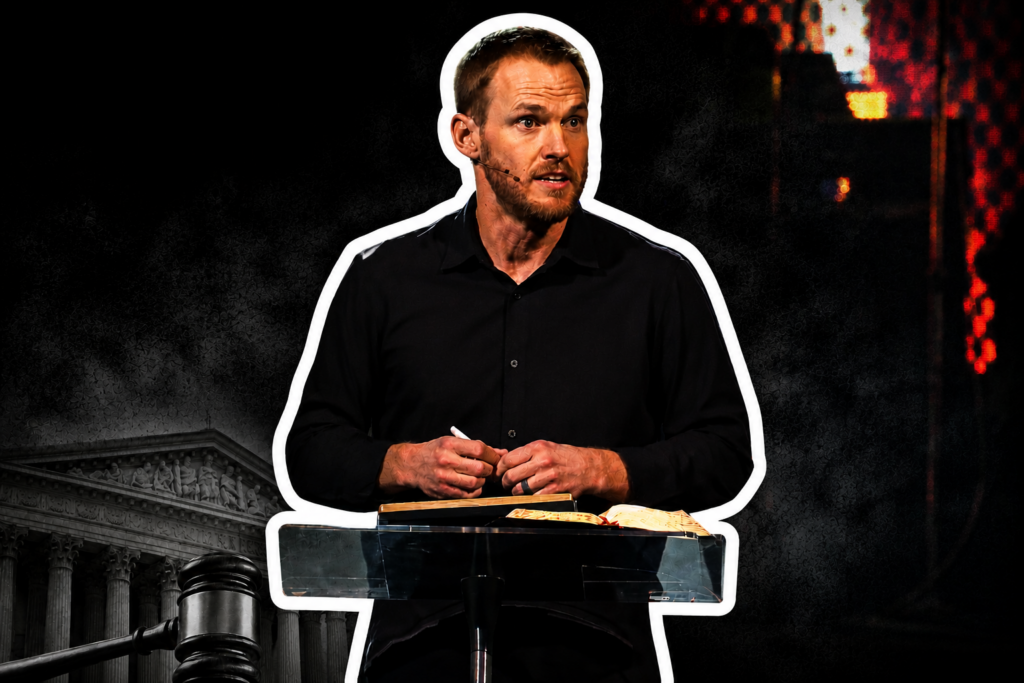

In a ruling issued Tuesday, the appellate court reversed a lower court dismissal in Gaskins v. McLean Bible Church and sent the case back to Fairfax County Circuit Court for further proceedings. According to plaintiffs’ attorney Rick Boyer, the decision represents a major rejection of the church leadership’s attempt to hide behind sweeping claims of ecclesiastical immunity.
The case stems from the now-infamous 2021 elder election battle at MBC, where critics accused leadership allies of David Platt of transforming what was supposed to be a congregational church into a tightly controlled elder-run machine. Plaintiffs alleged that members in good standing were illegally removed from voting eligibility under dubious claims they had missed “eight consecutive worship services without reasonable excuse,” conveniently silencing opposition voices ahead of the elder vote.
The original trial court largely accepted the argument that the dispute was untouchable because it involved church governance. But the Court of Appeals appears to have little patience for the notion that simply invoking the First Amendment automatically places church leadership above scrutiny.

According to the press release, the appellate court flatly rejected the idea that determining whether members missed eight meetings somehow drags courts into forbidden theological territory, writing: “This Court, and all other courts in Virginia, are surely able to count to eight without entering a ‘religious thicket.’”
That line alone is devastating to the broader argument advanced by MBC leadership and their defenders for years, namely that virtually any challenge to elder authority must be treated as an unconstitutional intrusion into church life.
Even more striking was the court’s warning that allowing churches to completely shield themselves from inquiry “could swallow the neutral-principles doctrine and present a great potential for abuse by religious entities endeavoring to shield their malfeasant employees from any secular ramifications.”
That language cuts directly against the increasingly common evangelical tendency to treat elder boards as effectively unreviewable so long as leaders invoke sufficiently spiritual language. In practice, many churches adopting quasi-presbyterian governance structures while retaining Baptist branding have functioned less like congregational churches and more like executive boards insulated from meaningful accountability.
The appellate court also reportedly affirmed that courts can determine whether a congregational church followed its own governing rules in order to establish whether “the majority ruled” according to those rules.
That point matters enormously because the fight at McLean Bible Church was never merely about personalities. It exposed the fault line inside modern evangelicalism between historic congregational accountability and the rise of managerial elder-rule systems that frequently consolidate authority while maintaining the outward appearance of member participation.
For years, critics argued that MBC leadership manipulated procedures, narrowed nominations to “three handpicked candidates,” and effectively treated dissenting members as obstacles to be neutralized rather than church members with legitimate voting rights. The Court of Appeals itself reportedly noted allegations that the board sought to “steal the election.”
The court stopped short of ruling on the ultimate merits of the plaintiffs’ claims, but it decisively rejected the idea that MBC leadership could simply wave the magic wand of “ecclesiastical abstention” and make the case disappear. Instead, the case now returns to circuit court for further litigation, including a balancing test over associational privilege and potential discovery into the alleged mass purge of dissenting members.
The ruling also stands in notable contrast to the disastrous outcome in the long-running lawsuit brought by former state executive Will McRaney against the North American Mission Board. In that case, courts largely accepted NAMB’s argument that the dispute was inseparably tied to ecclesiastical matters and denominational relationships, ultimately shutting the courthouse doors to McRaney’s claims under broad First Amendment protections. By contrast, the Virginia Court of Appeals signaled that not every church dispute magically becomes untouchable simply because leaders invoke “church autonomy.” Instead, the court emphasized that neutral legal questions still matter, particularly in a congregational church where leaders are allegedly accused of violating the church’s own constitution to maintain power. That distinction could prove enormously significant moving forward, especially as elder-rule advocates increasingly attempt to frame procedural and governance disputes as wholly beyond review the moment dissenters challenge leadership conduct.
For critics of the modern elder-rule movement, this ruling in Gaskins is likely to be seen as vindication after years of being dismissed as “troublemakers” merely for demanding that church leaders obey the church’s own constitution. And for churches increasingly tempted to function like insulated corporations governed by self-perpetuating leadership classes, the message from the Virginia Court of Appeals appears fairly simple:
You do not cease being accountable merely because you call your power structure “biblical.”




















6 responses to “Court to McLean Bible Church: You Are Not Above the Law”
Those who are still under the law cannot self-govern, and cannot effectively hold themselves accountable much less anyone else.
The solution is the true Gospel of Jesus Christ, which many churches these days have tossed out the window long ago.
Where there are truly born again Christians, just about any structure will work. Where there are not, no structure will work.
“42 And Jesus called them to him and said to them, “You know that those who are considered rulers of the Gentiles lord it over them, and their great ones exercise authority over them. 43 But it shall not be so among you. But whoever would be great among you must be your servant, 44 and whoever would be first among you must be slave of all. 45 For even the Son of Man came not to be served but to serve, and to give his life as a ransom for many.” – Mark 12:42-45
If any are unwilling to be held accountable, and defiantly and rebelliously refuse to obey the Lord and His word, then they are not born again Christians, much less qualified for the office of elder.
Deceit is sin. One who continues in sin, is not born of God. (1 John 3:4-10)
You know them by their fruit. And there are quite a few nasty thorns and thistles, seems to me.
To clarify, the structure defined by scripture certainly should be followed, but it is fairly loosely defined, and as everything in God’s word, it is so loosely defined for a reason. Probably because we’re not supposed to be getting too carried away with it, to the point where it becomes an idol, where the creation is worshiped rather than the Creator. It has significant potential to become a form of godliness that denies the power thereof (2 Tim 3). I.e., denies the power of the Holy Spirit, and thereby denies the Gospel. Structure is far less important than the condition of the hearts and minds of the men in those positions, as well as the congregation at large. Those who cannot govern themselves, because they are not truly born again, cannot govern a church, no matter the structure. Those who are truly born again can self-govern with very little structure at all. And so leadership within the Body of Christ is service. It is not “lording over” as the gentiles do.
To clarify the clarification, to try to fix my bad writing skills. Everything in God’s word is conveyed to us as it is conveyed for a reason. I did not mean to say everything is loosely defined. What I meant was if something is loosely defined it’s because God wants it to be loosely defined. If it’s defined in great detail, it’s because God wants it defined in great detail. And so on …
“Congregational” does not equal “democracy” or “no elders leading.”
It has a historical meaning different from how so-called Baptists use it today.
For the record: I’m no fan of Platt’s, but I do get annoyed with congregationalism being treated as a synonym for ecclesiastical democracy. Read The Cambridge Platform and LBCF.
“Congregational” does not equal “democracy” or “no elders leading.”
It has a historical meaning different from how so-called Baptists use it today.
For the record: I’m no fan of Platt’s, but I do get annoyed with congregationalism being treated as a synonym for ecclesiastical democracy. Read The Cambridge Platform and LBCF.