

The Southern Baptist Convention is once again preparing for a floor fight over women pastors.
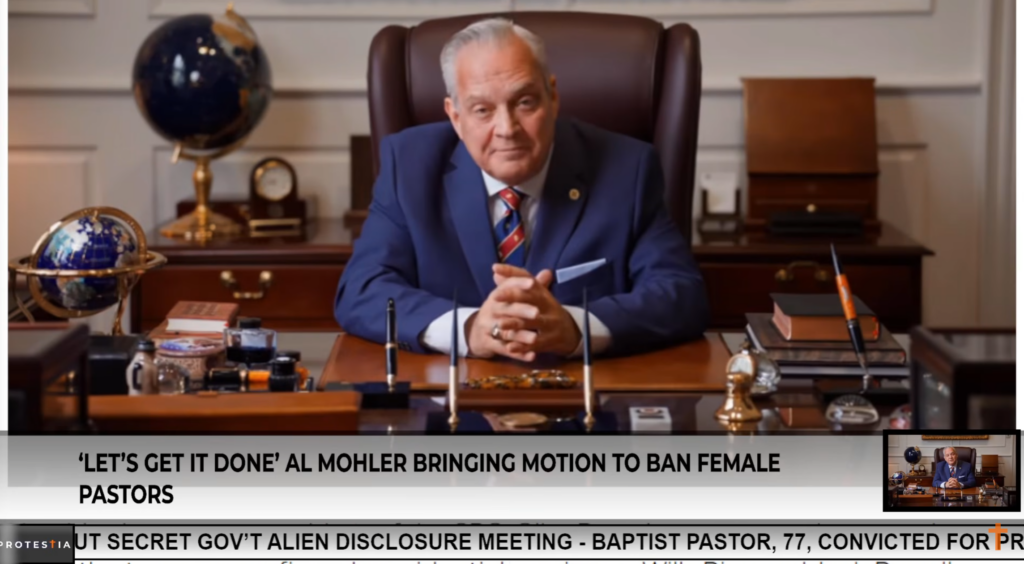
Ahead of next month’s SBC Annual Meeting in Orlando, Southern Baptist Theological Seminary president Al Mohler has announced plans to introduce a motion for the “Truth and Unity Amendment” to the SBC Constitution, an effort intended to clarify that cooperating churches may not “affirm, appoint, or endorse a woman serving in the office or function of pastor/elder/overseer, such as preaching to the assembled congregation.”
The proposal reflects a growing frustration among conservatives who believe the SBC has spent years trapped in an exhausting game of semantic evasion. Churches platform women to preach to assembled congregations while insisting they do not have “women pastors.” Others employ women in roles functionally indistinguishable from pastoral ministry under alternate titles like “director,” “minister,” “shepherd,” or “teaching lead.” Entire debates now revolve around whether a woman may preach occasionally, whether she may teach mixed adult classes, whether she may lead doctrinal instruction so long as she is “under elder authority,” or whether the issue is merely the title itself.

Mohler is correct that the SBC faces a crisis of clarity (even though, back in 2020, Mohler insisted there were no women pastors in the SBC). But the SBC’s confusion didn’t emerge out of the blue.
Ironically, much of the SBC’s (and conservative evangelicalism generally) inability to settle the question over women pastors has been enabled by the very elder-rule paradigm that conservative evangelicals spent the last several decades importing into Baptist life. The current SBC debate is not simply feminism pressing against biblical boundaries. It’s also the result of conservatives redefining pastoral authority in ways that unintentionally weakened their own theological position – a move that was part good intention and part distrust of the Spirit’s work in the hearts of ordinary congregants.
Historically, Baptists tended to understand the authority of the pastoral office as delegated through the ministry of the Word. Pastors preached, taught, exhorted, rebuked, defended sound doctrine, and shepherded congregations spiritually through Scripture. Their authority was ministerial and doctrinal. A pastor exercised authority precisely by teaching and applying the Word of God to the church.
This older Baptist instinct made the women pastor issue relatively straightforward. If pastoral authority was about preaching and doctrinal instruction, then women preaching to assembled congregations was naturally viewed as violating Paul’s prohibition in 1 Timothy 2:12. The issue was not merely whether a woman possessed a title or occupied an office on paper. The issue was the act itself.
But over the last several decades, Baptist ecclesiology underwent a profound transformation at the intersection of the modern seeker-sensitive movement and its reaction.
Beginning especially in the 1980s and accelerating through the 1990s and 2000s, many Baptist churches increasingly embraced elder plurality and elder-rule models heavily influenced by Presbyterian polity and broader Reformed ecclesiology. Simultaneously, the church growth movement reshaped the practical structure of evangelical churches around executive leadership, strategic vision casting, and CEO-style organizational governance.
Though these two streams often came from different theological instincts, they converged in practice.
The church growth movement emphasized visionary leadership, executive decision-making, centralized authority, and institutional scalability. Meanwhile, the Bible church stalwarts and the “Young, Restless, and Reformed” movement emphasized recovering “biblical eldership,” often through plural elder boards functioning as governing authorities over congregational life.
The result was a dramatic redefinition of how many conservative evangelicals understood pastoral authority.
Pastors increasingly became organizational rulers, strategic overseers, executive leaders, institutional governors, and board members. The language of “shepherding” gradually merged with the language of corporate management. Churches developed “executive pastors,” “vision pastors,” “campus pastors,” and elder boards functioning much like corporate leadership teams. In many churches, some elders rarely, if ever, preached. Their authority derived not from doctrinal instruction, but from participation in institutional governance.
That shift fundamentally altered the logic of complementarianism.
Once pastoral authority is defined primarily as governance rather than doctrinal instruction, preaching itself no longer needs to be viewed as inherently authoritative. Authority becomes institutional rather than ministerial. The question in terms of the Bible’s standard for exercised authority ceases to be, “Who is teaching the church?” and becomes instead, “Who ultimately governs the organization?” And once teaching/preaching is severed from pastoral authority, restricting women from teaching/preaching no longer makes biblical sense.
Suddenly, churches could argue:
“She’s not a pastor.”
“She’s under male authority.”
“She’s not an elder.”
“She’s accountable to the elder board.”
“The elders approved the sermon.”
“The men still govern the church.”
Under this framework, women may publicly preach, teach men, lead doctrinal instruction, and function practically as pastors so long as they remain formally (although often not openly) subordinate to male institutional leadership (with the men in charge relying on professional credentials or “gifting” as the plausible, coincidental reason they are in charge).
But that distinction only works if authority is fundamentally located in governance structures rather than in the teaching itself.
This is where the modern elder-rule paradigm unintentionally destabilizes complementarianism. Scripture does not treat doctrinal instruction in the gathered church as a spiritually neutral activity requiring authorization from some higher governing board before it becomes authoritative. The teaching itself carries authority.
This is precisely why Paul joins teaching and authority together in 1 Timothy 2:12: “I do not permit a woman to teach or to exercise authority over a man.”
Modern debates often attempt to separate these concepts, treating “authority” as though it refers only to institutional office-holding or formal governing status. But Paul’s argument makes far more sense if doctrinal instruction itself is understood as an exercise of spiritual authority within the church.
The modern elder-rule framework frequently treats authority as something detached from the ministry of the Word. Authority belongs to the plurality. Authority belongs to the institution. Authority belongs to the governance structure. Therefore, the actual act of corporate doctrinal instruction can supposedly be delegated to women so long as men retain final administrative control.
But this distinction would have sounded deeply foreign to earlier Baptist instincts.
Historically, Baptists did not need elaborate taxonomies separating “ruling authority” from “teaching authority,” or distinguishing between “teaching elders” and “ruling elders,” because pastoral authority itself was fundamentally tied to the handling of Scripture.
Indeed, many of the categories now common in conservative evangelicalism would have sounded bizarre to earlier generations:
- pastors who rarely preach,
- elders who never teach,
- women who regularly preach but supposedly possess no authority,
- “pastoral” ministry without doctrinal oversight,
- doctrinal teaching without pastoral function,
- preaching treated as spiritually non-authoritative so long as governance remains male.
These distinctions arose because modern evangelicalism relocated authority away from the ministry of the Word and into institutional governance structures.
Defenders of elder-rule systems frequently appeal to 1 Timothy 5:17: “Let the elders who rule well be considered worthy of double honor, especially those who labor in preaching and teaching.”
In Presbyterianism, this text is used to justify the two categories of ruling and teaching elders. In reformed-leaning Baptist or nondenominational contexts, this results in never-ending innovation in pastoral categorization. Administrative pastors, “Next Gen” pastors, technology pastors, and a host of “directors” of everything from children’s ministry to church planting.
From there, many churches conclude that ruling, governance, administration, and oversight constitute the essence of eldership, while preaching is merely a specialized subset of elders’ work. But that reading is far from necessary.
Paul does not clearly establish two separate offices or fundamentally distinct elder categories in this passage. Rather, he established that elders were entitled to make their living by the gospel ministry (1 Cor. 9:11-18) when they rule well – that is, consistently and properly divide the Word of God (rule) as a referee properly applies the rules of a game, or as a measuring tape/ruler correctly measures the length of raw materials. The shared characteristic of all elders remains doctrinal stewardship.
The New Testament consistently roots eldership in the ministry of the Word:
- elders must be “able to teach” (1 Tim. 3:2),
- they must “give instruction in sound doctrine and also rebuke those who contradict it” (Titus 1:9),
- they must guard the flock from false teaching (Acts 20:28-31),
- they shepherd through exhortation, correction, and doctrinal care.
Even the concept of “ruling” itself is often misunderstood.
The Greek term proistēmi does not inherently carry modern corporate connotations of executive management or institutional bureaucracy. It can refer to leading, caring for, managing responsibly, or standing before others in guidance and protection. The pastoral “rule” envisioned in Scripture is not primarily about strategic business leadership or administrative efficiency. Elders “rule” chiefly through faithful handling and application of the Word of God.
They “rule” in the sense that a judge rules on matters of truth and error.
Ironically, the more modern evangelicalism emphasized eldership as institutional governance, the easier it became to justify women publicly preaching so long as men retained organizational oversight behind the scenes.
This helps explain why the current SBC debate often feels incoherent.
Many conservatives instinctively recognize that something is wrong when women regularly preach to assembled congregations while churches continue claiming to uphold complementarianism. But because modern elder-rule paradigms have relocated authority into governance structures, conservatives now struggle to articulate why the preaching itself constitutes a problem.
The debate devolves into endless arguments over titles, organizational charts, reporting structures, and technical definitions:
What constitutes a “pastor?”
Does occasional preaching count?
What about a “women’s pastor?”
Can women teach men outside Sunday morning worship?
Can women preach if the elders approve the content?
Can women function as “ministers” without holding the office of elder?
Can women preach at conferences but not church services?
Can they exhort but not “authoritatively preach?”
All of these distinctions emerge from the same underlying confusion: authority has been detached from the ministry of the Word and relocated into institutional governance.
The result is a complementarianism increasingly reduced to male managerial control rather than biblical patterns of doctrinal shepherding.
In practice, many churches no longer object to women teaching men. They object only to women occupying the final layer of institutional oversight, and this layer is increasingly occupied by soft institutionalists rather than masculine doctrinarians.
Recovering biblical fidelity at the local church level will require more than constitutional amendments and parliamentary fights at annual meetings. It will require recovering a biblical understanding of pastoral authority itself.
Note: For a longer discussion of the emergence of the “Presbygational” church, check out the three-part series at Reformation Journal here.














7 responses to “Op Ed: How the SBC’s Newly-Discovered “Elder Plurality” Enables Women “Pastors””
Very good observations, David. But I believe it goes deeper. It reminds me of one time in college, in the hall before class, a classmate and I were chatting and the subject of big-E evolution came up. He said Evolution is absolutely proved because these fruit flies changed color over several generations. And I responded, how do you know those genes weren’t present all along? He had no answer. Right, we can’t know whether or not there’s an actual mutation if we don’t know what genes existed prior. If there were just a very tiny number of flies somewhere that had that latent gene, then the entire theory that there was a beneficial mutation would be entirely debunked.
In the same manner, I believe much of what has happened in recent decades is more a matter of wickedness of the heart of men that existed prior, and that has manifested. And now it’s just more evident. Now the difference is more obvious. Now the chaff is more separated from the wheat. It’s those who have always seen church as just a social institution of mankind.
Why the focus on multiple elders? Well, because there have been and are many single-elder churches where that single elder was and is a wicked man, himself not truly born again.
To focus too much on structure and the authority of men is tantamount to being back “under the law”. It is the same. It can deny the Gospel and the power of the Holy Spirit to directly address and cure the wickedness of the heart, rather than simply containing that wickedness as it was under the law.
What we’re seeing is a more obvious manifestation of wickedness that has existed from the beginning. The wickedness that tells us we’re ok if we just ignore the instructions from God that we don’t like. Mankind has a latent sin gene. Right. It’s been there since Adam sinned. He had only one single “shall not” instruction. Just one. And he still ignored the instructions from God, that he didn’t like. That’s the source of it all. Wicked individuals who ignore the parts of God’s word they do not like have always done so. That wickedness has always been there. Now it’s just more obvious, and now we see more clearly who’s chaff and who’s wheat.
Just as the question about those latent fruit fly genes, so is the question about latent wickedness. Wickedness is not environmental. It is not a product of some mutation to our environment. It is inherent from Adam. It’s been there all along, regardless of structure and environment.
If churches emphasized the scriptural command for women to remain silent in church it would shut down the idea of women preachers and teachers; that’s where the battlefront should be engaged.
Women pastors are the beginning of the end for the SBC, and every other church that buys it. Women have nearly destroyed the US already, and it you want a preview, look at what feminism has done to marriage, children, and the declining birth rate. Women will go for anything that is expedient, and the Bible is no exception.They already inhabit most other Protestant churches, and every kind of depravity is evident there. Women are not bad, they are just not meant to lead in the church, or military. Women leading churches will destroy them, and the faithful.
Post hoc ergo propter hoc.
I’d be willing to bet that if you surveyed all of the churches that have moved to a plurality of elders in the last 20 years you would find very, very few churches that allow women to preach or put have women with the title “pastor.” This op-ed, while well-written, doesn’t provide any evidence that proves its premise. Sounds like it could be possible, but I would need to see a large list of churches that match this elder-led/female preaching link,
In fact, I think – but likewise can’t prove – that the opposite is true. Churches who move to a plurality of elders typically do so for Biblical fidelity and lean heavily on the qualification of an elder as being able to teach, also linking that teaching not just to being able to teach a Sunday School lesson, but teaching with authority to the congregation, thus barring women from serving as elders and/or preaching to the congregation. Those who move to a plurality of elders do not view elders as just governmental/organizational oversight but as pastors. I don’t believe the link suggested in this op-ed has merit.
I agree. I serve in a church that has the governing body of Elders who do the business of the church and then the deacons who serve the people. How is that wrong? I was born, raised and educated in the SBC (including SBTS before the great Fall of 1993) and I like this structure. The ENTIRE business of pastors running their churches like CEOs came out of the seeker sensitive, purpose driven drivel that started in the late 1980’s and flourished in the 1990’s. I remember the first church I worked at when we were told by the pastor and a businessman member that we were now going to “treat our members as our customers” and I thought “what the heck?!”
I tried to sound the warning bells for years to no avail. I was told “God is doing a new thing” as pastors became more and more concerned with “nickels and noses.” The American Church’s current state is a direct result of that movement overtaking the Church across the country because as Rick Warren said we needed to let the people outside the church tell the church what they wanted. As Jack Wilkie wrote on his Substack this week “worship isn’t for visitors.” and a great article entitled “4 Lessons You’re Teaching Your Kids About The Church.” My music ministry has watched this decline for the past 40+ years. It has been sad to watch has Satan slithered into the church (and I have served in all mainline denominations+), but told that “this is what God is doing now.”
Why this is wrong.
1. The PCA and the LCMS do not have female elders. Meanwhile it was the Baptist and other evangelical churches that follow your preferred congregational polity that gave us the likes of Beth Moore.
2. The Bible gives 3 offices: pastor, teacher and deacon. The same Greek words are consistently used for them and they were clearly meant to be distinct. Ruling elder = pastor. Teaching elder = teacher. Administering elder = deacon. The terminology and perhaps the implementation might be wrong but the division of labor actually follows the Bible. Instead, it is combining them into “pastor-teacher” and especially “pastor-teacher-deacon” has no scriptural basis. It inevitably results in people who have only spiritual gifts in 1 or at most 2 of those areas relying on human ability for the others. Even when it succeeds, the result is very often a church that develops a cult of personality around the pastor. Among other problems, such churches tend not to survive very long when said pastor moves on.
I think a critical distinction should be made here: Elder-led vs. Elder-rule. They both operate under the premise of a “plurality” of elders, but their practice, heart, and tone of leadership are very different.
The elder-rule approach has been one of the worst applications of church polity, introducing a governance that breeds spiritual abuses, unhealthy focusses on the spiritual gift of giving, program-driven as a seeker model, nickels and noses, elevating a single senior preacher (visioncaster), and embracing worldly growth models from Willow Creek and Saddleback, etc. Truly operating more like a non-profit board of elders rather than a group of spiritual shepherds. And don’t forget the abuses of James MacDonald, a senior man ‘more senior than others’ that demanded 51% controlling interest of the ‘board.’ It is in this elder-rule environment that biblical fidelity was compromised regarding the role of women.
On the flip side, the plurality of elder led churches (perhaps modeling the Alex Strauch Biblical Elder approach) tend to reject a single personality competing for power (James MacDonald, Mark Driscoll, Jeff Schwartzentraub, and the list is long…) and unites primarily around the focus of shared spiritual leadership, but then secondarily handles the business of the church. Because the focus is first on the word and prayer, this model of leading rather than ruling leads to better biblical fidelity, including clarity regarding women’s roles.
Just because there is a plurality of elders, does not mean it is biblical, spiritual leadership. I have sat under both styles of leadership, and the elder-led model exhibited true spiritual leadership, and biblical fidelity, through love.