
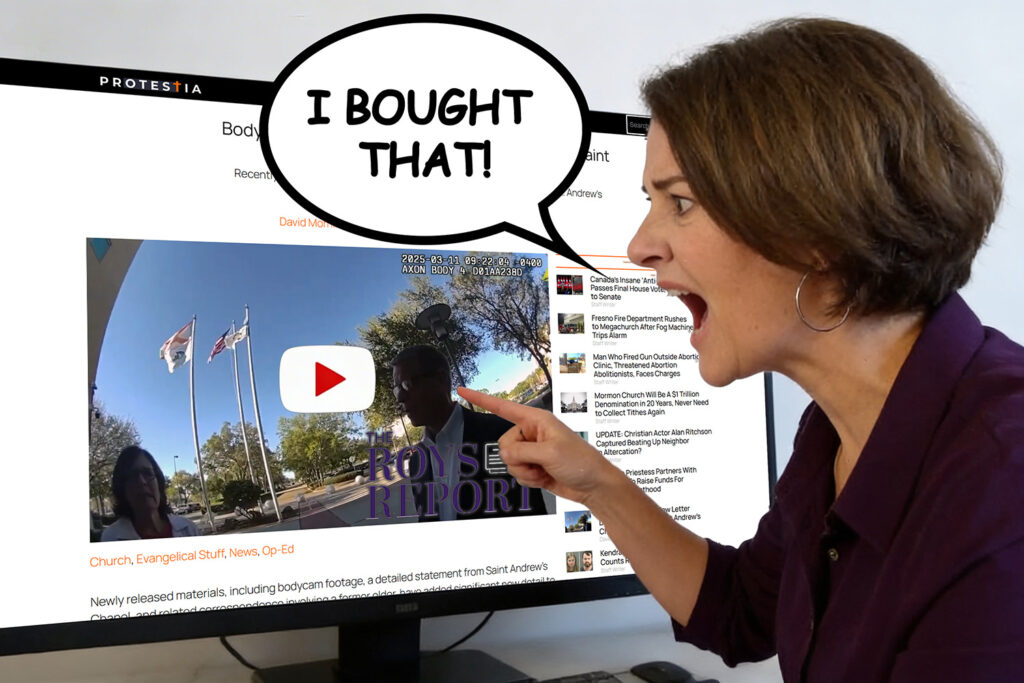

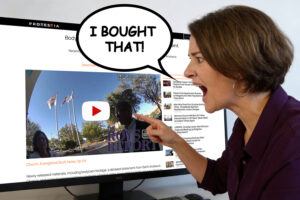
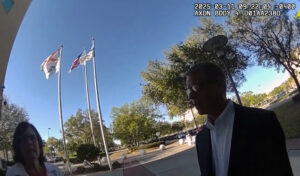
In a move that is nothing if not vintage Julie Roys, her YouTube channel issued a copyright strike against Protestia after we republished her publishing of police bodycam footage of Steve and Heidi Nichols talking to a Seminole County Sheriff’s deputy in May, 2025.
The video in question, of course, was not proprietary reporting or original creative work, but raw bodycam footage obtained and published in connection with former Christianity Today Senior News Editor Daniel Silliman‘s reporting on the recent kerfuffle between St. Andrew’s Chapel and Steve and Heidi Nichols. Roys (or Silliman, one of her growing team of writers) embedded the video directly in Daniel Silliman’s article, using YouTube as the hosting platform. Protestia, in turn, republished that same footage on our own channel, retaining Roys’ watermark to clearly indicate the source.
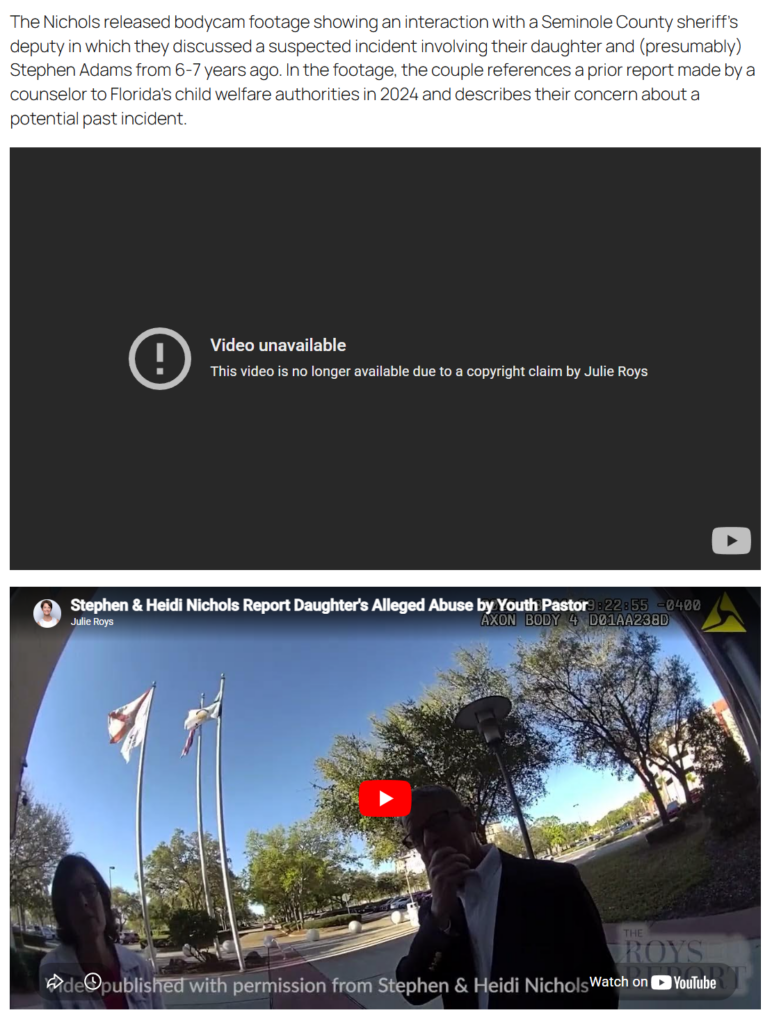
Despite this, Roys filed a copyright claim with YouTube, resulting in the removal of our video.
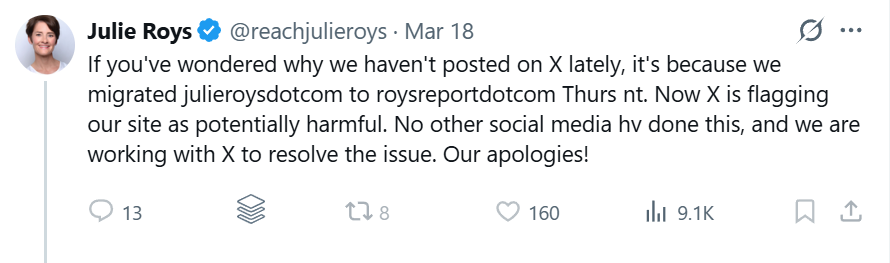
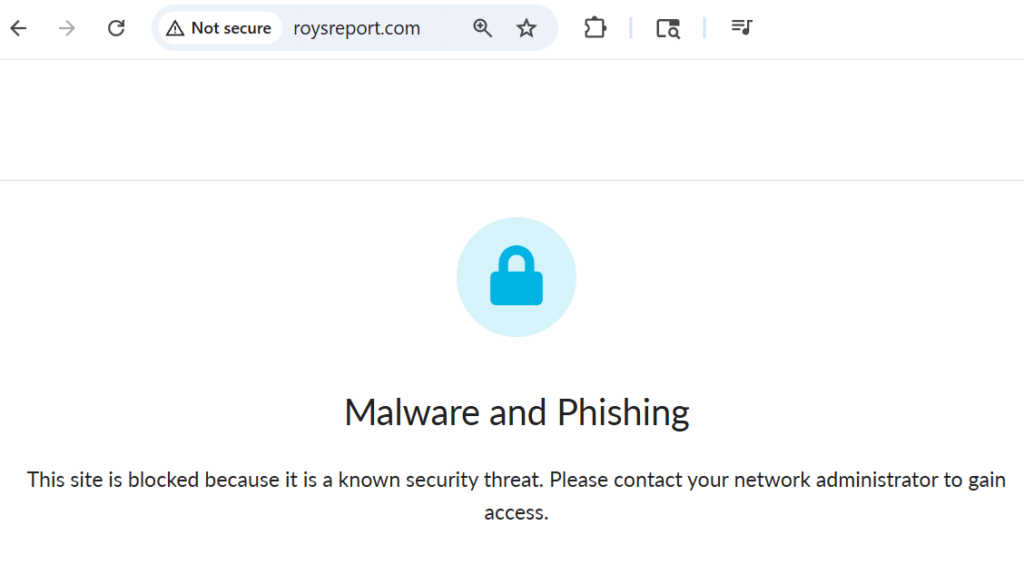
Our re-uploading of the public record footage was done in the public interest, as single sources of material hosted by third-party sites like YouTube are notoriously unreliable and subject to access being removed at the whim of the uploader. Even Roys’ own website recently experienced security issues, as an apparent redirect from julieroys.com to roysreport.com caused several DNS security systems to flag the site as a “known security threat,” with major social media traffic sources like X reportedly blocking links to her site.
Public Record, Private Control
Of course, the underlying footage is not owned by Roys. It is publicly-owned material that any citizen, journalist, or outlet has the right to obtain and publish. Yet by abusing YouTube’s copyright enforcement system, Roys is either:
- Trying to financially harm someone she doesn’t like
- Trying to protect the monetization of a video concerning suspected sexual abuse
- or claiming she owns the footage of the Nichols discussing abuse suspicion with a law enforcement officer, and should have the right to control its distribution.
While platforms like YouTube routinely act on facially valid copyright claims without adjudicating deeper legal questions, the practical effect is clear: an outlet presenting itself as a public-interest watchdog is now asserting control over the distribution of public-record material.
Note: After I responded to the copyright strike by emailing Roys, outlining the above information, and requesting removal/retraction of the copyright strike, she declined to remove it, and instead wrote that she believes Protestia “does more harm than good and takes liberties with the truth. As a result, I don’t want anything with our branding on your site.” She further wrote, “You are free to do what the rest of the journalism profession does and file an open records request with the sheriff’s office, pay the $150 fee and get your own video to post,” apparently not realizing that the $150 fee covers the labor in finding, redacting as neccessary, and preparing for the video footage for public release (not for licensing rights to it), and that the $150 she spent was tax-exempt donor money, ostensibly donated for the public good.
Of course, her desire to keep her branding off of Protestia has nothing to do with intellectual property rights, copyright, or the purpose of YouTube’s copyright system. We filed a pending counterclaim based on fair use, and in the meantime, have simply embedded her video underneath our stricken copy of the video, meaning her branding is, of course, still there(and here 👇).
A Question of Consistency
This move is particularly hypocritical given the nature of Roys’ own work, which frequently involves the aggregation, publication, and analysis of third-party materials related to church controversies and abuse allegations.
Protestia did not obscure the source, alter the footage deceptively, attempt to pass the material off as original reporting, or claim ownership of the bodycam footage. To the contrary, we preserved Roys’ own watermark, which is something that, in most journalistic contexts, would be considered more than sufficient attribution. The question, then, is not whether YouTube’s largely automated system will honor a copyright claim—it often will—but why a platform supposedly “restoring the church” would weaponize such a system to restrict dissemination and ongoing access to material ostensibly offered for transparency and public interest rather than the interests of its donors.
Donor-Funded, Not Audience-Supported
The incident also comes amid a dramatic and telling shift in Roys’ funding.
Prior to securing 501(c)(3) non-profit status in 2022, Roys solicited contributions via a fiscal sponsorship (a “special relationship,” as Roys described it) with Judson University. Even though Roys styled her operation as a non-profit, complete with basic financial disclosures and a board of advisors (rather than directors), contributions directly to Roys would not have been tax-deductible unless sent through Judson University. Fiscal sponsorship of this kind legally required the sponsor to control all donated funds, which were not to be earmarked for a particular person. Yet Roys’ link said donations were to “enable the Roys Report to equip believers with the truth so the church can be reformed and restored. Donations are tax-deductible through a special partnership with Judson University,” reasonably leading potential donors to believe that they were able to send tax-deductible donations directly to Roys.
Upon securing 501(c)(3) status, The Roys Report Nfp (not for profit) reported contributions of $122,497 in 2022, $319,095 in 2023, and $185,722 in the first half of 2024 (this was a 6-month period, representing $371,444 when annualized), and culminating with a surge to $693,048 in fiscal year 2025 (July 2024 to June 2025).
Tellingly, nearly all of the increase came from donors rather than program revenue, and the leap in contributions coincides with a leap in the number of contracted writers/editors like Daniel Silliman. The organization reports no meaningful earned income streams – no subscriptions, services, or product sales – relying instead almost entirely on unnamed donors. While not unusual for nonprofits, the lack of donor transparency makes it difficult to assess who is underwriting the outlet’s work and priorities.
The organization’s expense profile also raises questions about efficiency. Despite operating a relatively simple digital publishing model (blending original reporting with syndicated content), and organizing a small yearly conference, Roys reports tens of thousands in “office expenses” and technology costs, alongside significant administrative overhead. While such categories can encompass a range of legitimate services, the overall cost structure more closely resembles that of a larger institutional newsroom than a lean, reader-driven outlet. In the absence of meaningful earned revenue, these expenses highlight the degree to which the operation does not meet the financial profile of a reader-supported outlet growing organically with its audience. Rather, it is consistent with a model sustained by a relatively small number of large donors underwriting operations directly.
For an operation like Protestia, both a loss of traffic from X (like, if our website was flagged as dangerous), and copyright strikes on YouTube represent a real loss in revenue. Such issues would not be a concern if we were funded by deep-pocketed donors.
About the Article Itself
That same pattern of controlling narrative through selective presentation was evident in the Roys Report article that featured the bodycam footage in question.
In Daniel Silliman’s article, unsubstantiated allegations were presented against former St. Andrews Chapel teaching elder Stephen Adams, framed in a way that strongly implied an active law enforcement investigation.
The headline alone, suggesting that a Florida sheriff was “investigating,” creates the impression that Adams was under formal scrutiny. Yet buried near the end of the article is the key admission: the investigator merely forwarded the matter to other jurisdictions, indicating that no formal investigation had actually been opened.
The sequencing within the piece compounds the problem. Adams’ resignation is followed immediately by a reference to an investigator “having more questions,” inviting readers to infer that he stepped down to avoid inquiry, despite the fact that he had already been cleared months earlier.
The article itself relies heavily on claims from now-adult men that were never pursued criminally and were not pressed or maintained with the PCA committee that ultimately found Adams innocent. Missing almost entirely is the context in which those allegations arose: reported not by the alleged victims themselves, but by a friend group of mothers and former members during a period of documented conflict within the church, including apparent efforts to solicit accusations against Adams.
Additional relevant connections are likewise absent from the article, including ties between at least one source and individuals directly involved in prior disputes with church leadership. While these details may not prove anything on their own, they are nevertheless material to understanding the broader context.
Taken together, the article does not simply report claims; it arranges them. Timelines are compressed, implications are suggested, and context is selectively omitted in a way that consistently points toward a predetermined conclusion. Which makes the copyright strike all the more telling.
Because when an outlet not only frames a narrative this way, but then uses platform enforcement tools to restrict how the underlying source material can be redistributed or examined by others, it moves beyond reporting into something closer to narrative control.
And as history has demonstrated, this narrative control is often accomplished through confusion, character assassination, and attacks against institutional, male church leadership. Or you know, the standard Roys Report formula.
Previous reporting on Roys:
Julie Roys Beclowns Herself Going After John MacArthur (Again)
Judge Julie: Accusing a Shepherd
Julie Roys Funded by Progressive Baptist College Steeped in Wokeness
Roys vs MacArthur: Anatomy of a Smear
Julie Roys’ Fake Charity is Abusing Tax Laws, Subjecting Her Supporters to IRS Prosecution
The Spiritual Abuse of Julie Roys
The Last Piece of the Roys Puzzle
Julie Roys Pulls Out of Own Conference After Being Accused of Spiritual Abuse
Julie Roys Invites Notorious Racist to Speak at Her Conference
Muckraker Julie Roys Equates John MacArthur and Master’s Seminary to Benny Hinn
Former ‘Christianity Today’ News Editor Daniel Silliman Joins The Roys Report













One response to “Julie Roys Abuses YouTube Copyright System to Remove Nichols Bodycam Footage From Protestia Article”
Two words: use Rumble
jewTube will of course side with (((Julie Roys))) par for the course