
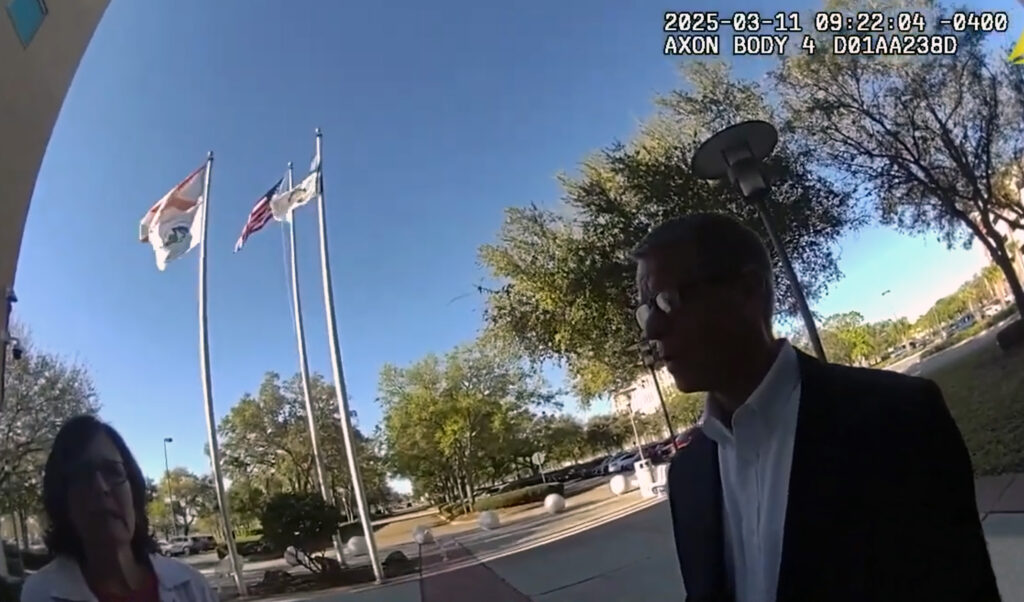

Newly released materials, including bodycam footage, a detailed statement from Saint Andrew’s Chapel, and related correspondence involving a former elder, have added significant new detail to the ongoing dispute surrounding the excommunication of Stephen Nichols and his wife. The new information clarifies key aspects of the timeline while also introducing new points of contradiction between the parties involved.
Bodycam Footage Shows Police Interaction
The Nichols released bodycam footage showing an interaction with a Seminole County sheriff’s deputy in which they discussed a suspected incident involving their daughter and (presumably) Stephen Adams from 6-7 years ago. In the footage, the couple references a prior report made by a counselor to Florida’s child welfare authorities in 2024 and describes their concern about a potential past incident.
During the interaction, the officer indicates that without a direct statement from the alleged victim or specific details regarding an incident, it would be difficult for law enforcement to proceed with an investigation. The Nichols express uncertainty about filing a formal police report under those circumstances, while also discussing the seriousness of their concerns. The footage confirms that the Nichols made contact with law enforcement, though it appears that a police report was not filed at that time.

Importantly, the Nichols indicate that the suspected abuse occurred when their daughter was 11 or 12-years old, at the hands of a former youth pastor (presumably Adams). This means that she may have been a legal adult while the Nichols were trying to get the church to take action against Adams on her behalf (Update: the daughter was not an adult at the time of the bodycam discussion with the deputy). The Nichols admit in the video that their daughter was not willing to report the abuse to authorities, but that they might be able to get her to cooperate because their relationship with her was “really good right now,” indicating that there had likely been ongoing relational difficulties between them.
At no point in the conversation with the officer do the Nichols seem to indicate whether or not their daughter was a legal adult, although it’s possible the information was given but redacted from the footage.
More than once, the Nichols indicate that they are seeking evidence to present to the church, yet they express reluctance to file an actual police report, which would place them in public record as reporting parties (presumably against the wishes of their daughter, who, according to them, explicitly did not want to report). Interestingly, Stephen Nichols says, “I almost wonder if we should just have a record that we reported this, even if it goes nowhere,” and after the officer reminds them that a police report would place them in the public record, Heidi Nichols requests (presumably in the interest of gathering evidence for the chuch) to take a picture with the officer, before explaining that they are trying to gather evidence to get the church to act.
Church Responds With Detailed Timeline
In a March 20 statement, Saint Andrew’s Chapel provided its most detailed account to date of the events leading to the excommunications. According to the church, in 2024, a former family member (presumably the Nichols) began “expressing hostility” towards Stephen Adams, yet did not bring the underlying matter to the church or report it to the authorities. The church reports not initially understanding the nature of the concerns being raised until early 2025, at which point they say they learned the family’s suspicions involved an unspecified sexual allegation against Adams.
The church states that it reported the matter to the Seminole County Sheriff’s Office based on the information it had at the time (and encouraged the Nichols to do the same) and that the prior report to Florida’s Department of Children and Families by the Nichols’ daughter’s counselor did not result in an investigation. The statement further asserts that no specific incident, date, or location was ever provided that would allow either church leadership or law enforcement to conduct a meaningful investigation.
According to the church, Adams was temporarily removed from ministry roles involving minors while the situation was reviewed and later reinstated after no grounds for further action were found.
Conflicting Accounts Remain
These accounts stand in tension with Nichols’ earlier public statement, in which he said that the central issue in the dispute is a reported suspicion of sexual abuse involving his daughter. Nichols has stated that he brought these concerns to church leadership in January 2025 and has emphasized that the allegation lies at the heart of the conflict.
The newly released materials highlight a central disagreement between the parties over both the nature of the allegation and the extent to which it was sufficiently defined to warrant further action by church leadership or law enforcement.
Related Case Raises Broader Questions
Additional documents related to the excommunication of former elder David Zima, issued the same day as the Nichols’ excommunication, suggest a broader pattern in the church’s handling of the situation. In a letter to the congregation, Saint Andrew’s Chapel similarly stated that Zima was removed from office and excommunicated for contumacy—defined as a refusal to submit to the authority of the church—rather than on the basis of adjudicated charges (which the church claims Zima avoided).
However, a separate response from Zima’s new PCA congregation argues that Saint Andrew’s Chapel forfeited its ecclesiastical jurisdiction when it withdrew from the Presbyterian Church in America in December 2025, and that any subsequent disciplinary actions against former members are without authority. This introduces a significant dispute over whether the church retained the authority to continue disciplinary proceedings after leaving the denomination.
A Dispute With Multiple Layers
It remains unclear what, if any, clarity will be forthcoming from PCA leaders on the validity of the church discipline process once a church leaves the denomination, but, practically speaking, the excommunication of the Nichols and Zima is merely a formality so long as other churches are willing to accept them into membership.
Although more details will likely emerge, evidence has yet to surface that St. Andrews Church acted inappropriately in anything other than the possibility that it lacked ecclesiastical jurisdiction over the Nichols and Zima when it pronounced them excommunicated. This will likely remain in dispute, but practically, it is legally inconsequential.
More importantly, the evidence available indicates that Stephen Adams was accused of criminal conduct, but both the church and civil authorities found the accusations to be unsubstantiated. How the Nichols may or may not have interacted with Adams prior to revealing the nature of their concern to the church seems to be the impetus behind the church’s attempt to discipline them, but as there remains no common ecclesiastical jurisdiction between the involved parties, we expect more information to be released by the parties in the process of clarifying the record.
Note: A previous version of this article posited that the Nichols’ daughter would have easily been an adult at the time the counselor reported and at the time the Nichols spoke to the sheriff’s deputy. This was due to an inadvertent transcription error that rendered “11 or 12” to be “2011 or 2012.” We apologize for the error.







7 responses to “Bodycam Footage, New Letter Deepen Dispute in Saint Andrew’s Chapel Conflict”
It’s difficult to understand what’s being said in the video, but I believe they said the alleged abuse occurred when she was 12 or 11 years old, rather than in the years 2011 or 2012. According to Roys, an article published yesterday, she is now 17 years old, which would put the alleged abuse in about 2020-2021.
It’s all about as clear as mud.
I’m not going to make a bunch of posts here, but I will say that I also do not understand why there cannot be an investigation without the victim explicitly stating that a crime occurred. It seems to me the Constitutional test would be probable cause, reasonable suspicion, according to the 4th Amendment. No different than an officer having probable cause that a crime could be happening, he has cause to go investigate. I don’t understand the requirement for the victim to submit what the officer said is called an “admission”. And I’m all but certain that’s not a standard the church should be going by. I don’t know of any scripture that speaks of any such requirement. If the church didn’t investigate, it’s unclear why. Deut 19 says no “charge” is to be admitted without evidence. It doesn’t forbid investigations.
Just searching Bible Hub for the word “investigate”, to make sure what I said is correct.
Esther 2:22-23… “… he told it to Queen Esther, and Esther told the king in the name of Mordecai”
Deut. 17:1-4 … ” … and it is told you and you hear of it, then you shall inquire diligently [investigate]”
Again in Deut. 13:12-14 … “If you hear …”
There are several more examples. The concept would be very similar to what is now called probable cause or reasonable suspicion. This notion that there cannot be an investigation without evidence prior, is not Biblical (if that’s indeed what the church did – it’s not exactly clear). It’s also nonsensical. The purpose of an investigation is to find the concrete evidence. If you already have said evidence, then you don’t need to investigate.
I’m about as certain as one could be, scripture does not forbid investigations in a case such as this. Regardless of what the secular law might be, the church should not be requiring any sort of “admission” or direct accusation from the victim, in order to justify an investigation.
There are all sorts of problems with this. It is not adding up. The church didn’t investigate because there were no specific dates or incidents or locations provided. Since when is it impossible to investigate a matter just because you lack such specifics? Makes no sense.
In the scriptures just posted, investigations are required without such specifics. Surely if God says to do it, then it can be done. That’s part of the purpose of an investigation, to get to the bottom of things, to determine such specifics.
The church has not done anything wrong or illegal according to the commandments of men. But that’s fairly irrelevant. The church is supposed to be operating according to the commandments of God. And it seems abundantly clear to me, by scripture, an investigation should’ve been conducted.
I’m going to have to take back what I said yesterday about the Presbyterians at least making an effort. It appears I was wrong about that.
Then again maybe not. Reading through the SAC statement, something I’d missed was that Adams is the one who reported it to the church, not the Nichols. And that would render some of what I’ve said to be incorrect.
Then again, again, maybe not again. Since scripture says “if you hear… “, it doesn’t specify that the hearing must be from someone other than the alleged wrongdoer.
There are reasons why someone might contact the accused before contacting the church. Right. Matt. 18, being the foremost example. That is how it’s supposed to be done, after all. So who knows.
What a mess.
At this rate, I’m afraid it would take a few hundred more posts to correct all my errors, and to correct the corrections, and to correct those corrections. And I’ve already posted too much again. If anyone finds something else I said that’s wrong, I’ll just repent now, to save making more posts. It’s time for me to sign off …
No, I’ve got to correct the previous correction, and it’s too important to let go uncorrected (hoo boy)
Adams did not report the alleged sexual abuse. The SAC says it wasn’t until later that they discovered it was about alleged sexual abuse. That delay does raise all sorts of questions, but I’m going to leave those for somebody else. I’ve posted too much.
I guess we have to wait for more information, and hope it will make the matter clearer. However, this raises many questions about the Nichols’ relationship with their daughter.