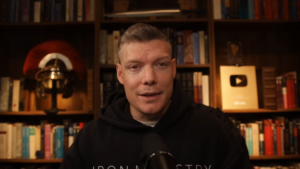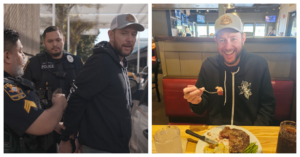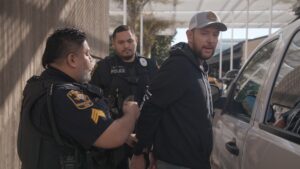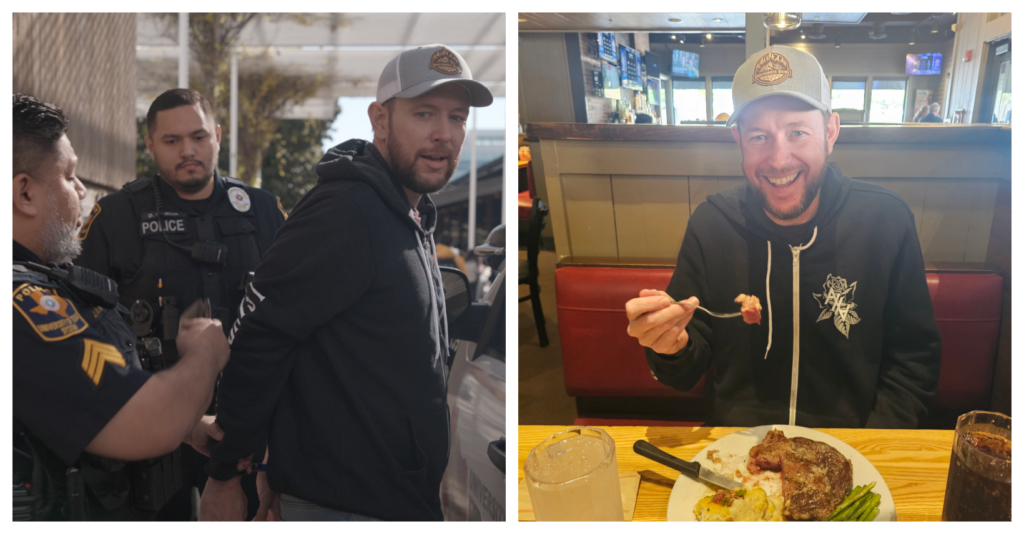

Prominent abortion abolitionist Russell Hunter has been released from jail after posting bond yesterday afternoon, following his arrest at the University of Texas after some students complained about their anti-abortion signs and messaging, which led to a trespass request.
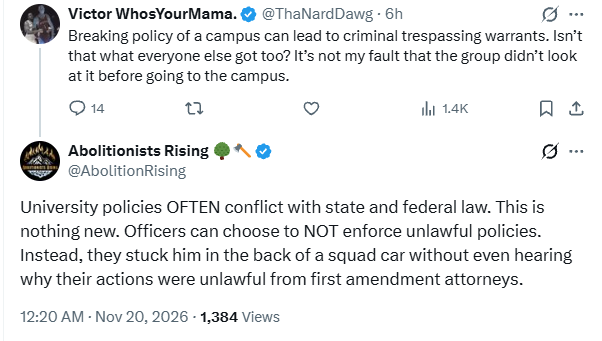
Abolitionist Rising, the organization Hunter founded, shared on X: “I’m sure there will be more updates to come on our legal case in the coming months. We plan to fight these unjust charges and the disrespect for the First Amendment that has been coming out of Texas for many years now.“

Texas attorney CJ Grisham, of the law firm GFA Law (which specializes in civil rights violations) and who is representing Hunter, wrote on X:

Yesterday, UT at Dallas had a man arrested for talking.
Our client stood at the Plinth, the open plaza in the middle of campus where students table, protest, and hold events every week. He had a sign about abortion & 2 cameras. No bullhorn or blocked sidewalks. He didn’t chase anyone down. Students walked up to him stayed because they wanted to talk.
That went on for more than 2hrs. Civil, productive, one-on-one conversations. Not one employee or officer said a word to him.
Then Tricia Losavio, UTD’s Ass Dean of Health & Wellness Initiatives, walked up & told him he had to leave. Her explanation, on video: UTD is “not an open campus anymore,” & students had complained that they “didn’t like what was being shown.”
Read that again. Then, read it again. A govt official at a public university in TX removed a peaceful man from public property because someone didn’t like a sign.
When UTD PD arrived, he did what any citizen should do. He asked what law or policy he was breaking. No answer. Less than 2mins later he was in handcuffs, charged w/ criminal trespass.
There is a name for shutting down a speaker because the audience objects to his message: a heckler’s veto, & SCOTUS has rejected it for decades. The Court also unanimously struck down a govt rule declaring public property “not open for First Amendment activities” back in 1987. UT Dallas apparently didn’t get the memo.
You don’t have to agree with his sign. That’s the whole point. The First Amendment doesn’t exist to protect speech everybody likes. If a dean can have you arrested because your opinion made someone uncomfortable, none of us has free speech on that campus. We just have permission, until someone complains.
GFA law insists that not only will they fight the charge but they will “hold UT Dallas accountable,” leading many to hope they will, along with defending their client, proactively sue the University for violating Hunter’s rights, which could result in a settlement.
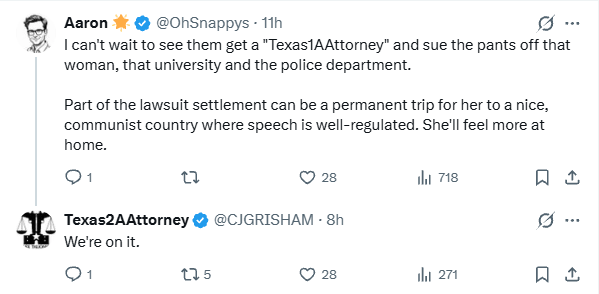
They conclude with a hint of the legal strategy they are going to employ if needed on behalf of their client.
1. Removing a speaker because listeners object to his message is content based. “Listeners’ reaction to speech is not a content-neutral basis for regulation.” Forsyth County v. Nationalist Movement, 505 U.S. 123, 134 (1992); Reed v. Town of Gilbert, 576 U.S. 155, 163 (2015).
2. That is true even if the Plinth is a nonpublic forum. In any forum, the government may not restrict speech in “an effort to suppress expression merely because public officials oppose the speaker’s view.” Perry Educ. Ass’n v. Perry Local Educators’ Ass’n, 460 U.S. 37, 46 (1983); Cornelius v. NAACP Legal Def. & Educ. Fund, 473 U.S. 788, 806 (1985); Rosenberger v. Rector & Visitors of Univ. of Va., 515 U.S. 819, 829 (1995).
3. A rule closing public property to all expressive activity cannot support a charge. The Supreme Court unanimously struck down such a rule as facially overbroad, whatever the forum. Bd. of Airport Comm’rs v. Jews for Jesus, Inc., 482 U.S. 569, 575 (1987). To the extent this arrest rests on Regents’ Rule 80101, the same defect applies.
4. Enforcement was selective. Arresting the one person holding the sign, while leaving three companions and regularly tolerating other non-student speakers, is the kind of comparator evidence the Supreme Court has held overcomes probable cause in a retaliatory arrest case. Nieves v. Bartlett, 587 U.S. 391 (2019); Gonzalez v. Trevino, 602 U.S. 653 (2024). Texas courts likewise allow trespass enforcement against speakers only when it is nondiscriminatory. Bader v. State, 15 S.W.3d 599 (Tex. App.—Austin 2000, pet. ref’d).
5. A federal court has already enjoined part of the University’s speech policy. The UT System, including UT Dallas, is preliminarily enjoined from enforcing portions of the campus speech policies adopted under Senate Bill 2972 because they likely violate the First Amendment. Fellowship of Christian Univ. Students at the Univ. of Tex. at Dall. v. Eltife, 806 F. Supp. 3d 662 (W.D. Tex. 2025), appeal docketed, No. 25-50914 (5th Cir.). That injunction addresses different provisions than the one applied to Mr. Hunter, but it confirms that these policies do not override the First Amendment. The Legislature said the same. Tex. Educ. Code § 51.9315(l).