
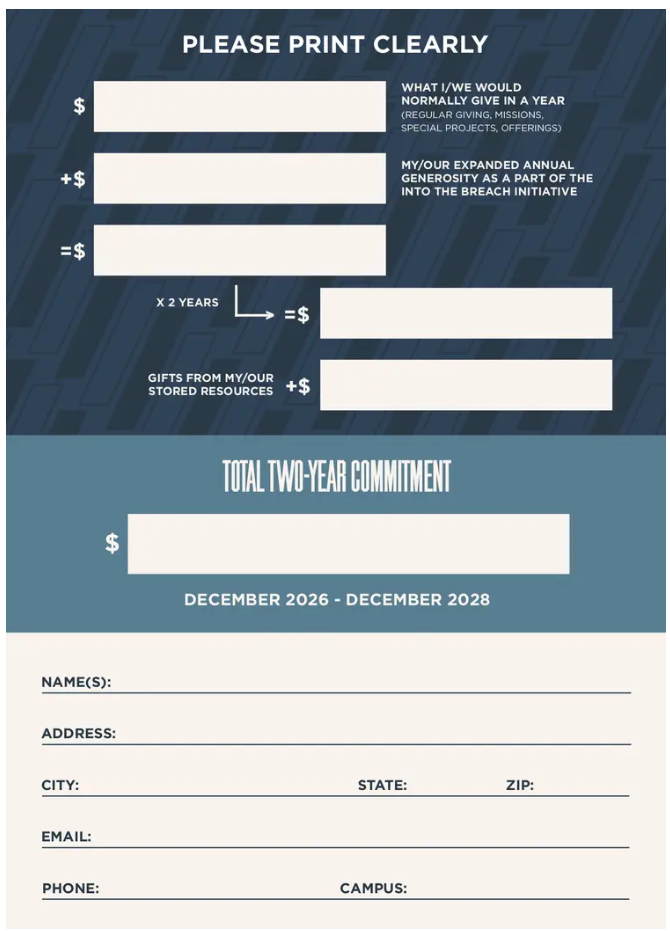
Start with the arithmetic. Write down what your household would ordinarily give to your church in a year. Add what you could give on top of that. Multiply by two. Then look beyond your income. Do you have stock, property, or other assets you could give? Add those, too. The result is your household’s two-year commitment. Josh Howerton‘s Lakepointe Church in Texas puts this calculation on the commitment card for its $225 million Into the Breach initiative. The church invites you to consider what filling it out will mean for your personal discipleship.
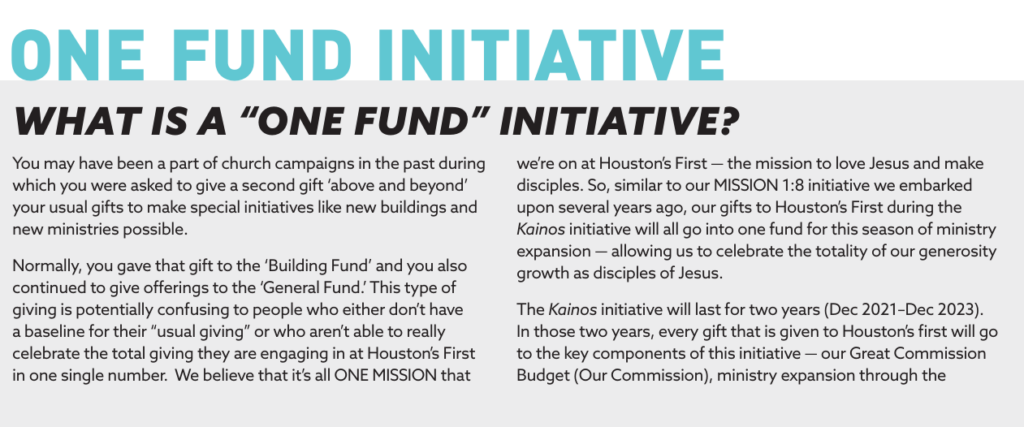
There’s an older version of that card. In its original Kainos campaign book, Houston’s First Baptist Church uses the same calculation in the same order. Both cards call the increase “expanded annual generosity” and the assets “stored resources.” Both roll ordinary giving into the total. The family’s usual offering goes into the first box, leaving the campaign to ask what else might be available.

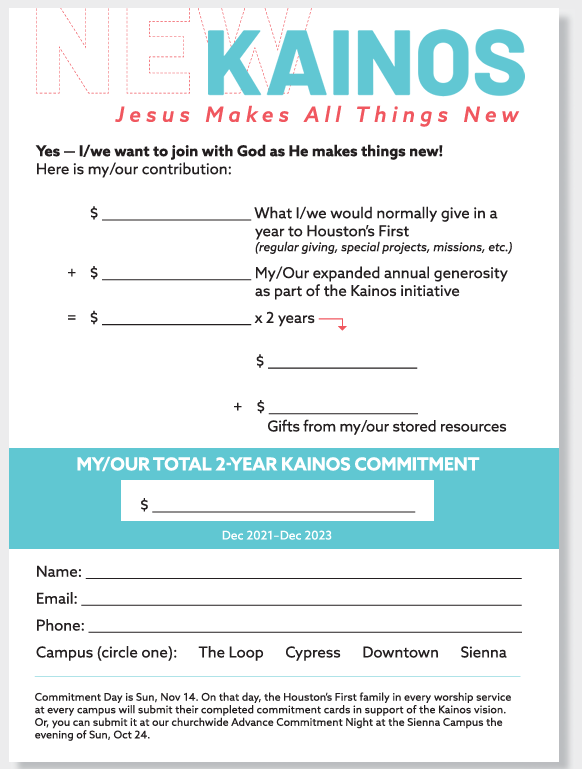
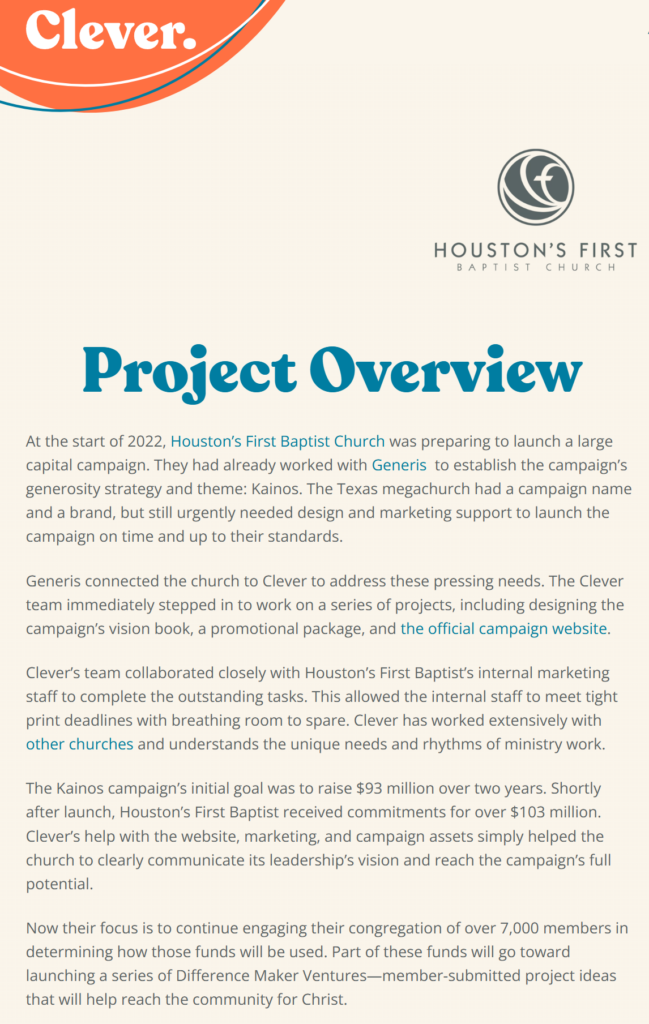
We know who helped develop the older campaign. Clever, the marketing agency that worked on Kainos, says Houston’s First had already worked with a church fundraising consultancy called Generis to establish the campaign’s strategy and theme. Generis then connected the church with Clever, which helped produce the vision book, website, and promotional materials.

The campaign that keeps your regular offering
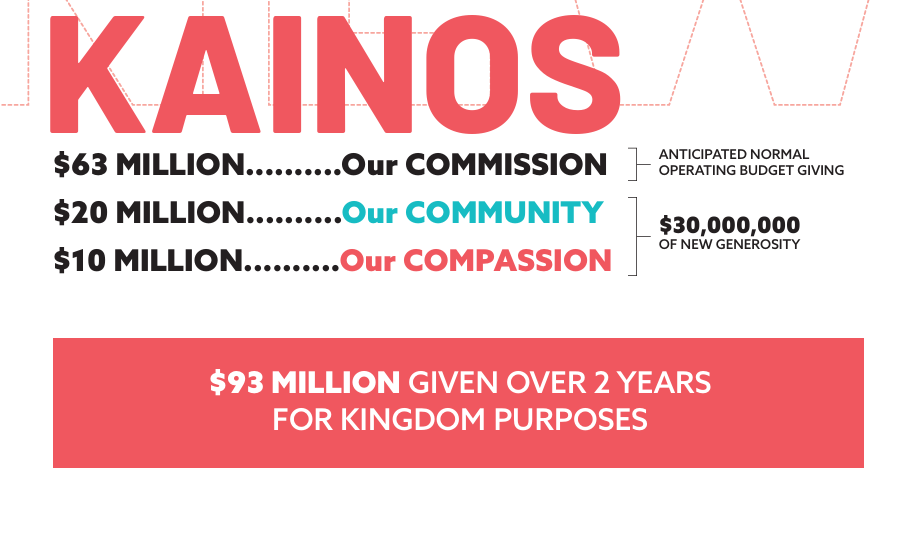
A church asking its members to help pay for a new building or a mission initiative is familiar enough. Suppose the church expects $63 million in ordinary giving over two years and wants another $30 million. It could tell members what they already support, explain what it wants to add, and ask them to decide whether the new spending deserves another gift. Those were the figures in the original Kainos proposal. Houston’s First put them together into a single $93 million goal. That figure represented all giving the initiative sought over two years, including the money the church already expected to receive.
Generis calls this service The One Fund™. The firm explains the financial rationale in an article about keeping the budget growing after a campaign ends. A separate appeal for an extra gift may leave someone who gives nothing with no obvious starting point. A single pledge includes that person while also asking existing donors to look at their previous giving and raise it for two years. Generis says the increases can outlast the campaign. Existing donors may settle below what they pledged during the initiative but keep giving more than they did before it. A two-year push can therefore raise the church’s ordinary income after the projects that occasioned it are finished.
Generis offers a service they call the “Generosity Calculator,” for churches “curious about what hidden giving potential is within your church body,” promising to “provide a high-level snapshot of your financial capacity for ministry.” The assessment asks for a church’s address, weekly attendance (not membership), and current annual giving, after which Generis will mail its assessment of how much money a church is presumably leaving on the table by not appealing properly to its attendees.
There are practical reasons a church might prefer one commitment and one stream of gifts. In a podcast, Generis chairman Jim Sheppard and former Elevation Church pastor and current Generis CEO Frank Bealer explain that, while a church may still have to allocate its newly consolidated, single income stream according to the budget presented to the congregation and report how it was used, the “One Fund” model changes what pastors can ask people to consider. The pastor gets to address all of a household’s giving. Sheppard gives the example of a household moving from five or six percent toward ten percent and says the hope is that it sticks after the campaign because the church has taught generosity as discipleship. Generis unapologetically instructs a church to attach its financial objectives to the spiritual framing of its pastor.
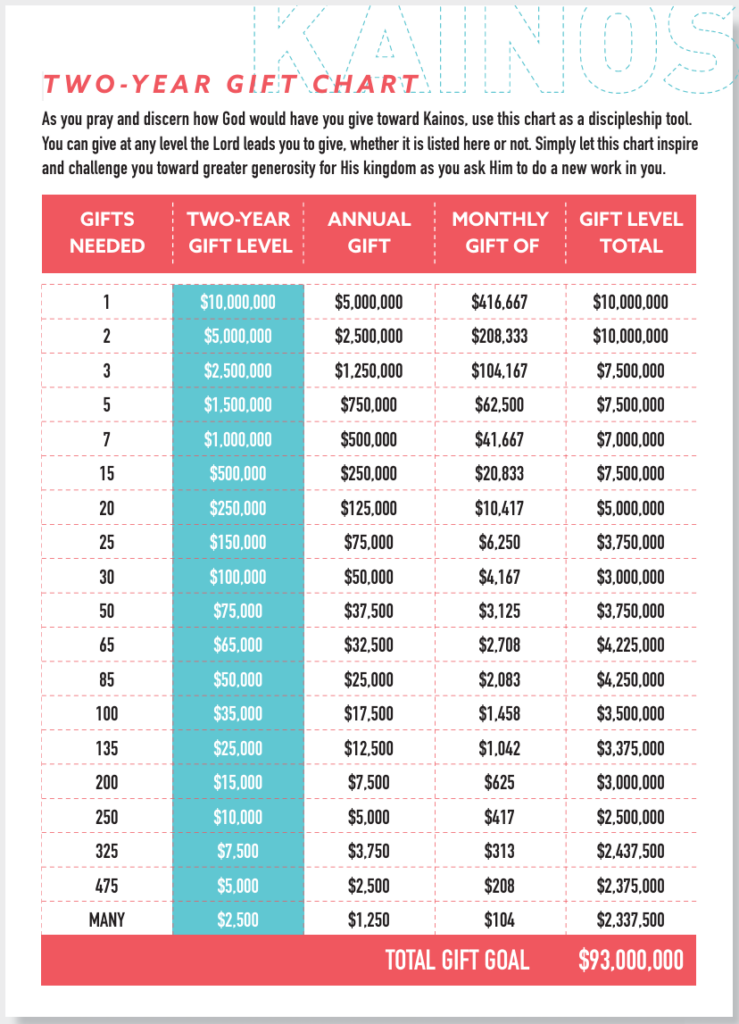
Look at how Houston’s First presented Kainos. The primary goal was “100% ENGAGEMENT.” The dollar goal came second. The church framed the response in terms of surrender, faith, and generosity, not (ironically) practical financial stewardship. The original book included a table showing how many gifts it needed at various levels, from one $10 million gift down through the smaller tiers. It called that table a “discipleship tool.” Every household could find a place in the campaign, and the figures told church leadership how many households it needed at each price point.
Cookie-Cutter “Vision”
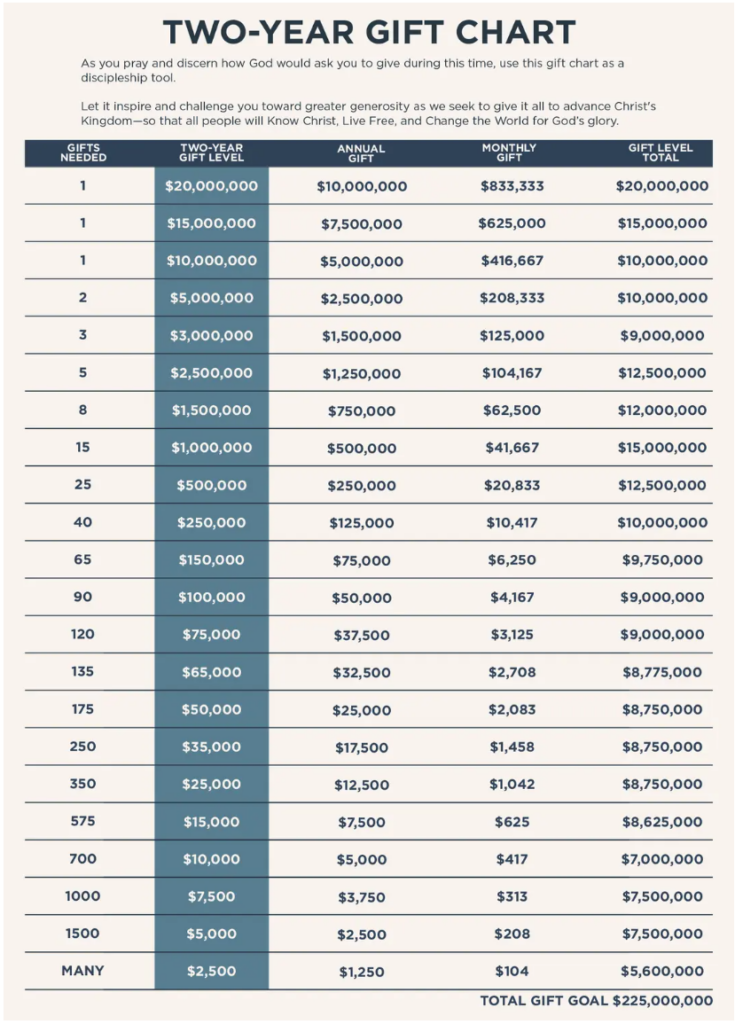
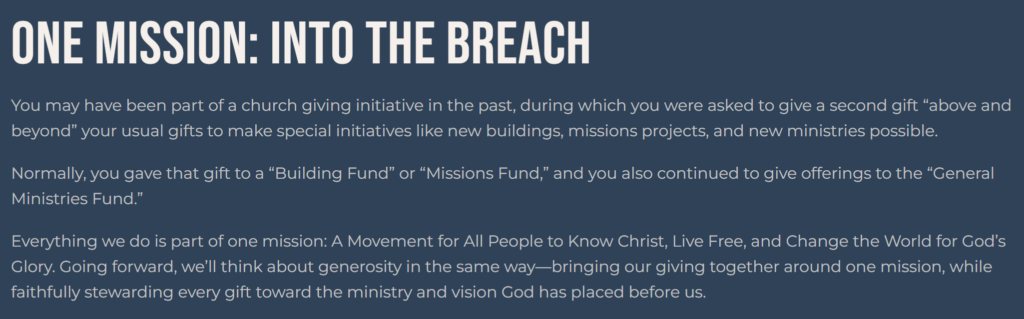
Lakepointe also puts “100 percent engagement” first. It uses the same three words in the same order: “surrender, faith, and generosity.” The $225 million secondary goal includes $135 million for ongoing ministries, $28 million for missions, and $62 million for projects and initiatives. A person who continues giving what he already gives is already helping fund the published total. The commitment card then asks him to consider an increase.
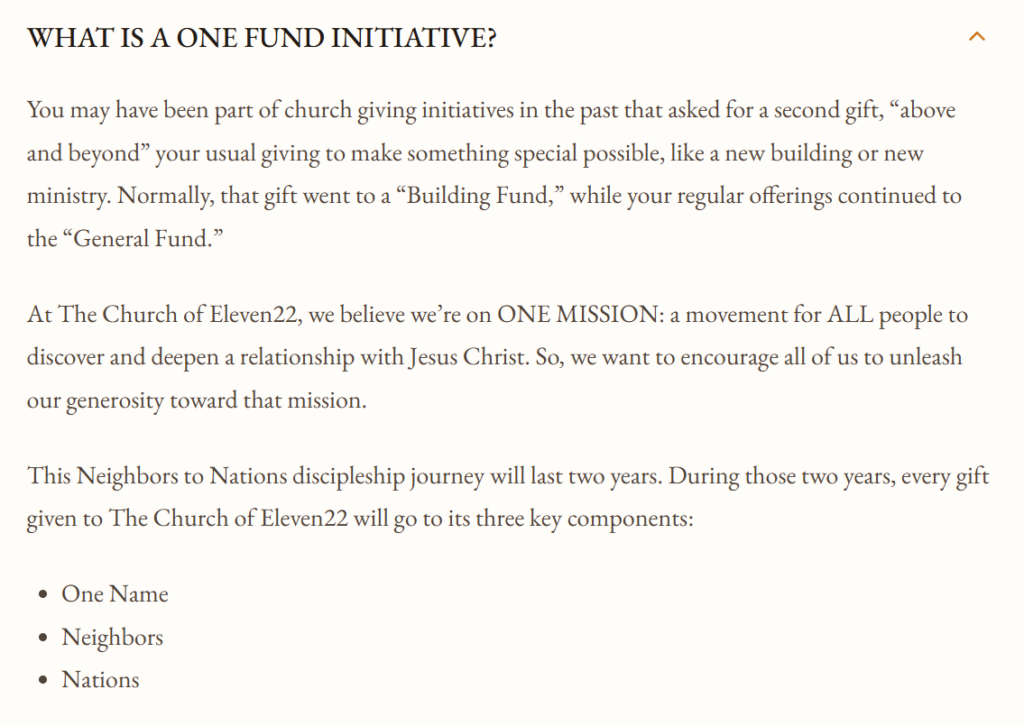
The Church of Eleven22 in Florida uses the same explanation of the shift to One Fund in its Neighbors to Nations FAQ (which also encourages jobless, indebted, and unbaptized people to give). Compare with Houston’s First’s Kainos campaign. Both start by asking readers to recall a campaign that sought a second gift beyond their usual giving. Both explain how a special gift went to the building fund while ordinary offerings went to the general fund. Both answer with one mission and two years of giving together. Eleven22 also asks households to consider whether God might be calling them to give from assets they already own. Lakepointe runs through the same contrast between the old extra gift and combining all giving around one mission. The overlap is in the sequence and wording of the pitch, as well as the financing.
Willow Creek Community Church’s Step Out campaign adds another example. It explicitly calls itself a One Fund campaign and puts $56 million in regular ministry expenses together with $44 million in additional investments. Its two goals are 100 percent participation and $100 million over two years. Willow describes the commitment card as an act of worship and offers a workshop on giving through stocks, donor-advised funds, and other assets.
At Bethlehem Church in Georgia, where Clever expressly identifies Generis as a campaign partner, a Be/Cause giving update lists 100 percent engagement as the primary goal and $27 million over two years as the secondary goal. Its evidence of engagement includes household commitments and first-time givers.
The matching copy and cards demonstrate the Generis origin of the current campaigns of Lakepointe and Eleven22. Our comparison video showed how closely Josh Howerton’s and Joby Martin’s presentations track each other. The Kainos materials add an earlier example of the same exact playbook. As both Josh Howerton and Joby Martin have been exposed repeatedly using the same sermon material as each other and other pastors (former Gateway Church pastor Robert Morris, for example), it remains open whether either church retained Generis for its current campaign or simply cribbed materials from prior Genesis campaigns of other churches. Bealer himself acknowledges that others use the One Fund name, while Clever’s account establishes Generis’s role in the Kainos campaign.
All Discipleship Leads to Financial Growth?
When a pastor teaches a Christian to budget so he can give regularly, remember the poor, or support the ordinary ministry of his church, he is teaching discipleship. A believer can grow through practicing generosity, including when a church has a specific need. The question is how the pastor gets from that biblical obligation to the suggestion that this family’s next step with Jesus can be worked out by adding a number to its existing gifts on the church’s commitment card.
Take a member who already gives consistently. She hears the campaign presentation, reads the proposal, and decides to keep giving as she has. Maybe she has obligations at home. Maybe she has committed to helping another believer in distress. Maybe she simply thinks her church should slow down and pay for the facilities it already has. Does her decision count as taking the campaign’s next step in discipleship? If it does, the church should be able to say so plainly. If it doesn’t, the pastor should explain what gives him the authority to treat her decision about his plan as a failure to grow in faith.
Paul’s collection for needy believers gives pastors ample room to urge generosity. In 2 Corinthians 8, he holds up the Macedonians, who gave voluntarily even beyond their means. In the same chapter, he says he is speaking by way of an appeal rather than a command (2 Cor. 8:8). He says a gift is acceptable according to what a person has (2 Cor. 8:12) and explains that the aim is relief for those in need without burdening the givers (2 Cor. 8:13–15). In the following chapter, he calls for each person to give as he has decided in his heart, free from compulsion (2 Cor. 9:7). The example of extraordinary sacrifice belongs alongside those protections. The apostle had every reason to want the collection to succeed, and he still protected the giver’s freedom.
A pastor can rebuke greed when Scripture warrants it. He should also recognize that giving less than a pledge card invites may be an act of stewardship. A parent’s obligation to provide for a household carries biblical authority (1 Timothy 5:8). A Christian can give away everything he owns and still lack love (1 Corinthians 13:3). If even Paul refuses to make an outward act of extraordinary giving proof of love, a church has considerably less ground for treating an increase in its own receipts as evidence of spiritual growth.
The distinction matters when leaders report back to the congregation. A pledge count tells you how many commitments came in. A giving total tells you what the church received. Even a rise in first-time gifts tells you only that more people gave to this church for the first time. Those are legitimate financial measures. To say that a congregation learned greater trust in Christ, you would need to know something about the people beyond what they wrote on the card. And when a member raises a question about a project, the church owes her an answer about the project. An exhortation to examine her heart may be pastorally appropriate in some circumstances, but it cannot explain why the project should cost what it costs or why the church should undertake it now.
Howerton has defended his campaign by pointing to the long history of believers giving sacrificially for churches, saying he receives no additional pay for the initiative, and listing proposed projects that include Bible translation, facilities for children with special needs, and a missions center. Those projects can be assessed on their merits. His willingness to give alongside his congregation is welcome. The question he still needs to answer is whether a member can hear his appeal, carefully weigh the proposal, and conclude that God has left her free to decline it. A pastor can sincerely believe in every project he has put in the budget and still speak with more authority than Scripture gives him.
Selling Out the Membership
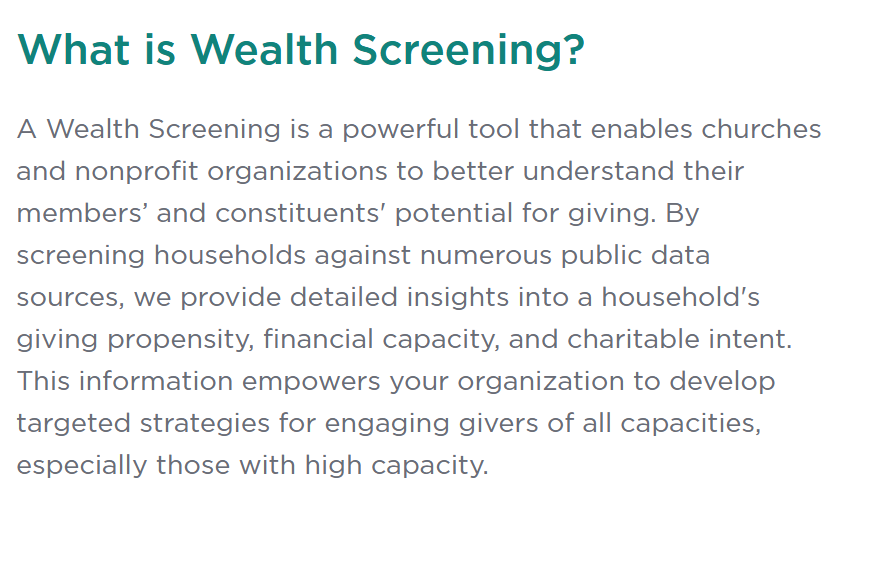
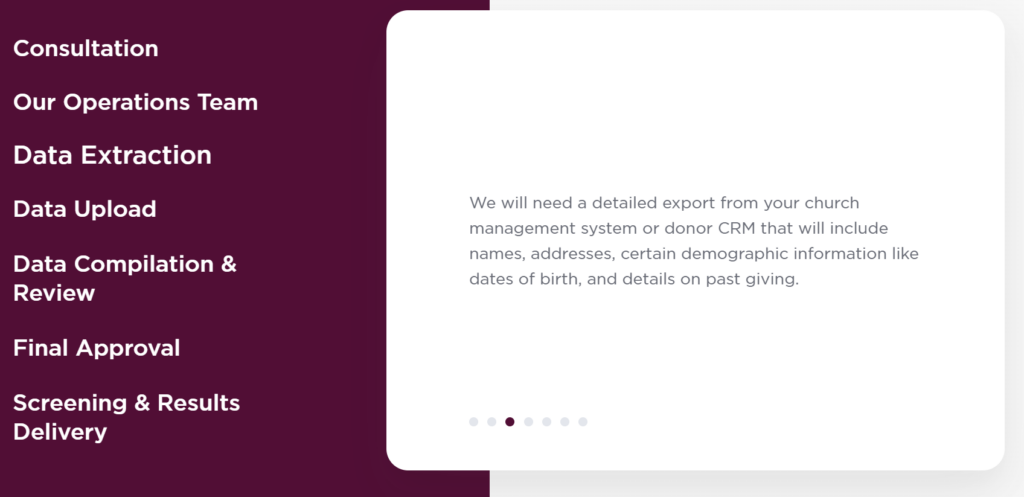
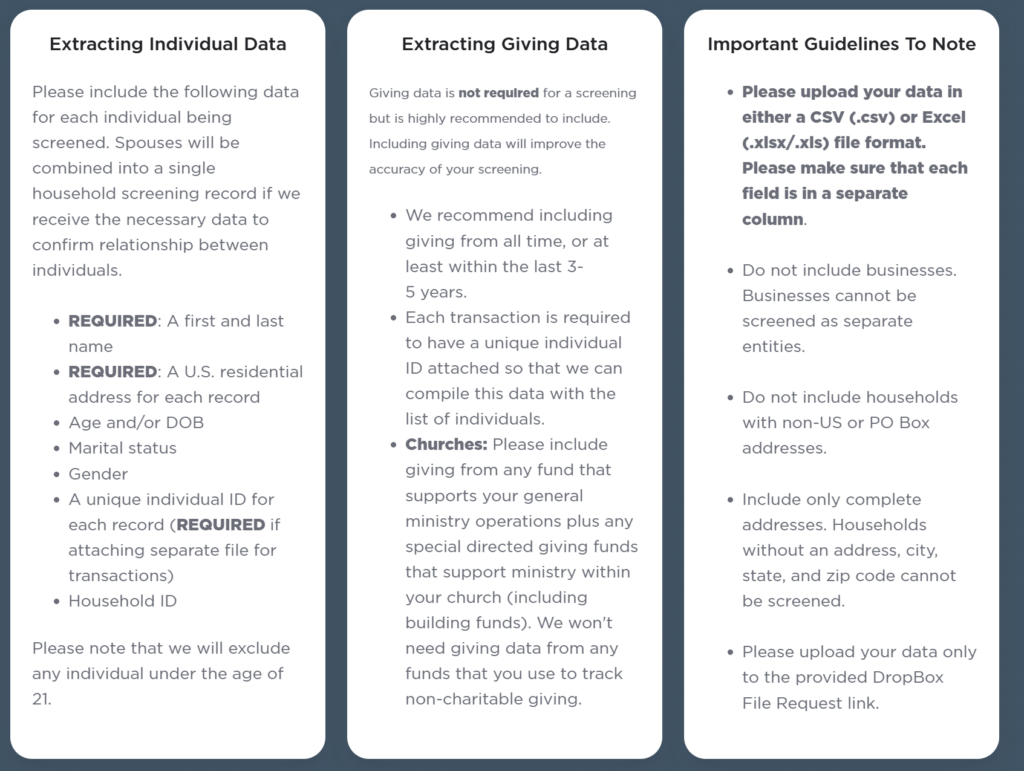
Thought analyzing the top-level stats of a church via the “Generosity Calculator” was bad? It gets worse. Generis’s public wealth-screening instructions describe a service in which a client (church) exports the personal details and giving history of their members for analysis through DonorSearch, with the client (the church) authorizing the screening. The consultant helps interpret the results for fundraising. Which churches have sent their giving records to Generis for what I’ll call “whale screening” remains an open question.
Josh Howerton has described how he cultivates big givers at Lakepointe. In a training video for church-planting organization Strategic Launch Network, he describes handwritten notes for gifts above a certain amount, personal calls after exceptional gifts, and private lunches for major donors. He tells guests (who, in contravention of Luke 21:3-4, he describes as the “most sacrificial”) that the lunch is simply a chance to thank them (and get to know members, which he likes to do “from time to time”), then explains to pastors that answering those donors’ questions can “unlock a new level of giving” because they may have much more in terms of resources than they are currently giving. Howerton described these lunches as a “once in maybe a lifetime opportunity to sit down with their pastor and ask any question they want.”

Whether or not Howerton or other pastors utilized Generis’s “whale screening” service (versus simply combing through the church’s giving records), the practice illustrates the difference between what the pastor may be asking people to think about from the pulpit and what a fundraising adviser can help leadership estimate about the households sitting in front of him. Of course, any church’s givers have every reason to ask how their giving records are handled and who has access to them.
When churches adopt the logic of customer marketing, they start sorting the people they’re called to shepherd by how much revenue they might bring in. That is partiality, and James calls it sin (James 2:9). Dressing the strategy up as discipleship compounds the problem. It puts the authority of the pulpit behind a campaign target and encourages Christians to read a larger pledge as evidence of greater faith. Paul tells believers to give cheerfully and freely, as each has decided in his heart (2 Corinthians 9:7). A pastor can teach that kind of generosity faithfully and see some people give more, some give elsewhere, and some keep giving exactly what they already give. If only the first response counts as spiritual growth, the church is using its own financial interests to define what it means to follow Christ.