
(John B. Carpenter) I was 9Marks before 9Marks was cool. I bought the books, gave them away, and taught the material. I was surprised, then, when religious statistician Ryan Burge reported that average weekly attendance as a share of reported Southern Baptist Convention membership had, by 2023, returned to roughly where it stood before 9Marks began. In 2023, that ratio was about 31%.1 More recent SBC figures put the ratio at approximately 36% in 2025, still about the same as when 9Marks was founded in 1998.2
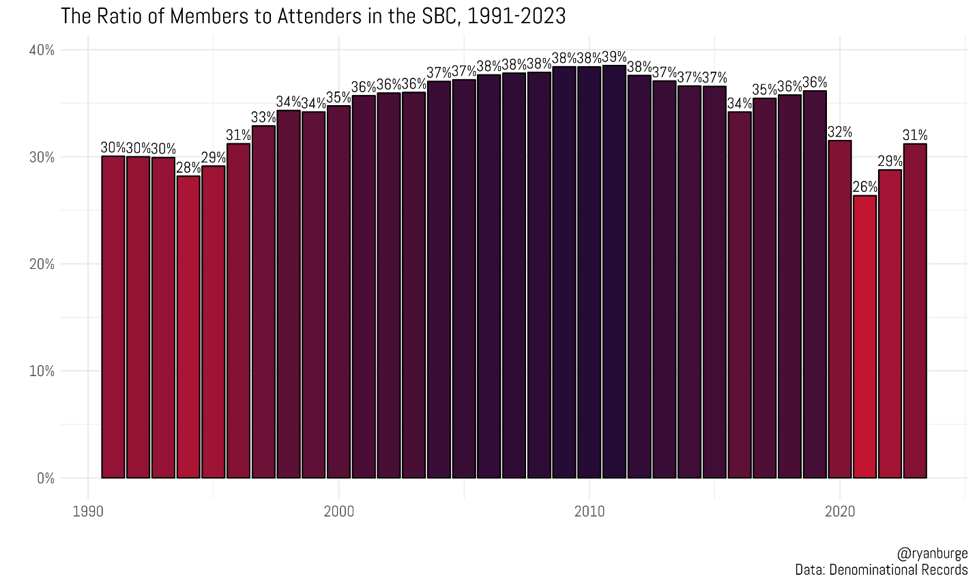
Why has 9Marks failed? One could argue that it has not; that without 9Marks there would be an even lower attendance-to-membership ratio in SBC churches; that 9Marks mitigated the decline of meaningful membership among Baptists. Admittedly, we are dealing in counterfactuals: alternative histories in which 9Marks either never existed (would the SBC be worse?) or pursued reform more robustly (would it be better?). We should not be dogmatic about what cannot be measured. But if 9Marks exists to promote healthy churches, and probably the chief metric of church health indicates no improvement, what are we to think?
Since 1998, when “The Center for Church Reform” (9Marks’ first name) was founded and began spreading its materials to eager seminarians like me, SBC membership has declined by over 20%. Some of that is the deaths of faithful saints, of course, but some of it is the loss of former members becoming “nones,” people who now claim no religious affiliation. Some churches may also have removed inactive members from their rolls. The denominational statistics cannot distinguish these explanations or measure 9Marks’ own influence. Yet the gap between reported membership and weekly participation remains substantial. Although these figures cannot isolate 9Marks’ impact or exclude a worse decline without it, the broader recovery of meaningful membership it sought has not materialized on a denomination-wide scale.

The importance of church membership is, perhaps, the number one theme of 9Marks, not without reason. And yet the SBC, one of its primary areas of influence, still has a striking disparity between reported membership and weekly participation. Why?
The Trickle-Down Fallacy
9Marks has failed because it has missed the fact that words—even theologically sound words—denied in practice become empty. So, if one says, as Jonathan Leeman did in The Church and the Surprising Offense of God’s Love, that church covenants are “nothing more or less than the existence of the local church,” and then, in the same book, that churches must bless covenant breakers even for “foolish reasons,” he effectively teaches that church covenants are worthless and, so by his own theology, churches have no basis of existence.3 Of course, he does not mean to say that. But the actions he calls for will send that message. Hence, while praising covenants, Leeman castrates covenants and bids the gelding-covenants be fruitful.4
The problem is a failure to let theology govern practice. Sometimes application remains abstract; sometimes practical counsel undermines the theology itself. 9Marks has fallen victim to a habit of Western academia: the assumption that people change best when you address the basic philosophy underlying their behavior in the abstract. Once you’ve done that, people will change their worldview, and then their behavior will change eventually. In Platonic style, talk about the grand ideas and leave the implementation to be changed by an ideological trickle-down effect.
So, Leeman apparently sees the crisis of authority in the churches and writes a book about authority. The goal is noble: address the culture’s faulty assumptions about authority, the fundamental suspicion that it is bad. He argues, rightly, that our culture’s assumptions about what love is were wrong; that once we see that love and authority and commitment are of one piece, we’ll be on the road to healthy churches and happier people. But it won’t work because didactic abstraction rarely reforms churches.
9Marksists will find this criticism incredible, as in lacking credibility. After all, the nine marks are mostly specific practices churches should employ to be healthy, like expository preaching and church discipline. Indeed, I must grant that expository preaching is exactly that: a specific practice vital for healthy churches that 9Marks calls for with a clear, loud voice. But for congregationalists, church discipline was historically tied to the church covenant, and 9Marks has not made that historically constitutive practice nearly as central to its public teaching as one might expect.
My eureka moment came when I was working on an article on church covenants and typed “church covenants” into the search for 9Marks’ Pastors Talk podcast. I got no results. I thought there must be a problem with the search engine. I looked manually. Then I emailed Jonathan Leeman and asked him if they had ever done a program on church covenants. They subsequently devoted an episode to the subject.5 The absence of a dedicated podcast discussion through nearly 250 episodes struck me as telling: the premier organization for championing congregationalism had not concentrated on what, for the first 300 years of congregationalism, was understood to be a constitutive act of the local church. This, along with Leeman’s treatment of departure for “foolish reasons” as something a church must “bless,” threatens to undermine the importance of membership that 9Marks otherwise commends. I documented the historic importance of church covenants and what I see as 9Marks’ relative lack of emphasis on them in my Perichoresis article, “The Missing Mark of Church Membership.”6 Hence, 9Marks, for its first quarter century, has produced high-quality theological works, but much of it remains abstract: material that edifies people who already agree while too rarely pressing the particular practices that earlier congregationalists believed sustained churches over time.
Christians learn through the practices that incarnate doctrine. Do it. They learn about conversion by baptism. They learn about Christ’s sacrifice through the Lord’s Supper. They learn about “walking together in Christian love,” the value of healthy authority, by church covenants, actual documents they subscribe to, recite, and are expected to follow. They learn about regenerate church membership and congregationalism by letters of dismission (formal letters confirming a departing member’s standing to another church). They learn about worship and genuine biblical spirituality by singing the Psalms.
These practices should serve, not replace, the church’s biblical responsibilities. Jesus directs the church to address unrepentant sin (Matthew 18:15–20); Paul charges the congregation with discipline and restoration (1 Corinthians 5:4–5, 12–13; 2 Corinthians 2:6–8). Covenants and responsible transfers can give those mutual obligations practical expression.
My tentative conclusion about 9Marks, formed by 2024 and developed in a draft of this article in 2025, was reinforced when 9Marks did a two-part series on Eastern Orthodoxy in spring 2026.7 I have published several articles on Eastern Orthodoxy’s case for icons, so I was eager to hear what they had to say, especially about icons. The veneration of icons violates the second commandment. I have argued elsewhere that early Christian resistance to icons was widespread.8 Their guest expert, a former Eastern Orthodox priest, mentioned icons several times, but Leeman never followed up. His concern was focused on theology, as if people were disembodied theological beings. Imagine: a ministry focused on polity and healthy churches discusses a tradition that, in my judgment, violates a commandment in its worship, yet this practice goes unaddressed. The suggestion is that being a “healthy church” is exclusively a matter of what is taught, not what is done.
Captive to the Tyranny of the Agreeable
9Marks has failed, in part, by refusing to be controversial. Rather than applying the cure directly to the disease, it tries to finesse the issues. Instead of attacking problems, it respectfully suggests alternative points of view. This is a good way to keep a high reputation among the evangelical elites, but it is no way to solve problems. 9Marks is captive to the “tyranny of the agreeable.”9
Consider, for example, the response to Mark Dever’s forceful defense of congregationalism at a 2022 9Marks conference at Southeastern Baptist Theological Seminary.10 Dever celebrated the strengths of congregationalism while sharply criticizing the shortcomings of alternative polities. Kevin DeYoung objected to the dismissive tone of the remarks, and Dever later publicly apologized on a 9Marks Pastors Talk episode.11 Dever himself said the correction was gracious and the apology sincere; I do not dispute that. But 9Marks later included this discussion among its top podcast episodes of 2023.12 I admire Dr. Dever and the humility required to acknowledge a fault. But he was not at fault. Indeed, his apology risked conveying the wrong lesson: that forcefulness in defense of necessary reform is a greater concern than the deficiencies being confronted.
The episode offers a potentially discouraging model to a pastor whose efforts to reform his church will offend influential members. Reforming churches means confronting unbiblical practices; reformers will meet resistance. Should they hesitate to challenge those practices for fear of being judged insufficiently agreeable? Kindness does not require keeping everyone comfortable. When the reformer’s forcefulness becomes a greater scandal than the deficiencies he confronts, those deficiencies are likely to endure.
9Marksists could argue that they have not failed because they have produced volumes of ecclesiology of high theological quality. I cannot argue with that. But beyond the occasional practical advice that undermines the sound theology they commend, as I believe Leeman has done, I do not mean to compare 9Marks to the absence of 9Marks; I mean to compare it to what it could have been, what I expected it to become when I eagerly first snatched up Dever’s pamphlet and tape at Trinity Evangelical Divinity School in the late 1990s. What if they had foregrounded the church covenant and insisted on recovering letters of dismission; instead of generalities about recovering congregational singing, they had championed (nonexclusive) psalm-singing; instead of nearly hiding Dever’s convictions about adult baptisms, they had directly challenged Baptists baptizing five-year-olds; and what if, rather than letting the tone controversy eclipse his argument, Dever had said to his critic, “Look, Kevin, we love you and respect your voice for orthodoxy, but apart from my clumsy ‘I’m tired of’ line, what I said about congregationalism was true. Jonathan learned that regenerate church membership was not invented by Baptists. Now you need to learn that your ‘covenant baptism’ argument falls apart, as Carpenter has argued at Founders Ministries!”13 What if?
What 9Marks Needed to Recover
The practices 9Marks needed to recover had sustained congregational life for centuries. It failed because it came along at exactly the moment of history it was needed and then failed to do what was needed. Congregationalism (including Baptist polity) remained stable for about 300 years, from the early seventeenth century until the early twentieth century. Even into my lifetime, Baptist churches were still accepting new members by “letter.” It withstood various pressures, such as the apostasy of a large chunk of New England Congregationalism into Unitarianism and Universalism, and remained largely unchanged, especially among Baptists. But by the twentieth century, the forces of (well-meaning but misleading) revivalism and antinomianism eroded the foundations of congregationalism from within. Meanwhile, consumerism and what Carl Trueman described as the autonomous “modern self” battered down the walls of congregationalism from without. The habits of congregationalism, especially church discipline and the institutions needed to uphold it, like the church covenant and letters of dismission, began to disappear over the last century. The pillars that had made congregationalism the bulwark of orthodoxy Dever praised had collapsed.
Late into this process, around the turn of the twenty-first century, 9Marks arose, aspiring to reverse the breakdown. But it did not, typically, re-erect the pillars prior generations had deemed weight-bearing for church health. It threw volumes of helpful and healthful theology at the problems, almost all of which I would agree with. But it did not consistently foreground the practices that had originally incarnated that theology. The result has been continued decline. Indeed, 9Marks may even have softened the urgency of reform among young Christian leaders, effectively inoculating some of them to thorough, congregational reform. They could have become champions of full-blown orthodoxy–and–orthopraxy congregationalism. By giving them too much theory without enough concrete direction – reading lists but few to-do lists – and telling them that this is church reform, they turned out men who thought they were latter-day Puritans but were really preserving the status quo of late-twentieth-century, theologically serious Baptists. But that status quo was unstable; it was in the midst of the disintegration of congregationalism. Instead of being equipped to lead the church back to church covenants, they were told we have to accept covenant-breaking. Instead of leading us back to (non-exclusive) psalm-singing, they harkened back to the glory days of the mid-twentieth century. Instead of recovering letters of dismission, they learned pious theories about healthy churches. Professor Harold Hill, the “Music Man,” taught his band to play their instruments with the “think system,” dreaming that with theory alone 76 trombones would lead the big parade, without ever having to learn how to finger their valves. 9Marks thought it could lead a parade of healthy churches by aspiring to it, without ever having to do the needed practices.
The good news is that it’s not too late to reverse course. Teach congregations to covenant together, hold members accountable to their promises, sing less “Gloryland” and more psalms, and restore responsible transfers between churches. Defend those practices when they become unpopular. Meaningful membership requires promises that mean something.

John B. Carpenter (MDiv, ThM, PhD) is pastor of Covenant Reformed Baptist Church in Danville, Virginia, and author of Seven Pillars of a Biblical Church(Wipf and Stock, 2022) and the Covenant Caswell Substack. You can contact him on X at @CovenantReform2.
- Ryan Burge, “The State of the Southern Baptist Convention in 2023,” Graphs about Religion, May 8, 2024, https://www.graphsaboutreligion.com/p/the-state-of-the-southern-baptist. ↩︎
- Lifeway Research, “2025 SBC Annual Church Profile: Statistical Summary,” prepared April 19, 2026, https://research.lifeway.com/wp-content/uploads/2026/05/2025_ACP_Summary.pdf (4,460,910 weekly worship attenders; 12,331,954 members; ratio approximately 36.2%). ↩︎
- Jonathan Leeman, The Church and the Surprising Offense of God’s Love: Reintroducing the Doctrines of Church Membership and Discipline (Wheaton, IL: Crossway, 2010), 318. ↩︎
- John B. Carpenter, “A World of Worthless Words,” Plough, November 13, 2023, https://www.plough.com/articles/a-world-of-worthless-words. ↩︎
- “On Church Covenants,” Pastors Talk, November 14, 2023, episode 249. ↩︎
- On 9Marks’ paucity of addressing church covenants and Leeman’s own negation of the covenant, see John B. Carpenter, “The Missing Mark of Church Membership: Covenanting, Congregationalism, and the Ethics of Keeping Our Word,” Perichoresis 24, no. 3 (2026): 28–48, https://doi.org/10.2478/perc-2026-0015. ↩︎
- Jonathan Leeman and Mark Feather, “On Eastern Orthodoxy Part 1,” featuring Joshua Schooping, Pastors Talk, episode 326, 9Marks, audio podcast, March 31, 2026, https://www.9marks.org/podcast/pastors-talk/; Jonathan Leeman, Mark Dever, and Mark Feather, “On Eastern Orthodoxy Part 2,” featuring Joshua Schooping, Pastors Talk, episode 327, 9Marks, audio podcast, April 7, 2026, https://www.9marks.org/podcast/pastors-talk/. ↩︎
- John B. Carpenter, “Don’t Convert: Icons and Images in the Early Church,” Theopolis Institute, February 25, 2025, https://theopolisinstitute.com/dont-convert-icons-and-images-in-the-early-church/. John B. Carpenter, “The Early Church on the Aniconic Spectrum,” Westminster Theological Journal 83 (2021): 35–47. ↩︎
- John B. Carpenter, “Tyranny of the Agreeable,” Theopolis Institute, July 22, 2024, https://theopolisinstitute.com/tyranny-of-the-agreeable/. ↩︎
- Southeastern Seminary, “9Marks at Southeastern 2022 – Church Membership & Biblical Discipline: Session 5 Panel,” YouTube video, 40:05, March 4, 2023, https://youtu.be/Ny13nMF7eHE. ↩︎
- “On Pastoral, Public Tone with Kevin DeYoung” (Pastors Talk, Ep. 245), September 19, 2023. ↩︎
- Sam Koo, “Top Ten 9Marks Podcast Episodes from 2023,” 9Marks, December 19, 2023, https://www.9marks.org/article/top-ten-9marks-podcast-episodes-from-2023/. ↩︎
- John B. Carpenter, “Colossians 2:11–12 and Kevin DeYoung’s Case for Covenant Baptism,” Founders Ministries, April 20, 2026, https://founders.org/articles/colossians-211-12-and-kevin-deyoungs-case-for-covenant-baptism/. ↩︎