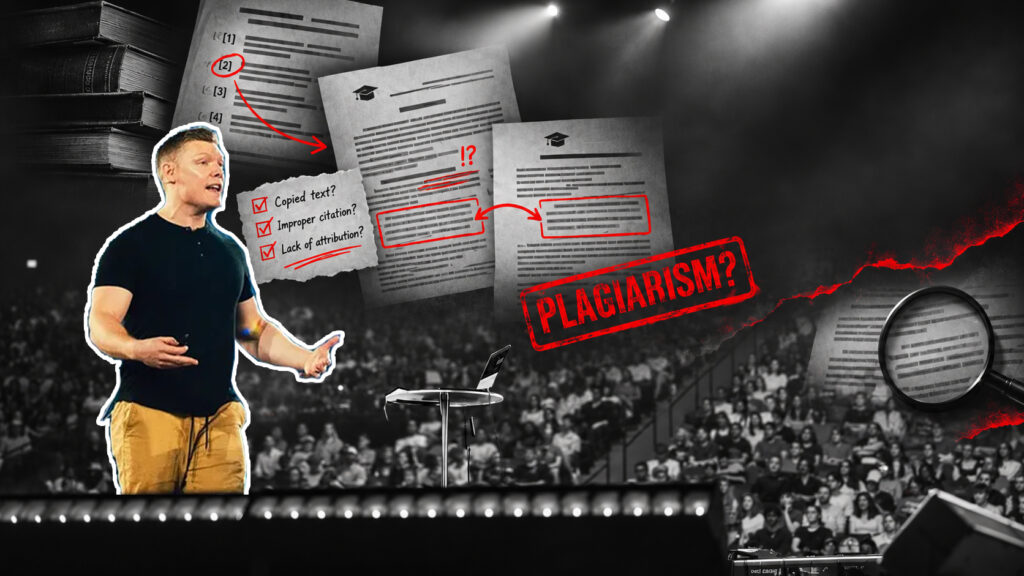

Christian apologist Wesley Huff has spent the last two years rising to evangelical stardom. From his celebrated appearance on Joe Rogan’s podcast to interviews with influential secular personalities, Huff has introduced millions to serious arguments for Scripture’s historical reliability and Christianity’s truth claims. Conservative Christians, used to seeing their views sidelined in mainstream media, saw Huff’s success as a win. He was young, articulate, and academically trained, and he could break down complicated issues in biblical history and textual criticism for huge audiences.
Protestia welcomed his appearance on Rogan’s podcast, even as we subsequently expressed concerns about his theological discernment, particularly his treatment of annihilationism and willingness to accommodate positions we consider serious doctrinal error (lady preachers, for example). But whatever disagreements we had with Huff, his ability to communicate Christianity intelligently and persuasively was undeniable, which makes his exposure as a serial plagiarist especially disappointing.

What started as questions about a single old academic paper has turned into a major controversy. Now there are multiple graduate papers, borrowed material in public lectures, and real doubts about how Huff has presented his academic work. Yet perhaps the most troubling part of this saga is how many Christians seem more focused on saving Huff’s reputation than on what he actually did.

From a Questionable Paper to a Pattern of Plagiarism
The controversy erupted when Mormon and longtime Huff critic Dan McClellan examined a 2016 paper Huff uploaded to Academia.edu and identified extensive similarities to a 2010 work by pastor and scholar Brian J. Wright. Other researchers subsequently identified similar problems in additional papers, including later graduate and doctoral coursework.
Professor Stephen C. Carlson of Australian Catholic University publicly identified examples of his own work appearing in Huff’s writing, including passages in which portions of the original version were retained while other words were substituted.
As Christian commentator Bethel McGrew details in her excellent essay, Wesley Huff and the Curse of Evangelical Celebrity (a title I intentionally cribbed for this piece), the similarities extended well beyond forgotten quotations. In one 2019 paper, researchers identified material apparently borrowed from at least three scholars. Some attempted paraphrasing produced nonsensical results, while another passage retained an outdated reference to thirty years of scholarship from a much older source.
This isn’t a case of scholars simply reaching the same conclusions. It looks like Huff took other people’s work and passed it off as his own. The allegations have now expanded beyond scholarly papers, and the internet (doing what it does best) has unearthed passages in older video lectures that closely reproduce published scholarly material absent clear acknowledgment. One example involves Brent Nongbri’s God’s Library, while another concerns material attributed to Peter J. Williams in a December 2025 lecture. Put together, these examples make it hard to pretend this is just about a few sloppy citations from Huff’s early twenties.
An Explanation That Made Things Worse
Protestia reached out to Huff, who filled us in on the many, many videos Dan McClellan had made attacking him, and explained to us what he later said in a now-removed YouTube video, where he acknowledged problems in his old coursework while pointing out his youth, inexperience, and the supposedly unfinished nature of the materials. “If you want to cancel Wes Huff from 2016 or maybe even 2017 and 2018, I do too,” he explained.
Huff suggested his Academia.edu account functioned something like a personal Dropbox, containing drafts and notes that had not necessarily been submitted for academic credit. That video might have calmed things down if this was only about one sketchy paper from 2016. But as more examples came out, Huff’s original explanation stopped making sense. He took down the video and started scrubbing other material from his online accounts.
Huff later announced that he would cooperate with a review by his church leadership and Apologetics Canada, but hasn’t yet attempted to give a full account of what material was actually copied. Of course, there’s a big difference between admitting you were sloppy with citations and admitting you kept passing off other people’s work as your own. One is a technical mistake. The other is a real honesty problem. Meanwhile, McGrew has reported that Huff’s doctoral supervisor and dissertation committee withdrew amid plagiarism concerns throughout the summer, months before the controversy became public, potentially giving Huff a window with which to come clean as necessary about his academic sticky fingers.
Not Just Another Sermon Plagiarism Controversy
In September, I published an essay at Reformation Journal titled Your Pastor Is Not Writing a Term Paper: Rethinking Sermon Plagiarism. I argued that the pulpit and academy serve fundamentally different purposes and therefore should not be judged by identical standards of originality and attribution. Primarily, a pastor is not commissioned to produce novel theological arguments every Sunday. He is commissioned to study, understand, and faithfully proclaim God’s Word. Borrowing an illustration or outline is not necessarily dishonest. But purchasing another pastor’s sermon, preaching it without preparation, and leading a congregation to believe one has performed the expected exegetical and pastoral labor presents a different problem.
The real issue isn’t just that the words are similar. It’s that someone is pretending to have done work they didn’t do. That same principle applies to Huff or any other student, researcher, or writer, although academia imposes more specific standards. By agreeing to a school’s academic conduct code, a student agrees to conduct the intellectual work necessary to produce his research, identify the sources upon which he relies, and distinguish his own contributions from those of other scholars. These aren’t hoops set up by secular academics to trip up Christians. They’re basic requirements for proving you actually did the work your degree says you did. And in Huff’s case, the damning concern is that academic credentials and production were central to the credibility of his public apologetics ministry.
The Curse of Evangelical Celebrity
Yet the bigger problem might not be Huff himself. Instead, it’s the way his audience is reacting. McGrew identifies what she calls the twofold curse of evangelical celebrity. First, prominent evangelical Christians frequently face disproportionate hostility from critics who despise their theology and celebrate their downfall. Second, those same Christian celebrities develop audiences so emotionally invested in their success that legitimate criticism becomes nearly impossible. To be sure, this emotional investment plagues nearly every brand of online Christianity.
The first problem is real. Those investigating Huff’s work have undoubtedly enjoyed seeing a prominent Christian apologist embarrassed. But it doesn’t mean they are wrong on the issue, any more than those who cheered Samuel Sey’s deportation are wrong in their criticisms of his violations merely because they took a digital victory lap. Christians across the theological spectrum should be able to judge documented comparisons between published works without succumbing to the Bulveristic tendencies of online religious discourse.
Some heartbroken Huff supporters excused his plagiarism just because they think his ministry does a lot of good. Some weirdly suggested that Christians cannot plagiarize because the gospel belongs to everyone. Yes, the gospel belongs to all who are Christ’s, but that doesn’t mean Christians may misrepresent another scholar’s intellectual labor as their own. If a researcher spends years building arguments and digging through evidence, that’s real work. It doesn’t become fair game for someone else to steal just because the thief has a bigger YouTube following. Nor does the appropriator’s popularity make the original contribution less valuable. Being useful in ministry doesn’t give anyone a pass on basic honesty.
The reaction to Christian apologist Mike Winger has been particularly revealing. Winger, a friend of Huff’s and fellow popular apologist, publicly urged Christians not to rush to his defense and released a lengthy discussion of the controversy. Whether Mike Winger knew about upcoming revelations about Huff’s work, his advice boiled down to general “wait and see” wisdom. Yet numerous supporters subsequently attacked him for supposedly betraying Huff or assisting Christianity’s enemies anyway.
This is the usual evangelical scandal playbook. A big name gets accused, his fans circle the wagons, and anyone asking for accountability gets called uncharitable or jealous. Pretty soon, the fight isn’t even about what happened. It’s about whether anyone is allowed to criticize the guy at all. But Christian charity has never meant turning off your brain. It means judging fairly and telling the truth.
The Gospel Does Not Need Wes Huff
None of this means Huff isn’t a Christian, that his entire ministry has been worthless, or that we must now discard every argument he has ever made. The resurrection of Jesus Christ doesn’t depend upon whether Wesley Huff properly credited a scholar in a paper ten years ago. People have benefited from his ministry. That is not in dispute. But those benefits do not excuse dishonest conduct. God does not need Wesley Huff. He doesn’t need Joe Rogan appearances, million-subscriber YouTube channels, impressive academic credentials, or celebrity apologists to accomplish His purposes.
Huff’s family has also recently endured a serious medical emergency involving his daughter. Christians should pray for her recovery and for the entire family, without exploiting their hardship or imagining it somehow negates the seriousness of the allegations. As I tried to demonstrate in the misunderstood (or miswritten) satire below, Huff’s present difficulties are not divine retribution for my or anyone else’s opposition to him.
The immediate issue is not whether Huff can rebuild his platform. The issue is whether he will clearly acknowledge what happened. If the documented passages were knowingly presented as original when they were not, repentance means naming the conduct honestly, correcting the record, accepting consequences, and addressing those whose work was taken. Forgiveness and accountability are not competing Christian principles.
Huff may still have a future in Christian apologetics. His rhetorical ability remains. That future should not depend on how many subscribers are willing to ignore what happened. The church does not need another celebrity who manages to survive a scandal. It needs men who understand that the truth they proclaim is infinitely more important than the reputations they build proclaiming it.