

It has been a hot minute since I have theologically examined a Christian song. And so far, I have focused only on songs written for and programmed into corporate worship, many of which, unfortunately, remain uncontroversial in otherwise relatively solid churches.
This “review” will be a departure. Not in terms of the amount of the apparent controversy generated by the song at issue, but in the approach I’d like to take in discussing it.
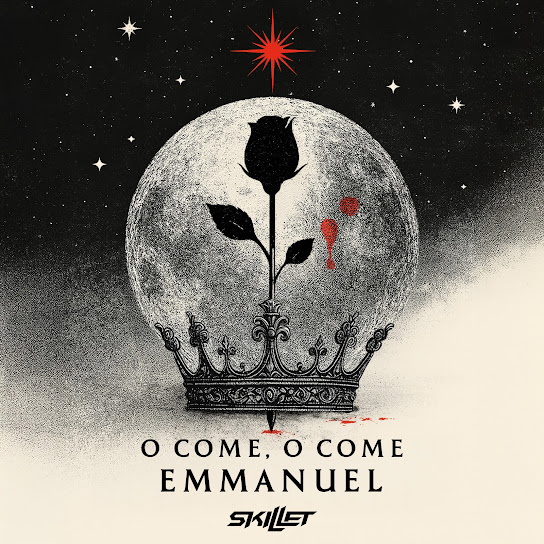
Three days ago, the Christian rock band Skillet released a new single (technically, two versions) of the 17-18th-century Christmas hymn, “O Come, O Come, Emmanuel,” (their first foray into Christmas music) to streaming services, accompanied by a music video and a promo-length clip of the video for social media. The response to the release has been polarizing, with voices we respect (as well as many we don’t) lining up on either side of its approval.
“O Come, O Come Emmanuel” has various historical English translations, and while we could spend time reaffirming the biblical doctrine of its lyrics, this has not been the source of controversy. Rather, the argument seems to be about whether the hard rock stylings of Skillet are an appropriate vehicle for the song and (more broadly) how much, if any, hard rock is appropriate in a Christian context. Considering the band’s refusal to cave to the spirit of the age that has engulfed so many other Christian bands who came of age in the mid-90s and 2000s, a third component of the debate might be the trustworthiness of Skillet’s (and particularly lead singer and bass player John Cooper’s) discernment in the polemical fights of the day, which has had some legitimate concerns.
The Band
I’m old enough to remember when Skillet looked and sounded like a Christian alternative to Oasis, with a 21-year-old John Cooper pulling off a convincing Liam Gallagher aesthetic. I was with my church youth group at Youth For Christ’s DC/LA 1997 DC conference, and was handed a free sampler CD with a bunch of quintessential mid-90s tracks from Christian acts with fittingly quirky 90s names: Bleach, Considering Lily, Grammatrain, Switchfoot, and yes, Skillet, who included a song called “Saturn.”
Following the early 2000s influence of nu-metal (think Linkin Park or P.O.D.), Skillet’s style moved towards the metal and cinematic sound fans know today, with records like 2006’s Comotose and 2009’s Awake seeing wide appeal on both Christian and secular charts.
Fast forward to 2020-present, and Skillet’s John Cooper has become outspoken in the culture wars, most recently writing the book “Wimpy, Weak, and Woke” to address cultural decay and left-wing infiltration of the church. Skillet’s Christian presence in the often depraved and dangerous secular music industry has seen no shortage of debate, conflict, and yes, some discernment misfires. Yet the distinction between the band and so many of their apostasized contemporaries (Switchfoot, Kevin Max, Jars of Clay, Relient K) must not be missed, if for no other reason than it should affect how Protestia or any other ministry approaches our interaction with them as brothers/sisters rather than enemies of the Almighty.
The Song and Video
Skillet’s rendition of “O Come, O Come Emanuel” (we’ll be discussing the first track rather than the “light” version) begins with Cooper’s rock-compressed vocals over cinematic piano arpeggios, as the video shows him in a darkened, sad room beside an empty hospital bed. A shot of what appears to be crystallized snow forming on rocks is interspersed.
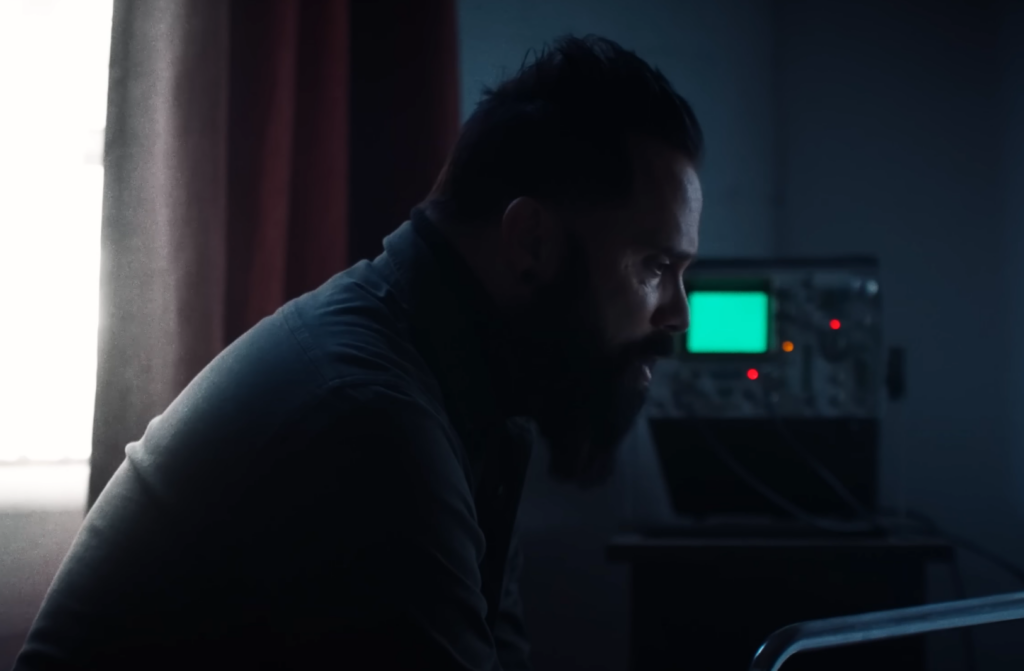
The narrative appears to be twofold: the lyrics of the song refer to Christ’s first coming, while the video seems to look forward to His second coming, when He will wipe away tears and sadness from events like losing loved ones. The second verse moves to a dark church, with long-time drummer and singer Jen Ledger adding harmonies and an “Our God is with us” counterline (the meaning of “Emmanuel”) as light enters the dark room, and is shown outside breaking through the clouds.
The third, “O come, Thou Day-Spring, come and cheer” stanza’s “Rejoice” sees the light fill the church and the hospital room, as Cooper and Ledger sing overlapping and harmonic lines. At this point, the arrangement and video could be from just about any Christian musical act.
It’s here where the controversy apparently starts.
The song/video drops the viewer into a desaturated room with a full hard rock rhythm section, flashing lights, quick video cuts, and Cooper offering a downbeat metal scream and an 8-bar instrumental before the song modulates from B minor to a guitar solo “rejoice” and vocal refrain in F# minor as the band rocks out. The song ends with a brief return to the prior piano B minor mode before fading to white.
Some in conservative evangelicalism seem to be under the impression that, when it comes to musical style, once the world has sufficiently linked a particular style with unbiblical ideologies, the style becomes sinful for Christians – not sinful or unwise for corporate worship, mind you, but off limits for Christian production or consumption. Such is one of two options underlying strident objections to Skillet’s “O Come, O Come, Emmanuel” itself, but it is not possible to directly derive this view from scripture, which clearly describes a variety of musical/dance/worship expressions that might very well be called off limits by the same voices who opposed “turning it up to 11.”
The other (in this case, distant) possibility is that one might oppose the song because they have objections to the band itself based on any number of potential discernment issues. This has more legitimacy, but it seems not to be the focus of the pushback against Skillet’s first Christmas release.
Discernment Misfires
To be sure, expecting a Christian band to enter the culture war conversation and rub shoulders with outspoken and controversial Christian ministers and movements without missteps is likely as unrealistic as expecting the Rolex of Polemics Watchblogs to not say something about it when they do. We’ve wondered why John Cooper was comfortable sharing the stage of Christian brotherhood with practitioners of false religions (a critique he shared with other brothers who should have known better), why Skillet links arms with purveyors of the false gospel of Rome (along with notably apostate groups like Jars of Clay and Switchfoot).
Legitimate concerns have been raised over the years about the wisdom or effectiveness of Christian bands participating in festivals or concerts featuring groups who actively hate and mock Christianity, yet Skillet has maintained an evangelistic posture for its participation.
While some may not prefer the hard rock stylings of Skillet (and may continue to express concerns about some of the aforementioned issues), there is nothing inherently sinful about turning up the volume, increasing the distortion on the amplifiers, or employing a double-kick pedal. There are valid criticisms of Skillet, but “O Come, O Come Emmanuel is sacred ground” (or “hard rock is inherently evil”) isn’t among them.













5 responses to “Song Review: Skillet’s O Come, O Come Emmanuel”
The one thing I have noticed, in regards to the MANY Christians, not just skillet is, they don’t actually know what Catholic believe and why we had really multiple reformations culminating in the reformations of the late 15th and early 16th century. I was raised by former Catholics so I understood a lot more about what made them heterodox, despite their insistence that THEY are the Orthodox ones. It is because of this ignorance, in the last year, I have devoted a lot of time to furthering my understanding of the many damning false beliefs of the Catholic church. Really good video on this topic: https://www.youtube.com/watch?v=5fIBTEE9iF8
Also, on the music side, I find it silly, as you clearly do, that people think music styles are inherently evil. It really comes down to the lyrics and the intent behind the music. There are plenty of Christian rappers and Christian hard rock/metal bands who are far better alternatives to the filth in these genres. Even though those who make the music are not perfect morally, and some of them, like Lecrae, or my formerly favorite band, Jars of Clay, go way off the reservation.
I wish we had more bands like Skillets, they have some blind spots for sure, but they seem to be trying to do the right thing, and be a light in dark places with the gospel. I commend that.
There is also absolutely a good reason Christians should be at these music festivals evangelistically. No, we should not participate in sinful activities, but most of these festivals offer a wide range of bands and views. There are thousands at these festivals in desperate need of Jesus and the Gospel. There are many Christians who go to Burning Man for evangelism, which is literally a giant hedonistic party with orgies. MANY people have been converted because of these evangelistic efforts. So many of these people have never heard the true gospel, I talk to people all the time, even who grow up in churches who do not know the gospel. We need to be out there shining a light and bringing the gospel to the darkest corners of the world. Satan is really good at convincing some Christians to avoid “sinful” locations, and by that I mean where sin is more likely to occur, not places that are only for sin, like a Brothel or a Opium house. Even people go into Planned Parenthod and Abortion clinics as pregnant women to try to convince women to not abort their babies, these are horrible places, but this is a good work, it’s not evil. We need to be careful not to be like the Pharisees, in the literal sense, where we make up rules and call them biblical. That is true legalism and it kills our faith and it kills evangelism.
“there is nothing inherently sinful about turning up the volume, increasing the distortion on the amplifiers, or employing a double-kick pedal”
Sorry I disagree. It gives more leeway to audio arts than visual ones. No one objects to the idea that an image depicting someone half dressed or committing a violent act is questionable because of how it can influence the viewer. In a similar manner, aggressive or discordant sounds can influence the minds and emotions of people. There is a reason why most action movies and video games have rock or rap soundtracks as opposed to classical. A great many songs and genres create images in the mind and emotional associations before a single lyric is sung. Yes he was Presbyterian but the late R. C. Sproul did an entire series on how art, beauty, etc. have subjective standards that can be validated using – at the very least – natural theology. Some musical forms are constructive and some are destructive. You do not need to be a postmil prattling on about notions like redeemed culture to recognize and acknowledge this.
Even in special revelation, the Bible at various points mentions songbirds. Songbirds sing according to harmony, melody and rhythm, not in menacing, guttural violent aggression. Yes, predators do the latter but the Bible does not enjoin us to snarl like the jackal or screech like the carrion fowl when giving praise.
I say this as a longtime personal fan of Christian rock and rap. I will not listen or endorse any of them for the reason alluded to in the article.
It’s so sad to see that even the Reformed church is now becoming heretical and lack any discernment.
Thinking that lyrics justify perversion is the height of complete apostasy.
I care less about your theology when your fruit is rotten to the core.
Not sure what the fuss with Skillet is about. It’s a beautiful rendition of one of my favorite carols (Oh Holy Night is the best) Skillet is not a choir, he is a hard rocker. I don’t know why anyone would expect anything different. This is no different than Dan Vasc’s monumental take on “Amazing Grace”, For King and Country’s “Little Drummer Boy” or even Madison’s Rising “National Anthem”. These are great takes on great musical staples. I like it!
It always amazes me when people say rock Music is inherently evil or demonic, but country music (as an example) is okay. I don’t see how anyone can argue that Dan Vasc’s take on Amazing Grace is anything but beautiful, and Skillet’s take on O Come O Come Emmanuel is not much different. I’m willing to listen to any Biblical argument anyone might have, but I have not heard a reasonable one yet.