
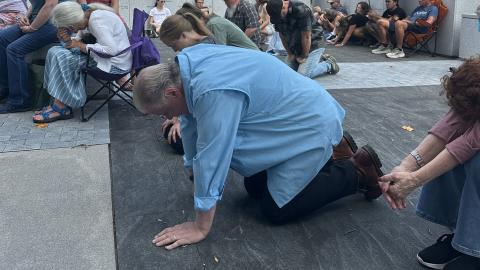

The province of Quebec has made good on its promise to put secular humanism at the forefront of its political and cultural life after passing new legislation (Bill 9: titled An Act respecting the reinforcement of laicity in Quebec)that enacts limits on public prayer and prohibits some daycare workers from wearing crosses and crucifixes. According to the CBC’s summary of the legislation, the law will now:
- Ban subsidized daycare workers from wearing religious symbols, with a clause exempting those already in their position.
- Prohibit public institutions, such as hospitals, from only offering food based on a religious tradition, such as halal or kosher meals.
- Phase out public subsidies for religious private schools that select students or staff based on religious affiliation.
- Ban prayer spaces in public institutions including universities, with some exceptions, as well as group prayers in public spaces such as parks without municipal authorization.
Much of the legislation has been in response to the rise of Islam in the country and growing anti-religious sentiment. The Muslim population in Quebec has quadrupled in recent decades, from 108,620 people in 2001 to 421,710 in 2021, and now represents more than 5% of the population.
Jean-François Roberge, the Member of Parliament and Super-Minister of Identity, has been the driving force behind the legislation. He has called public prayers in the streets “acts of provocation.”

Quebec has a long history of hostility towards religious groups. In 2019, the province passed Bill 21, which bans public sector employees, including teachers, police officers, firefighters, doctors, and nurses, from wearing religious symbols, such as crucifixes, while on duty.
Quebec’s Premier François Legault has strongly supported the measures to ban praying in public, saying:

“Seeing people praying in the streets, in public parks, is not something we want in Quebec. When we want to pray, we go to a church, we go to a mosque, but not in public places.”


















One response to “Canadian Province Bans Street Prayers, Daycare Workers From Wearing Crucifixes”
“The Crucifix Decrees were part of the Nazi Regime’s efforts to secularize public life.”