
Samuel Sey has been deported.
On October 30, the Ghanaian-Canadian Christian commentator’s wife, Annie, confirmed that her husband had been removed from the United States and was now in Canada, following his October 21 arrest by Immigration and Customs Enforcement at Columbus International Airport in Ohio.

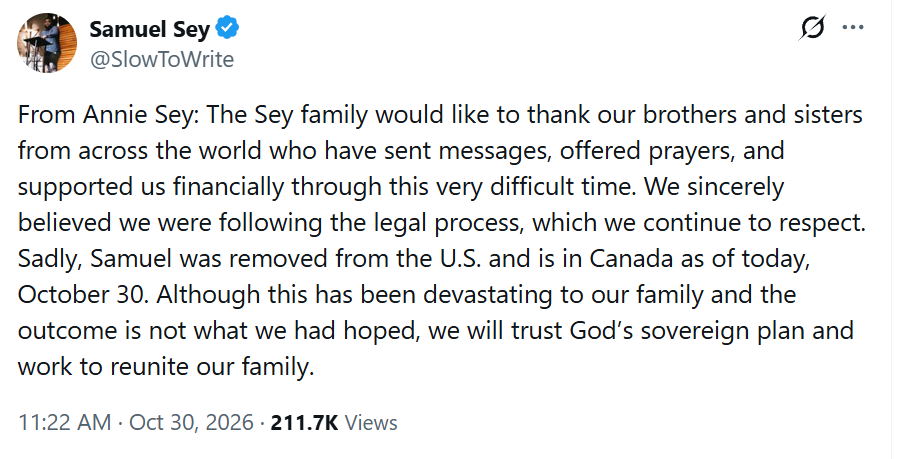
For Sey, his wife, and their three children, the outcome is understandably devastating. For certain Christian personalities who have spent years feuding with Sey over politics, race, and Christian Nationalism, however, the episode has apparently provided a welcome opportunity to celebrate what they regard as God’s personal vindication of their grievances. The result has been a spectacle.

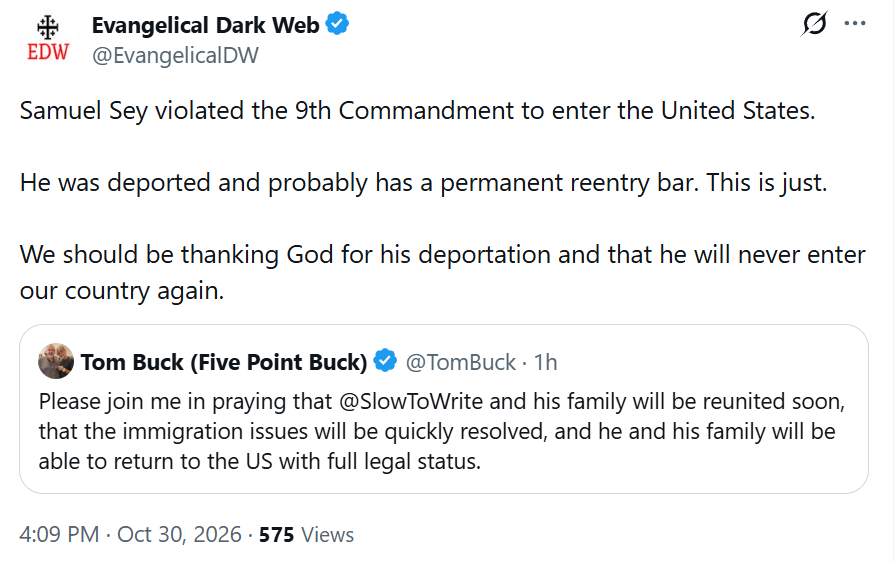
We’ve witnessed Christians congratulating themselves on the arrest of another professing Christian, allegations that Sey deliberately manipulated American immigration law, insinuations that his family’s account of the situation is dishonest, and even a pastor thanking God for using federal immigration authorities to “silence” a man he considers a liar and slanderer. All of this while a rather significant question remains unanswered:
What did Samuel Sey actually know about his immigration status, and when did he know it?
It’s a question that should be central to any Christian attempting to distinguish an unlawful circumstance from a deliberate act of dishonesty. Instead, some of Sey’s loudest critics have apparently decided that the answer can be inferred from something considerably more convenient: Sey previously said things about them that they didn’t like, and some things they vehemently disagree with. And since criticisms about them are to be considered categorically false (every fair critic with a brain knows no criticism of these guys can possibly be true), Sey must have spoken with malice – knowing that what he said was false and saying it anyway. And as he maliciously spread falsehoods about his opponents, it is not only reasonable, but in fact required, to credit his immigration situation to the same malice. But this kind of conscience-discerning bait-and-switch is not biblical reasoning. It is mystical spiritualization of personal grievance. It is a mess, and the fact that several pastors are promoting this self-promoting, superstitious reasoning only makes it worse.
What We Actually Know About Samuel Sey’s Immigration Case
The Department of Homeland Security says Sey legally entered the United States in 2022 but overstayed his authorized admission by more than four years. DHS also reported that he had no pending immigration applications and had accepted voluntary departure.
These are serious assertions that deserve the presumption of truth. None of Sey’s friends or supporters have offered concrete evidence that dismisses them. Some have even suggested that special consideration should be offered to Sey because he’s a Christian, but this has largely been in terms of charity for the family rather than special legal consideration, while the Seys themselves have consistently expressed support for the rule of law.
Protestia reported the DHS statements on October 26, even as Sey’s supporters were claiming that the detention involved some sort of administrative or clerical mistake. Sey’s family has maintained that he was attempting to comply with the law.
In an October 26 statement, Annie Sey explained that her husband entered the country legally and had been working with an immigration attorney to obtain permanent legal status. The family said it was attempting to understand what had gone wrong. On October 30, following his removal to Canada, she reiterated that they sincerely believed they had been following the legal process.
These statements do not establish that Sey actually possessed lawful immigration status. They do not establish that his attorney filed the appropriate documents, that the government made a clerical mistake, or that Sey was entitled to remain in the country. Nor do they establish that his removal was legally improper.
But they do raise an entirely separate question from whether his immigration status was lawful: whether Sey believed he was complying with the law.
A person can violate an immigration requirement without understanding that he has violated it. He can misunderstand a visa’s expiration, rely upon incorrect legal advice, confuse a pending immigration proceeding with authorization to remain, or simply make a serious mistake.
Alternatively, he can know precisely what the law requires and deliberately violate it. Neither possibility should be dismissed without evidence.
Sey’s reported domestic travel and international movements, which we discussed in our October 30 Bully Pulpit podcast, would be relevant to examining his understanding of his legal status if the details can be established. Someone deliberately hiding an immigration violation might reasonably be expected to avoid repeated encounters with federal border and airport authorities.
That would not prove his innocence of deliberate wrongdoing. But it would certainly be evidence worth considering. As of this writing, the public information does not resolve the question of Sey’s knowledge or intentions. Yet that hasn’t stopped certain Christians from speaking as though the contents of his conscience have been entered into the public record.
Joel Webbon Apparently Received a Special Revelation
Perhaps the most extraordinary response came from pastor Joel Webbon, whose October 27 program included a remarkable interpretation of Sey’s arrest.
Invoking Romans 13 and the language of the civil magistrate as God’s servant, Webbon declared:
“God sent his diákonos, his deacon, his avenger to capture, the slanderer, the liar, and shut his mouth before he could do any more damage to the people of God and to our United States of America.”
Read that carefully.
Webbon did not merely say that Sey had violated immigration law and was consequently subject to federal enforcement. He explicitly connected Sey’s arrest to his own accusations concerning Sey’s previous speech. In Webbon’s telling, the government had not simply enforced immigration requirements. Rather, God had sent His avenger to capture a supposed slanderer and prevent him from speaking further.
During a prayer on the same program, Webbon thanked God for Sey’s arrest and for shutting his mouth. He further prayed that Sey would be deported so the country would be relieved of his influence (which of course makes no sense in the internet age).
Now, there is a perfectly legitimate Christian discussion to be had concerning immigration law, Romans 13, the obligations of foreign nationals, and whether deportation constitutes an appropriate civil consequence for unlawful presence (which of course it does). But Webbon was doing something else entirely. He was taking a governmental action concerning immigration status and interpreting it as God’s specific punishment for speech he personally regarded as sinful.
The distinction is obvious. The government detained Sey over immigration status. Webbon celebrated the detention as divine vengeance for alleged slander. Where, exactly, did he acquire the authority to make that connection? Did DHS determine that Sey was a slanderer? Did an ecclesiastical tribunal adjudicate Webbon’s accusations? Did anyone establish that Sey knowingly made false statements concerning Webbon or his associates? More importantly, what does any alleged prior slander have to do with Sey’s understanding of American immigration law? Nothing, so far as the evidence presented establishes.
Yet somehow these unrelated categories have been mashed together into a single moral indictment, complete with a pastoral prayer celebrating the result. It’s a convenient move. All that’s required is to presume that because Sey criticized you in the past, his present legal difficulties must be God’s judgment upon him for having done so.
Would the same interpretive principle apply if Webbon or any of the other conscience seers suffered some unfortunate civil consequence? Would every speeding ticket, late fee, fine, or other civil penalty applied to our theological opponents be evidence of God’s vengeance on our personal behalf? Would we then be entitled to declare that God had sent His avenger to silence them?
Of course not. That would be vindictive, uncharitable, and a misuse of Scripture.
When Being Wrong Becomes Lying
The underlying error concerns a distinction that should be elementary to Christians who routinely accuse one another of violating the Ninth Commandment: Making a false statement is not necessarily the same thing as telling a lie.
Suppose Sey has made false accusations about a Christian Nationalist commentator. Suppose he has misrepresented someone’s position on race, immigration, or civil government. Suppose the accused individual can demonstrate beyond reasonable dispute that Sey’s characterization was objectively incorrect.
What has been established? That Sey was wrong. What has not necessarily been established? That Sey knew he was wrong. This is not a trivial distinction. A person who sincerely believes an erroneous claim and communicates it as true has committed a different moral act than someone who knows a claim is false and deliberately communicates it to deceive others. Both might produce identical false statements. Both might cause harm.
One might be guilty of negligence or recklessness, while the other is guilty of deliberate dishonesty. But the mere falsity of the statement does not establish the speaker’s knowledge or intention.
Scripture condemns lying (Leviticus 19:11; Colossians 3:9), false witness (Exodus 20:16), and malicious speech (James 3:5–10). It also recognizes distinctions involving ignorance, intention, and culpability, as demonstrated by the treatment of unintentional and high-handed offenses in Numbers 15.
Christians can certainly sin through reckless accusations, irresponsible reporting, and willful refusal to consider corrective evidence. But those sins must be identified according to what can actually be established. You cannot simply declare every mistaken opinion an intentional lie because you personally find the mistake offensive.
Which brings us to one of the more revealing ironies of the Sey controversy. The very people who have accused Sey of being wrong about practically everything appear unwilling to entertain the possibility that he might also have been wrong about his immigration status.
Apparently, Sey is sufficiently incompetent to misunderstand Christian Nationalism, race relations, political philosophy, and the character of his opponents, but simultaneously sufficiently calculating to have orchestrated a years-long immigration deception while maintaining the appearance of legal compliance (and apparently, back to ignorant enough to try to get through TSA while knowing he was not a legal resident).
Could he not simply have been mistaken? Could he not have misunderstood something? Could he not have relied upon incorrect information, just as his critics insist he has done in other contexts?
Those possibilities do not establish what happened. But the apparent unwillingness to consider them reveals something about the quality of the current arguments being made.
Deception, Lying, and the Limits of Human Judgment
Another contributing problem is the way online Christians collapse the concepts of falsehood, deception, and sinful intent into a single undifferentiated accusation.
Scripture is considerably more careful. Rahab concealed the Israelite spies and misdirected those searching for them in Joshua 2. Hebrews 11:31 and James 2:25 commend her faith and her protection of the messengers. Christians have historically disagreed over whether her false statements were themselves morally permissible or whether God commended her faithful actions despite an accompanying lie.
But the account certainly demonstrates why not every instance of concealment can be analyzed without regard to its purpose and circumstances.
Likewise, Paul’s escape from Damascus in a basket (2 Corinthians 11:32–33) involved deliberately avoiding the authorities who sought to seize him. There is a difference between concealment, misdirection, false assertion, and sinful lying. Not everyone is entitled to every piece of information, and withholding information is not automatically dishonest.
More importantly for Sey’s situation, a person who mistakenly believes something false is not thereby practicing intentional deception. The specific moral character of an act depends upon facts that must actually be established. Consider the accusation that Sey knowingly misrepresented his immigration status.
To establish that claim, one would need evidence showing that he understood his authorization had expired, understood that he lacked a lawful basis to remain, and nevertheless deliberately represented his status otherwise. That evidence might exist. Correspondence with his attorney or others might reveal it. Immigration notices might establish what he was told. Statements by Sey himself might illuminate his understanding.
But DHS’s determination that his authorized stay had expired does not independently establish all those additional facts. And evidence that Sey previously criticized Christian Nationalists certainly doesn’t establish them. This is why Paul’s warning in 1 Corinthians 4:5 matters. He cautions against premature judgment, observing that the Lord will disclose hidden things and reveal the purposes of the heart.
The passage does not prohibit Christians from judging doctrine or externally observable conduct. It prohibits our pretending to possess divine insight into motives we cannot yet know. We can examine a man’s actions. We can examine his statements. We can even infer intent when the evidence actually supports that inference. But we cannot transform personal certainty into evidence and then call the result righteous judgment.
The Christian Nationalist Grievance-to-Guilt Pipeline
One of the more disturbing aspects of Sey’s situation is how neatly it illustrates a recurring pattern among certain online Christian Nationalist personalities.
Sey has publicly criticized elements of the Christian Nationalist movement, particularly positions involving race, ethnic identity, and national belonging. Some of his opponents have strongly disputed those criticisms. They believe he has misunderstood or misrepresented their positions and have consequently accused him of dishonesty, slander, and maliciousness. These disagreements are perfectly legitimate subjects of public debate.
At Protestia, we have our own substantial disagreements with Sey. We’ve criticized what we consider erroneous or progressive tendencies in aspects of his thinking, and we have no intention of pretending those differences have disappeared. We’re not Sey’s personal public-relations department.
We don’t need to agree with his political analysis, his commentary on racial issues, or his treatment of other Christian figures to recognize that he may sincerely believe the things he says. And we certainly don’t need to agree with him to insist that accusations against him be supported by evidence. But some of his critics appear to have adopted a considerably less discriminating approach.
The logic is roughly as follows:
Sey criticized me. His criticism was false. Because I know it was false, he must have known it was false. Therefore, he deliberately lied about me. Therefore, he is malicious. And because he is malicious, any subsequent controversy involving him may be interpreted through that established moral verdict, even to the point of ridiculously characterizing Sey’s writing/speaking as some sort of existential threat to Western Civilization itself.
It’s a remarkable little machine.
Feed it a theological disagreement, and it produces a comprehensive judgment of another man’s character. Feed that judgment into an unrelated immigration controversy, and out comes a declaration that his legal difficulties must be intentional, deserved, and perhaps even providential punishment for his previous criticism.
The machine is especially efficient because the person operating it never has to demonstrate the crucial step: that his opponent actually knew the disputed criticism was false. His own offended sensibilities apparently constitute sufficient proof. And once the label of malicious liar has been applied, every subsequent accusation becomes easier to believe.
This is the same intellectual error underlying the increasingly popular practice of declaring theological opponents categorically unworthy of sympathy, fellowship, or even ordinary charitable consideration. An opponent is transformed from a Christian with allegedly erroneous views into a fundamentally malicious actor. Once that transformation occurs, practically anything can be justified as an appropriate response.
Now we can celebrate his detention. We can interpret immigration enforcement as God’s revenge for personal criticism. We can treat the disruption of his family as a morally satisfying development. And all while insisting, naturally, that none of it is vindictive. Obviously not. It’s merely the righteous satisfaction of watching a man who criticized you suffer consequences for something entirely unrelated.
How very spiritual of us.
A Violation of Immigration Law Does Not Establish a Sin of Dishonesty
Let’s be perfectly clear about what we’re not arguing. We’re not arguing that Christians should receive special exemptions from immigration law. Sey should not be allowed to remain in the United States if he lacks lawful authorization. His family’s sincere belief about his legal status, if genuine, does not establish a legal defense.
And the government does not need to prove that immigration violations are intentional before enforcing the applicable law. Civil statutes and administrative requirements should impose consequences independently of a person’s subjective understanding. A person may be legally responsible for something he did not understand. That is an ordinary feature of blind justice.
But legal responsibility and moral culpability are not synonymous. The fact that an individual is subject to a lawful civil consequence does not tell us everything about his motives, sincerity, or spiritual condition. A man can owe taxes he mistakenly believed were already paid. He can violate a licensing requirement he misunderstood. He can fail to comply with an administrative deadline through negligence, bad advice, or honest confusion.
The government still has the authority and responsibility to enforce the applicable requirement. But the existence of the violation doesn’t establish that the man was deliberately dishonest. Why should this elementary distinction disappear when the subject is Samuel Sey?
There is a legitimate question concerning whether Sey was lawfully present. DHS has offered its determination, and the government has now removed him. There is another question concerning whether Sey deliberately deceived others about his status. The latter question does not automatically follow from the former. And it certainly cannot be answered by producing a collection of his previous criticisms of Christian Nationalism.
Romans 13 Does Not Make You the Judge of Samuel Sey’s Heart
There is an additional theological irony here.
Sey’s opponents’ invocation of Romans 13 is particularly revealing because the passage describes the governing authority as God’s servant in the administration of civil justice. It does not appoint individual Christian commentators as interpreters of God’s hidden purposes in every governmental action. Nor does it authorize a pastor to conclude that because the magistrate acted against someone, the action must represent God’s punishment for whichever unrelated sins the pastor believes that person committed.
The distinction is critical.
Government authorities possess a legitimate, God-ordained jurisdiction. Their decisions can still be mistaken, their actions unjust, and their officers personally sinful. Even when government acts lawfully, we cannot simply infer that every consequence represents God’s particular judgment upon an individual’s unrelated behavior.
The existence of divine providence does not give us privileged access to the reasons for every providential event. Christ Himself directly challenged simplistic connections between suffering and personal guilt in Luke 13:1–5. When questioned about Galileans whose blood Pilate had mingled with their sacrifices, Jesus rejected the assumption that they were worse sinners than other Galileans because they suffered such things. The lesson was repentance, not an invitation to identify a victim’s supposedly deserving sins.
Likewise, the account of the man born blind in John 9 opens with the disciples attempting to assign his condition to a particular sin. Christ rejected their proposed explanation. Neither passage prevents Christians from recognizing that particular sins sometimes produce particular consequences. But they do warn against the presumption that we can simply read God’s hidden purposes from another person’s misfortune.
So when Webbon or anyone else describes Sey’s detention as God sending His avenger to silence a slanderer, he is doing more than affirming the authority of ICE. He is interpreting God’s purposes in the event according to his own preexisting judgment about Sey’s speech.
And he is doing so without demonstrating the causal or moral connection. Romans 13 does not supply the missing evidence. Calling the immigration officer God’s diákonos doesn’t supply it either. The government may have acted within its authority to remove someone lacking legal status. That does not establish that God commissioned the action to avenge Christian Nationalist grievances.
Even a Guilty Man Is Not Guilty of Everything
Suppose additional evidence emerges tomorrow establishing that Sey knew his immigration status was unlawful. Suppose correspondence demonstrates that he understood the problem and knowingly remained in violation of applicable requirements. Then Christians would have an appropriate basis to evaluate that conduct as deliberate.
If he knowingly made false representations to obtain benefits or deceive supporters, those specific representations could also be examined for dishonesty. We will report that evidence. We would not excuse it merely because Sey professes Christ, opposes abortion, or holds some political positions with which we agree. But here’s the important part.
Even if Sey deliberately violated immigration law, that would not retroactively validate every accusation his theological opponents have made against him.
It would not prove that his criticisms of Christian Nationalism were malicious. It would not establish that his previous statements about race were knowingly false. It would not prove that every unflattering characterization he made of his opponents constituted sinful slander. Each of those accusations requires its own evidence.
A person can be guilty of one thing and innocent of another. He can be mistaken on one subject and correct on another. He can knowingly deceive in one circumstance and genuinely misunderstand another. Christians shouldn’t need an extended theological treatise to understand this.
Yet the discourse surrounding Sey suggests that some have adopted the opposite presumption: once a person has been categorized as a liar, he becomes presumptively guilty of any subsequent accusation.
That’s not how biblical justice works.
Exodus 23:1 warns against spreading false reports. Deuteronomy 19:15 establishes the importance of adequate testimony in adjudicating wrongdoing. Proverbs 18:17 reminds us that the first person to present his case appears correct until another examines him. And the Ninth Commandment doesn’t suddenly stop applying because the person being accused has a history of criticizing you. Quite the opposite.
If you claim Sey knowingly lied about his immigration status, you have made a factual and moral accusation that requires support. If all you can demonstrate is that he was unlawfully present, then that is what you can responsibly say. If you claim Sey maliciously slandered you in the past, demonstrate that accusation according to the available evidence.
But you don’t take your own allegations about his previous speech, declare his entire character adjudicated, and then treat that declaration as proof concerning unrelated circumstances. That’s self-serving circular moral reasoning decorated with Scripture references.
The Actual Sin We Should Be Concerned About
There is no shortage of legitimate disagreement concerning Samuel Sey. His views can be examined, criticized, corrected, and challenged (and we’ve certainly done so). His immigration situation can be investigated. Public statements concerning his legal status can be compared against documentary evidence. If deliberate wrongdoing is established, it can be identified and condemned.
But the Christian response should begin with the evidence and proceed only as far as the evidence permits. It should not begin with a conclusion concerning his wicked heart and work backward until every available fact can be made to fit. That’s the central problem with much of the online Christian reaction to this controversy.
Some of Sey’s opponents appear to have confused their personal certainty that he wronged them with objective evidence of his malicious character. They’ve then treated that supposed character judgment as permission to presume malicious intent in an unrelated immigration matter.
And when government enforcement produced consequences for Sey, they announced that God Himself had vindicated their previous accusations. But none of those conclusions necessarily follow. Sey may have been wrong about his immigration status. He may have been negligent. He may have been deliberately deceptive. The evidence will determine what can be said responsibly.
What cannot responsibly be said is that his intentions are established merely because he previously disagreed with Joel Webbon or criticized certain Christian Nationalists. That is not biblical reasoning. That is a personal grudge masquerading as discernment. And pastors, of all people, should know better.
Christians are commanded to speak the truth, judge righteously, refrain from bearing false witness, and exercise charity toward their brothers. Those obligations are not suspended when the person under examination has publicly criticized us. Nor does being on the receiving end of a supposedly false accusation make us omniscient concerning the accuser’s heart.
You can be right that Samuel Sey is wrong about Christian Nationalism. You can be right that he mischaracterized your positions. You can be right that his immigration status was unlawful. And you can still be completely wrong about whether he was deliberately lying.
Being right about someone’s error does not make you right about his motives.
And being the target of his criticism certainly doesn’t entitle you to presume those motives in perpetuity. God knows the heart. You don’t. The Ninth Commandment applies to your accusations just as surely as it applies to his. And if your response to another Christian’s removal from the country is not thankfulness for the equal application of justice, but rather to thank God that the government has finally “silenced” your critic, perhaps it’s time to examine the one heart over which you actually have some knowledge and responsibility. Your own.