
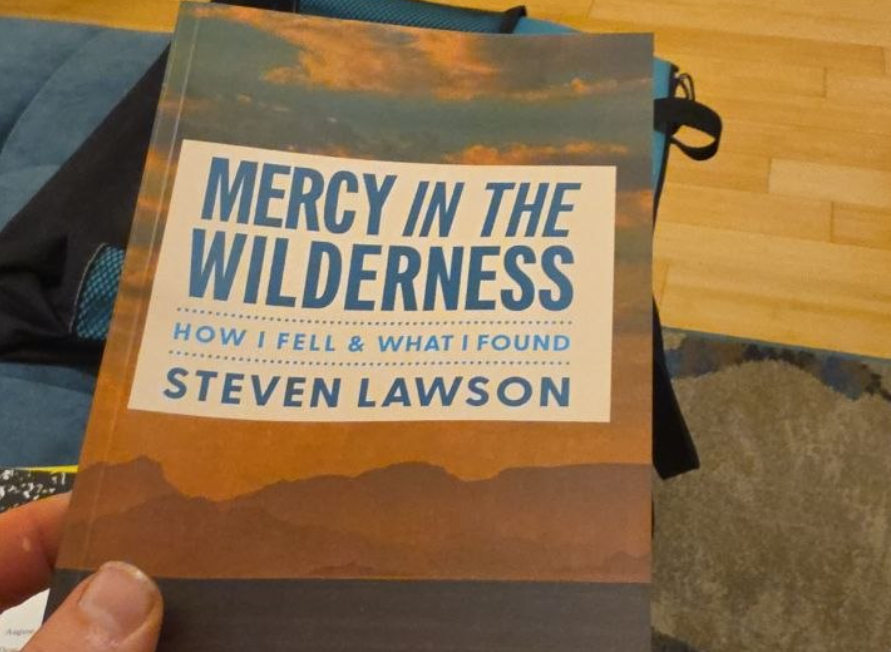

Last week, I was sent screenshots of a paperback on Amazon, released September 1st, 2026, authored by “Dr. Steven Lawson.” I’ve placed this in quotes because there is another “Steven J. Lawson” on Amazon, seemingly tied to Steve Lawson’s previously published material. Although, strangely, the bio of Amazon Lawson 1.0 seems to belong to Mike Curtis, an author and pastor in Florida.
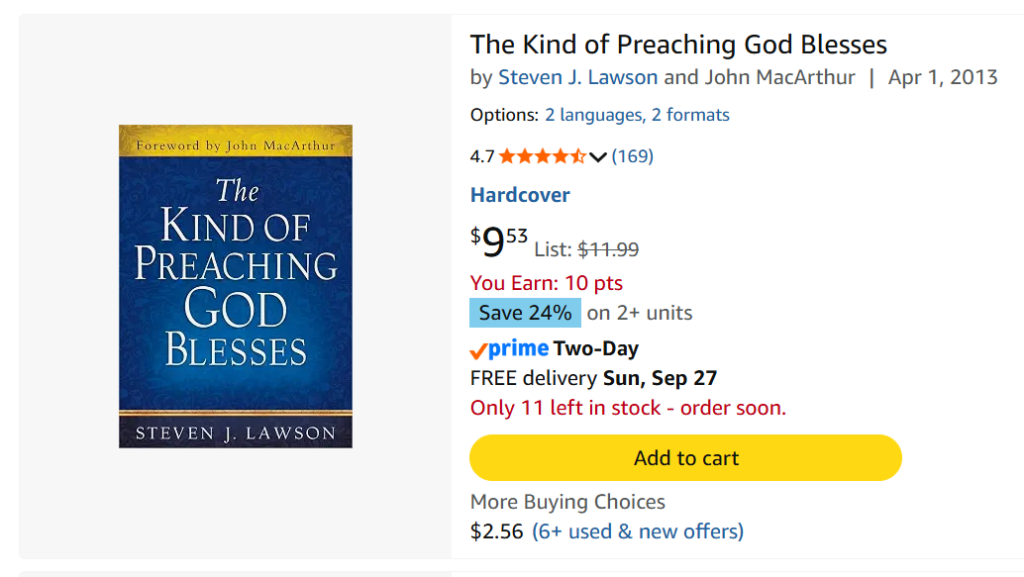
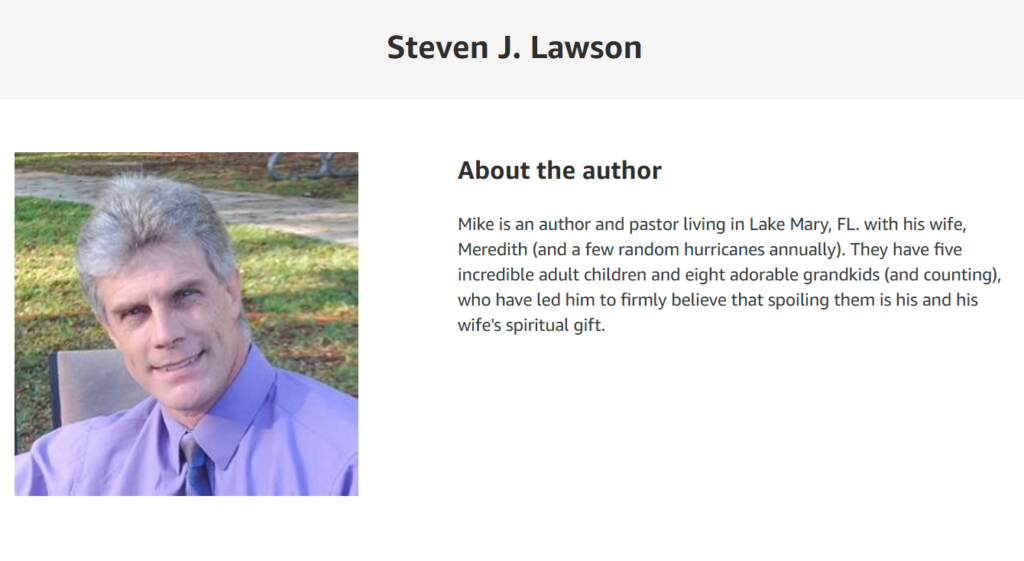
After reading the example pages from the Dr. Steven Lawson book and noting the sheer volume of nonspecificity (not to mention the lack of a digital version, audiobook, etc.), I was fully convinced it was not the real Steve Lawson’s book. Nearly every bit of prose in the example pages could have been generated by AI that was fed public reporting on Lawson’s fall, and there are near-limitless examples of falsely authored, self-published books trading on known authors yet containing nothing more than AI-regurgitated public information.
Yet primary sources did confirm that the book was from the Steve Lawson, and considering our involvement in reporting on his 2024 fall, I felt a journalistic responsibility to our supporters and readers to read and review the book for myself.

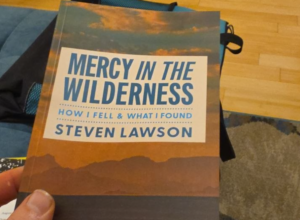
Steven Lawson’s Mercy in the Wilderness: How I Fell & What I Found begins with a striking assertion: “The details of my story are not important.” It is a difficult sentence to place near the beginning of a book about his fall.
Lawson is right that readers have no claim to the intimate details of his sin. His wife, family, and the other woman are not characters whose private lives must be exposed to satisfy public curiosity. But Lawson has chosen to publish a book about what led to his sin and what followed it. The question, then, is not whether he owes us every detail. It is whether the account he has chosen to give offers enough particularity to warrant making a public book out of it. As I initially suspected, it does not.
The book is organized around Lawson’s descent, his recovery, and the mercy he says he found along the way. He describes an overloaded ministry schedule, neglected communion with God, pride, spiritual complacency, harsh preaching, and neglect of his wife. Some of these admissions are concrete and painful. He recounts that his wife asked him to seek marriage counseling and that he refused because he was too proud. That is more revealing than a generalized statement that he had failed as a husband, and it deserves to be taken seriously.
But such moments are surrounded by pages and pages of familiar formulations. Lawson was too busy. His guard was down. He ignored warning signs. The devil set a trap. He hit rock bottom. God met him in the wilderness. Again and again, the prose returns to variations on the same images and assurances. In the final chapter, the discovery of mercy is announced, illustrated by an oasis, streams in a desert, and a fountain, then announced again. Repetition can serve devotional writing; here, it frequently takes the place of development. The reader finishes a passage knowing how intensely Lawson says he felt, but not necessarily understanding much more than at its start. Lawson is emoting, but the reader is kept at a measurable distance.
That matters because this is not simply a book about a Christian experiencing hardship. Lawson’s hardship followed his own sustained wrongdoing, and other people bear consequences they did not choose. Yet the narrative’s center of gravity repeatedly settles on what he lost: ministry, income, friendships, credibility, peace, and a sense of purpose. His account of Christians who housed, fed, counseled, and encouraged him may be sincere. It also occupies considerably more space than any clear account of where the damaged relationships now stand.
I am not asking Lawson to speak for his wife. Quite the opposite: her perspective is hers to disclose or withhold. But restraint concerning her privacy should also restrain his claims about the meaning and progress of his own story. The book says he attempted reconciliation with family members. It does not plainly tell readers that his marriage has been reconciled. According to witnesses, Lawson and his wife remain estranged. If that is so, readers should resist treating a moving account of his spiritual consolation as the conclusion of a restoration story whose most consequential human relationship apparently remains broken.
The distinction is theological as well as literary. A Christian may genuinely repent, receive God’s mercy, and remain subject to lasting consequences. Reconciliation cannot be narrated into existence by the person who caused the injury. Nor does the affirmation of pastors and elders—even pastors and elders who have cared for him faithfully—settle every question a reader may have about his public witness. Their encouragement would be important to know about. It would not make his family’s interests, or the wisdom of publication, irrelevant.
Indeed, why publish this book now? Lawson already made a public confession. A book sold to the public is a different undertaking. It asks readers to spend time with his interpretation of events and invites renewed attention to a family still living with their consequences. Perhaps Lawson hoped his account would warn others and encourage sinners to repent. Those are worthy aims. But they do not automatically justify every means of pursuing them, particularly when a more private statement could communicate responsibility without placing his family back inside a public narrative centered on him.
There is also a missed opportunity in the book’s treatment of ministry accountability. Lawson describes traveling, preaching, teaching, writing, and producing at a pace that left little room for his wife or ordinary fellowship. He recognizes his own pride and neglect. But how did a pastor maintain such a life for so long? Who could question him? What happened when his wife raised concerns? What safeguards would have mattered, beyond the familiar exhortation to pray more, slow down, and remain alert to temptation? These are not requests for salacious detail. They are questions a book offered as a warning to other Christians—especially other ministers—really should answer.
Lawson’s discussion of his preaching raises similar questions. He now describes himself as having become combative, harsh, and more interested in judgment than mercy. That self-criticism is noteworthy. But a fuller account would have examined whether the problem lay only in his tone or also in a ministry culture that rewarded a forceful public persona while leaving private life insufficiently accountable. Instead, the analysis tends to return to Lawson’s inner condition. The public systems that helped make his prominence possible receive less scrutiny.
None of this requires a reader to deny that Lawson is repentant. We simply cannot see into his heart, and I do not need to pronounce on it to evaluate his book. Nor should Christians make forgiveness contingent upon the production of a sufficiently compelling memoir. The concern is almost the reverse: if the details that would make this account instructive properly belong to other people, perhaps this was not yet a story suited to a book.
Mercy in the Wilderness contains real admissions, including a particularly consequential one about his refusal to seek marriage counseling. It also contains far too much language that could have appeared in a generic book about failure and grace. Lawson is free to testify that he has found mercy. Readers are equally free to ask whether this repetitive, largely self-focused public testimony was the wisest way to do so—and whether its publication serves the people most deeply affected by his sin.

















9 responses to “Mercy in the Wilderness: A Public Testimony That Says Too Little”
Solid take.
f I want advice on how not to sin, I believe I’ll seek advice from someone who didn’t sin. Too much of this sort of inherent self-centered analysis, and necessarily humanist “how-to”, can very quickly run counter to the Gospel and reach the point of blasphemy of the Holy Spirit. Especially when it does not address the underlying wickedness of the heart and the understanding that sexual sin, adultery, and so on, are the culmination of something more wicked that exists in the heart.
It is clear that Mr. Lawson is not born again. One who is born of God will not continue in sin. 1 John 3, etc. And his further dodging of the truth of the Gospel, of what it means to be born again, indwelled by the Holy Spirit, with the implanted word, is just more evidence of that fact. The focus is still on the flesh, what the flesh did wrong, and what the flesh can do to save itself. The chaff is just exposing itself further.
There is ONE and ONLY ONE way to counter and avoid the wickedness and corruption of the flesh and corruption of creation. And that way is the indwelling of the Holy Spirit. That one way is becoming born again. That is the Gospel of Jesus Christ.
And to direct attention away from that fact, away from the Gospel, and the miraculous supernatural work of the Holy Spirit, is to blaspheme the Holy Spirit.
“I couldn’t do it. I failed. It was too much” … “I couldn’t hold the flesh at bay. I was consumed with what the flesh wanted.” … etc.,etc.
Well, no kidding Sherlock. There’s a cure for that problem. It’s called the Gospel …
So many have all sorts of academic knowledge, but have never come to a knowledge of the truth. They’ve studied the book cover to cover for years and decades, but its contents have still not registered with their noggins. They still don’t truly understand it. They still have not “come to a knowledge of the truth”. And it many cases, the reason why is because they don’t really want it to. There is deep wickedness in the heart, in many cases that they don’t even know is there. And they are blind to it – often times willfully and knowingly blind to it, dodging and ignoring it on purpose.
The result of it is a “church” that is as described in 2 Tim. 3. It’s all about the here and now. All about comfort and service of the flesh. All about how the flesh can correct itself. All about being lovers of pleasure, with a form of godliness that denies the power thereof – a fake and fraudulent godliness, a bandied on top of a wicked heart that will fail and crumble when put to the slightest test. Because it has blasphemed the Holy Spirit and denied the power of the Holy Spirit to counter the flesh and to thereby cleanse the heart.
And so that’s the problem. He has pretty much denied the Gospel.
You make a lot of statements. This one stood out the most – “It is clear that Mr. Lawson is not born again. One who is born of God will not continue in sin. 1 John 3, etc.”
You have drawn a conclusion about the spiritual state of this man quoting a bible verse but not giving any basis for your application/interpretation.
The natural inference from your statement is that Lawson is still continuing in sin. Is that the case? Or do you mean to say he continued in the sin of an adulterous relationship for too long?
I am concerned with how casually we Christians cast verdicts upon others, especially in the online world.
Have we even begun to realise the seriousness of the words of the Lord in such matters? – Matthew 7:2 ; Matthew 12:36 .
I’m more concerned with the eternal fate of others who are led to believe they are eternally secure when God’s word very clearly states that one who falls back into sin is certainly not (Heb. 10, Jude, 2 Pet. 2, etc.). I’m more concerned for those who are being led astray than I am concerned for the feelings of an obviously wicked man. He did what he did. He is what he is. He is chaff.
The end of your wrong reasoning Alex, is a race to the bottom, where sin ends up being entirely overlooked. It is that wrong reasoning that has turned the church into an apostate dumpster fire.
Your reasoning, Alex, is basically that it’s ok to engage in the worst of all sins as long as it’s not made into a practice.
Now consider whether or not one who is truly born again, indwelled by the Holy Spirit, would or could possibly fall back on such wicked reasoning? That’s perverting the grace of God into a license to sin.
What does it say in passages such as 1 Cor. 6:9-11, Gal. 5:16-21, Eph. 5:3-12, Rev. 21:8, Rev 22:15? It lists the sins. Why does it list the sins? When you understand the answer to that question, then you’ll begin to understand the true Gospel.
Read Eph. 5 again. What does it say? “… must not even be named among you … ”
I’m telling you that sin worsens as it continues. Lesser sins compound. And the type of sin, indeed the manifestation of the wickedness and corruption of the heart, gets worse. When and if it reaches the point of sexual immorality, it has already progressed and continued for far, far too long. It didn’t start with the adultery. That’s just where it ended up. (and yes, though he may not be continuing in sexual immorality at this time, he is, for reasons given, continuing in sin with the sinfulness of his book being the latest example) One who is indwelled by the Holy Spirit will be convicted long before it ever reaches that point. You have to understand what sin is. It is wickedness and corruption from the sin of Adam. It is out of the wickedness of the heart (uncorrected by the Holy Spirit) that the specific sins manifest (Mark 7:21-22, etc.)
1 Cor. 6 makes it extremely clear – Mr. Lawson should not be welcome anywhere within the doors of any congregation of born again Christians, much less trying to teach anyone anything at all. If he knew anything – more aptly had come to a “knowledge of the truth”, he wouldn’t have sinned as he sinned in the first place. You see how he continues pridefully in his wickedness. Nobody needs any advice from a sinner how not to sin. That too is a race to the bottom that can very quickly lead to the justification of sin and subsequent condemnation of righteousness (Prov. 17:15) Jesus is the author and perfecter. If I need advice on how not to sin, I’ll take His advice …
One who is indwelled by the Holy Spirit, born again, would not do what Mr. Lawson did. And that’s what God’s word says about it. And your concerns frankly don’t matter. Neither do mine. We don’t know or understand what He knows, and we’d be wise to quit trying to out-think Him. It says what it says. Accept it or don’t, that’s your decision. Choose this day whom you will serve (Joshua 24:15).
God’s word says what it says. You can accept it, or you can reject it. That’s up to you. But if you have a problem with it, you need to take that up with your Creator, and try to explain to Him how you know better than he does. I did not write it. He did.
Matt. 7:1-2 is about hypocrisy. It is not about hurting the feelings or having pity for those who suffer due consequence for sin. (at some point, such pity becomes a matter of telling God that He is not loving and is wrong – there’s a reason Deut. 19, etc. says “your eye shall not pity”). The commandments of God are not grievous (1 John 5). Matt. 7:1-2 essentially means not to make up one’s own standards, but to stick with the commandments of God. That’s the one and only way one can possibly avoid being a hypocrite. Right. You can’t for everyone else to abide by your own contrived standards, by the commandments of men, by things God never commanded – that’s what the pharisees were doing. So anytime you are holding to and trying to impose your own standards according to your own reasoning, you will be completely unable to avoid quickly becoming a hypocrite. This is why Jesus named hypocrisy as a tell-tale sign – the “leaven” of the pharisees (Luke 12:1, etc.). And so you might want to consider which of us here is not acting in accordance with Matt. 7:1-2.
These are some things for you to consider.
Ultimately you have to ask whether or not you love those who may be led astray by a false gospel. You have to ask whether or not your concern for the one who sinned supersedes your concern for those who may be led to eternal damnation. Which is more important? The feelings of a wicked man in the here and now, or the eternal fate of the lost who may be led astray by a false gospel? Scripture very clearly gives that answer to these questions. But I ask you to consider them in order to understand how and why God’s word is not unloving, hypocritical or unfair. There is nothing unloving, mean, hypocritical, unfair, etc. in what I posted about Mr. Lawson. The opposite is the case. I have a lot of concern for those who may be led astray. And I have zero pity for a wicked man who knew better, suffering the due consequence of his sin. He is in a far worse condition than before (Heb. 10).
Be very careful Alex. Too much leaning on your own understanding will lead you in the wrong direction every time. Just do what God says to do. Honor what His word says. And let Him worry about the results. That’s His domain.
It’s about eternity, Alex. It’s about the eternal fate of each and every person alive. For God is not willing that any should perish (2 Peter 3:9)
The Gospel of Jesus Christ is not about some sort of social group, some sort of restoration back into “polite society”. It’s not about the here and now.
It’s about where people will spend eternity …
I’ve been where you are. And I’ve thought about things the way you are thinking about them. Alex, none of us are without sin. But when we fall into that sort of thinking what we’re really doing is having more concern for ourselves, our own temporal “fate” in the here and now, how it might affect us in this life. It’s all about self love and far too much concern for oneself. That’s the real reason we react with an improper interpretation of the old goto passages often warped into excuses to sin, such as Matt. 7:1-2. When we do that, it’s not about truly loving others. It’s not even about any concern for Mr. Lawson. It’s about concern for ourselves, the acceptance and inclusion in a social group, restoration to “polite society”, as well as our need for mammon. That becomes our false gospel. We end up evaluating everything based on the opinions of others, and in so doing end up putting them, and/or some organization of them, in God’s place where they do not belong. Even when Jesus Himself has warned us against it, and told us that there would come a time when we would not be welcome in the churches. Even the church cannot take God’s place. It is His opinion and His acceptance that matters.
That’s where Mr. Lawson is. He’s still preoccupied with the here and now and the temporal things of this world. And his book is evidence. An attempt to try to salvage something in the here and now, and more concern for himself than those he may be leading astray. That’s the false gospel I’m talking about here. He’s trying to salvage a business career, a reputation, be restored to polite society, be accepted by congregations of men, put more mammon in his wallet, and so on.
Hell will have no shortage of “pastors”. You can be assured of that fact …
The Lord and only the Lord decides who is in his flock. We don’t decide that. And don’t be fooled, Alex, that’s not what I’m doing in my comments here. I’m doing the opposite. I don’t decide Mr. Lawson’s eternal fate, good or bad. I cannot reward him with Heaven anymore than I can condemn him to Hell. Right? No man has the power to restore him to the Body of Christ. That’s the Lord’s domain. We do not decide these things. God does. So we must stick with His word, and boldly speak it no matter who might take offense. And His word is very clear on the subject …
It’s about eternity and the eternal fate of others. That’s what’s at stake. It’s about the Gospel.
Understand this Alex?
My words are not careless. But yours just might be. You should think about it.
I, for one, am not about to lead millions astray for the sake of Mr. Lawson’s feelings. To do so would be extremely careless.
I’m not about to warp Matt. 7:1-2 with a wrong interpretation that justifies sin, gives license to sin, conflicts with other scripture, and conflicts with the Gospel. By the time you’re done saying “judge not lest ye be judged” back and forth to one another, there isn’t a sin in existence you couldn’t excuse.
God’s word says what it says. When it says “those who do such things” will not inherit the Kingdom of God, it means “those who do such things” will not inherit the Kingdom of God. It means there is no indication that Mr. Lawson was truly born again. Scripture says he wasn’t. So he wasn’t. And as for me, there is still no indication of anything that would lead me to believe otherwise. If he were truly repentant, then he himself would admit this fact first and foremost, in order to not lead others astray. But as it stands, he’s conveying a false gospel. Mr. Lawson is essentially saying “those who do such things” can be born again. And in so doing, Mr. Lawson is in severe conflict with God’s word.
Be sure not to take Matt. 12:36 out of context. Here it is with more context.
“30 Whoever is not with me is against me, and whoever does not gather with me scatters. 31 Therefore I tell you, every sin and blasphemy will be forgiven people, but the blasphemy against the Spirit will not be forgiven. 32 And whoever speaks a word against the Son of Man will be forgiven, but whoever speaks against the Holy Spirit will not be forgiven, either in this age or in the age to come.33“Either make the tree good and its fruit good, or make the tree bad and its fruit bad, for the tree is known by its fruit. 34 You brood of vipers! How can you speak good, when you are evil? For out of the abundance of the heart the mouth speaks. 35 The good person out of his good treasure brings forth good, and the evil person out of his evil treasure brings forth evil. 36 I tell you, on the day of judgment people will give account for every careless word they speak, 37 for by your words you will be justified, and by your words you will be condemned.”
Now the Pharisees had accused Jesus of casting out demons by power of Beelzebub. They were denying the power of the Holy Spirit. Now those who claim that one can be born again, indwelled by the Holy Spirit, while they “do such things”, are they not also blaspheming the Holy Spirit, denying His power. Are they not also speaking a word against the Holy Spirit?
There’s a reason why blasphemy of the Holy Spirit is an unforgivable sin. It’s because one cannot be born again without the power of the Holy Spirit to overcome the corruption of creation and wickedness inherent from Adam.
Who’s being careless?
Who’s speaking a word against the Holy Spirit?
Remember what the Pharisees said when Jesus first rebuked them right to their faces, the time at which they started to target Him. They said “you insult us”.
Consider these things. The truth is not careless. God’s word is not careless. Referencing and repeating it can never be careless. The truth is not careless. I’ve referenced several scriptures here that would, by your own reasoning Alex, be considered careless. So what are we to conclude? Is God careless with His own word, or should we not lean on our own understanding and try to tell Him what’s careless and what isn’t?
You’re right about one thing. This is indeed a very important subject. Consider it …
[…] Mercy in the Wilderness: A Public Testimony That Says Too LittleEpiscopal Priest Goes Viral For Unhinged Sermon ‘If You deny that God is trans, you deny the divinity of Jesus’‘Grateful to God for this extra time’ Ben Sasse Gives Terminal Cancer UpdateSteve Lawson Releases ‘Unflinching Confession’ Book Detailing Road To Adulterous AffairArchbishop of Canterbury Revokes Award Given To Muslim Iman Who Praised Osama Bin Laden […]
Let’s see, how about a grifter who is profiting off of his sin. I know, I’ll write a book and have people buy it and I can make a quick buck because Christians are generally too stupid and gullible to fall for just about anything as long as it says ‘Jesus’. If you are truly repentant you don’t sell a book. How about just writing a free article that can be published openly and freely for the world to see. No, instead he continues to grift the gullible by profiting off a fake repentance.
I see that his idolaters and the yes-men he surrounds himself with have allowed him to release a book instead of, I don’t know, repairing relationships? I was a member of his Mobile church and he was idolized so much it was sickening. He could do no wrong and was always obsessed with himself, his accomplishments, and his overseas trips. Him being idolized so much was a problem then and seems to still be a problem now. He should not be releasing this book as it is, in my eyes, a form of pastoral work/ministry.