
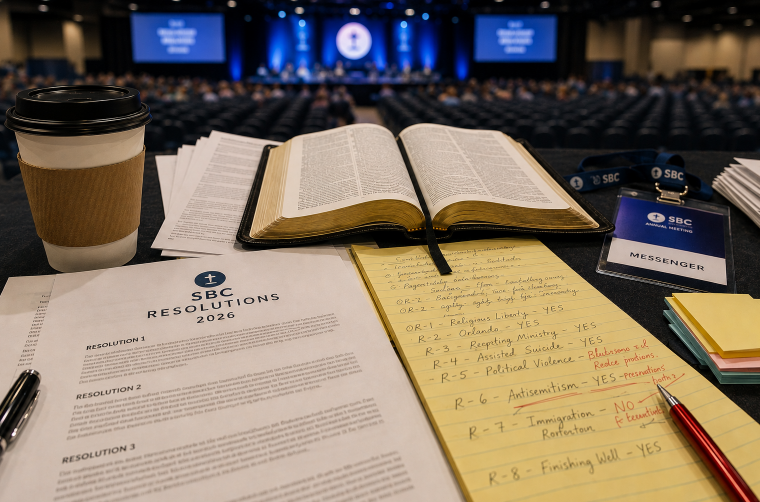

Every year, Southern Baptists arrive at the annual meeting to vote on a series of resolutions that, while not binding on local churches, often reveal the priorities, theological trajectory, and public witness of the Convention. This year’s slate contains a mixture of routine appreciation resolutions, important doctrinal clarifications, cultural engagement statements, and a few proposals that deserve closer scrutiny.
I won’t be able to attend this year’s annual meeting in Orlando (so probably not the year to re-nominate me for president). Nevertheless, I hope this guide proves useful to the messengers who will be there and to Southern Baptists following the proceedings from afar. My goal is not to tell anyone how to vote, but to identify the strengths, weaknesses, assumptions, and implications of each resolution so that messengers can make informed decisions on the convention floor. As always, I encourage Southern Baptists to read the resolutions for themselves, weigh them carefully against Scripture, and exercise wisdom in determining whether they should be adopted, amended, or rejected. This is a long-form analysis, so if you’re looking for a yes/no overview, skip to the conclusion of this article.
Quick Navigation
- Resolution 1: 250th Anniversary of the United States and Religious Liberty
- Resolution 2: Appreciation for the City of Orlando
- Resolution 3: Disability Ministry and Their Families
- Resolution 4: Assisted Suicide and the Sanctity of Life
- Resolution 5: Political Violence and Speech
- Resolution 6: Antisemitism
- Resolution 7: Immigration, Human Dignity, and the Rule of Law
- Resolution 8: Finishing Well in Life and Ministry
- Resolution 9: Appreciation for Bivocational and Volunteer Pastors
- Resolution 10: The Physically Gathered Church in a Digital Age
- Resolution 11: The Office and Function of Pastor/Elder/Overseer
Resolution 1: On the 250th Anniversary of the United States and the Baptist Contribution to Religious Liberty
Recommendation: YES

What it does
This resolution commemorates America’s 250th anniversary while highlighting the historic Baptist contribution to religious liberty through figures such as Isaac Backus and John Leland. It expresses gratitude for God’s providence in the nation’s history, affirms religious liberty as a biblical conviction, encourages civic engagement, and calls Southern Baptists to pray for national revival and faithful public witness.
Strengths
- Avoids both uncritical nationalism and reflexive anti-Americanism.
- Acknowledges genuine cultural sin patterns, including slavery, racism, abortion, injustice, and sexual immorality, without adopting the modern progressive narrative that America’s history is primarily defined by oppression.
- Correctly recognizes the historic Baptist role in advancing religious liberty and freedom of conscience.
- Affirms that Christians have obligations as citizens and should participate in public life rather than retreat into a “citizen of the world” mentality detached from national responsibilities.
- Maintains that the ultimate hope of the nation is not political reform but the gospel of Jesus Christ.
Potential Concerns
- Some Baptists may object to references to “natural law” in the civic engagement section, fearing ambiguity or misuse.
- Others may wish the resolution were more explicit regarding abortion or current threats to religious liberty.
- The resolution’s call for civic engagement is broad and does not endorse any particular policy agenda.
Bottom Line
This is a balanced and historically grounded resolution. It expresses gratitude for God’s providence in American history, acknowledges real national failures without indulging in national self-loathing, affirms the Baptist commitment to religious liberty, and encourages Christians to be faithful citizens while remembering that Christ’s kingdom remains supreme. Southern Baptists should support it.
Resolution 2: On Appreciation for the City of Orlando
Recommendation: YES (Routine Courtesy Resolution)
What it does
This is the customary host-city appreciation resolution that appears at many SBC annual meetings. It thanks the city of Orlando, the Orange County Convention Center, local officials, volunteers, hotels, and Florida Baptists for hosting the convention. It also includes a brief Great Commission emphasis and prayer for the city.
Resolution 3: On the Church’s Opportunity for Evangelism, Discipleship, and Care for Persons with Disabilities and Their Families
Recommendation: YES
What it does
Encourages churches to welcome, disciple, and care for people with disabilities and their families, while removing barriers to participation where practical.
Strengths
- Grounds human dignity in the image of God.
- Focuses on evangelism, discipleship, and pastoral care.
- Recognizes the challenges faced by caregivers and families.
- Encourages churches to serve according to their abilities rather than imposing mandates.
Potential Concerns
The resolution uses terms like “inclusion,” but within the text the concept is clearly tied to biblical hospitality and church participation rather than secular DEI frameworks.
Bottom Line
This is a straightforward call for churches to better serve people who are often overlooked or isolated. It is rooted in biblical compassion rather than political activism. This is an uncontroversial effort to encourage churches to minister faithfully to people with disabilities and their families.
Resolution 4: On Assisted Suicide and the Sanctity of Life
Recommendation: YES
What it does
Reaffirms the SBC’s historic opposition to euthanasia and assisted suicide, rejects euphemisms such as “medical aid in dying” and “death with dignity,” warns about the expansion of assisted-suicide regimes, and calls for policies that protect life from conception until natural death.
Strengths
- Clearly affirms the sanctity of human life.
- Distinguishes assisted suicide from legitimate end-of-life medical decisions.
- Recognizes how language is often used to obscure the reality of intentionally ending life.
- Encourages hospice, palliative care, and compassionate support for those who are suffering.
- Correctly notes the tendency of assisted-suicide laws to expand beyond their original limits.
Potential Concerns
The resolution’s warnings about Canada and Europe will likely be challenged by supporters of assisted-suicide legislation, but they are broadly consistent with concerns raised by many pro-life advocates and bioethicists.
Bottom Line
This is a strong, unapologetically pro-life resolution that extends the SBC’s commitment to the sanctity of life beyond abortion and into end-of-life ethics. It rejects the increasingly common cultural argument that some lives become less worth living when suffering increases.
Protestia Assessment: Vote yes. Southern Baptists have long opposed euthanasia and assisted suicide, and this resolution appropriately addresses one of the fastest-growing threats to a biblical understanding of human dignity and the value of life.
Resolution 5: On Political Violence and Speech
Recommendation: Lean No / Significant Reservations
What it does
Condemns political violence, terrorism, riots, vandalism, intimidation, and coercion. It also addresses political rhetoric, calling Christians to reject “dehumanization,” “reckless speech,” “hatred,” “contempt,” and other forms of toxic political discourse.
Strengths
- Clearly condemns political violence regardless of ideology.
- Rejects the notion that good ends justify sinful means.
- Affirms lawful civic engagement and faithful Christian citizenship.
- Reminds Christians that the church advances through gospel proclamation rather than force.
Concerns
The resolution repeatedly moves beyond condemning violence into regulating rhetoric using broad and highly subjective categories.
Terms such as “dehumanizing rhetoric,” “reckless speech,” “hatred,” “toxic contempt,” and even “polarization” are left undefined. While genuine slander and sinful speech should certainly be condemned, these categories are frequently weaponized in modern political discourse against people making legitimate moral judgments or offering sharp criticism of error.
Scripture itself contains examples of severe rebuke against false teachers, tyrants, hypocrites, and evildoers. Christians are commanded not only to love good but also to hate what is evil (Psalm 97:10; Romans 12:9). The prophets, Christ, and the apostles often employed language that modern observers might classify as inflammatory, divisive, or contemptuous.
The danger is that language intended to discourage sinful speech can easily be interpreted to discourage necessary moral clarity.
Bottom Line
Southern Baptists should have no difficulty condemning political violence. The difficulty arises when the resolution attempts to define acceptable rhetoric using vague categories that can mean almost anything depending on who is applying them. A resolution narrowly focused on political violence would have been stronger and less susceptible to misuse.
Protestia Assessment: The anti-violence portions are excellent. The speech-related portions are overly expansive and employ terminology that lacks clear biblical definition. Because of those concerns, messengers could reasonably vote no or seek amendments that narrow the resolution’s focus to political violence rather than subjective judgments about rhetoric.
Suggested Amendment: Narrow the speech provisions to clearly biblical categories such as malice, slander, false witness, and threats. Remove vague terms like “dehumanization,” “reckless speech,” and the blanket condemnation of “hatred,” which lack clear definition and can be interpreted in ways that discourage legitimate moral judgment and prophetic rebuke.
Resolution 6: On Antisemitism
Recommendation: YES, with reservations
What it does
Condemns the recent rise in antisemitism, including violence, harassment, terrorism, and conspiracy theories directed at Jewish people. It reaffirms Southern Baptists’ opposition to sinful ethnic partiality and hatred, encourages friendship and gospel witness toward Jewish people, and calls for prayer for their salvation.
Strengths
- Clearly condemns unjust violence and ethnic hostility directed toward Jewish people.
- Rejects conspiracy theories that assign collective guilt or sinister motives to Jews as a people.
- Affirms the dignity and worth of Jewish people as image-bearers of God.
- Maintains the necessity of evangelizing Jewish people rather than treating Judaism as a separate path to salvation.
Concerns
The primary concern is that the modern concept of “antisemitism” (a special category of partiality) is often applied far more broadly than sinful ethnic prejudice. In contemporary political discourse, accusations of antisemitism are frequently used to silence criticism of the State of Israel, Zionism, Jewish organizations, or Jewish religious beliefs.
Christians must remain free to evaluate all nations, governments, religions, and ideologies (including Israel and Judaism) according to biblical standards. Opposition to antisemitism should never be used to shield any nation, ethnic group, or religion from legitimate scrutiny.
A second concern involves the resolution’s references to God’s continuing purposes for the Jewish people. Many Southern Baptists agree that Romans 11 teaches a future salvation of ethnic Jews as the natural branches being grafted back into their own olive tree. However, Baptists differ regarding how Old Testament promises relate to modern Jewish populations and the modern State of Israel.
Some believers question whether modern people identifying as Jews can simply be equated with the genetic descendants of Abraham. Others emphasize that the New Testament identifies all who are in Christ as Abraham’s offspring and heirs according to promise (Galatians 3). At the same time, Romans 11 appears to preserve a distinction between ethnic Israel and the Gentiles while anticipating a future conversion of Jewish people through faith in Christ.
Because of these theological differences, Southern Baptists should not assume that every biblical promise concerning Israel applies to the modern State of Israel or to every person claiming Jewish identity. Thankfully, the resolution itself stops short of making such claims.
Bottom Line
The resolution is strongest when it condemns ethnic hatred and violence directed toward Jewish people. It is less helpful when modern political assumptions about Israel, Zionism, or Jewish identity are read into the text. Southern Baptists can oppose “antisemitism” under the umbrella of opposing all sinful partiality while retaining the freedom to critique Israel, reject false religion, and debate questions surrounding Israel and the covenants.
Protestia Assessment: Vote yes, or possibly amend. Southern Baptists should reject ethnic hatred, violence, and conspiracy theories directed toward Jewish people. At the same time, opposition to sinful partiality must not be confused with unconditional support for Israel, Zionism, or Judaism, nor should it be used to discourage legitimate biblical critique of nations, governments, or religions.
Resolution 7: On Immigration, Human Dignity, and the Rule of Law
Recommendation: NO, unless amended
What it does
Attempts to balance compassion for immigrants with support for border security, immigration enforcement, and the rule of law. The resolution affirms human dignity, rejects amnesty, supports lawful immigration enforcement, and encourages churches to minister to immigrants and refugees.
Strengths
- Affirms that all people are made in the image of God.
- Recognizes that governments have a legitimate responsibility to secure borders and enforce immigration laws.
- Explicitly rejects amnesty.
- Distinguishes between the responsibilities of the church and the state.
- Encourages evangelism and ministry among immigrant populations.
Concerns
While the resolution moves closer to a law-and-order position than many previous evangelical statements, it continues to employ language that blurs important distinctions.
The resolution repeatedly frames immigration primarily through the lens of “human dignity,” “hospitality,” and “compassion,” while treating enforcement as a secondary concern that must be balanced against those values. A biblical understanding of neighbor-love does not merely permit the enforcement of just laws; it requires it. Governments serve their citizens and resident aliens alike by maintaining order, punishing wrongdoing, and protecting the integrity of the nation (Romans 13).
Likewise, describing illegal immigration as merely “large-scale and often disorderly migration” obscures the central issue. The primary concern is not disorderliness but the ongoing violation of immigration law and national sovereignty. Millions of people entering or remaining in a country unlawfully is not simply a matter of administrative disorder; it is a breakdown of lawful order itself.
The resolution also relies upon modern political terminology such as “nativism” and “ethno-nationalism” without carefully defining those terms. While genuine racial hostility should be rejected, vague labels are often used to dismiss legitimate concerns regarding border security, national identity, cultural cohesion, assimilation, and citizenship.
Suggested Amendments
- Replace “large-scale and often disorderly migration” with language that explicitly addresses unlawful immigration and violations of immigration law.
- Clarify that love of neighbor includes the government’s God-ordained duty to enforce just laws and maintain national borders.
- Remove or carefully define terms such as “nativism” and “ethno-nationalism” to prevent their misuse against legitimate policy positions.
Bottom Line
The resolution contains several welcome improvements, particularly its rejection of amnesty and recognition of the state’s duty to enforce immigration law. Nevertheless, its framing remains heavily influenced by evangelical immigration rhetoric that often treats enforcement and compassion as competing values rather than recognizing that lawful order is itself an expression of love for neighbor and a requirement of justice.
Protestia Assessment: As written, this resolution fails to establish clear biblical and legal categories and uses terminology that obscures rather than clarifies the nature of the immigration crisis. Messengers should seek amendments or consider voting no.
Resolution 8: On Finishing Well in Life and Ministry
Recommendation: YES
What it does
Encourages pastors, ministry leaders, and church members to persevere in faithfulness, holiness, and integrity throughout their lives and ministries. It expresses gratitude for those who have served faithfully and finished well, while urging current leaders to do the same.
Strengths
- Addresses a timely issue in light of the steady stream of pastoral scandals, moral failures, and public ministry collapses.
- Emphasizes character, perseverance, holiness, and endurance rather than celebrity, platform size, or ministry success.
- Recognizes the many faithful pastors whose ministries receive little public attention.
- Grounds confidence not in human effort but in God’s preserving grace.
Potential Concerns
Very few. The resolution is largely aspirational and devotional rather than political or policy-oriented. Some may wish it addressed accountability structures more explicitly, particularly given the SBC’s recent history of high-profile leadership failures, but its purpose is encouragement rather than institutional reform.
Bottom Line
This is a straightforward and needed reminder that ministry is not merely about starting well or building something impressive, but about remaining faithful until the end. In an age when ministry scandals often dominate headlines, the resolution rightly directs attention to the countless pastors who quietly serve Christ and their churches with integrity.
Protestia Assessment: Vote yes. There is little controversy here. Southern Baptists should gladly affirm faithfulness, perseverance, holiness, and finishing well in both life and ministry. One could argue that the SBC needs more conversations about how to prevent ministry failures, but that is not a reason to oppose a resolution encouraging leaders to remain faithful to Christ.
Resolution 9: On Appreciation for Bivocational and Volunteer Pastors
Recommendation: YES
What it does
Expresses gratitude for bivocational and volunteer pastors who serve churches while also maintaining secular employment. It recognizes their sacrifices, honors their families, and encourages churches and SBC entities to support and equip them.
Strengths
- Recognizes a large but often overlooked segment of SBC ministry.
- Correctly notes that compensation level does not determine the importance or legitimacy of a pastor’s ministry.
- Encourages churches to care for and support their pastors.
- Gives appropriate recognition to pastors serving in rural, small-town, church-plant, and underserved contexts.
- Affirms the biblical dignity of both ministry and ordinary labor.
Potential Concerns
Very few. The resolution is largely a statement of appreciation and encouragement. Some may note that bivocational ministry is often necessary because churches are small or financially constrained, not because it is necessarily ideal. However, the resolution does not romanticize bivocational ministry so much as honor those who faithfully serve in it.
Bottom Line
Many Southern Baptist churches would not exist without faithful bivocational and volunteer pastors. While prominent conference speakers and megachurch leaders often receive the attention, much of the SBC’s actual ministry is carried out by pastors who spend their weekdays at ordinary jobs and their evenings and weekends shepherding congregations.
Protestia Assessment: Vote yes. This is an appropriate recognition of the faithful men who quietly carry much of the burden of Southern Baptist ministry without significant recognition, compensation, or platform. If anything, these pastors often represent the SBC at its healthiest and most grounded.
Resolution 10: On the Nature and Importance of the Physically Gathered Church in a Digital Age
Recommendation: YES
What it does
Affirms that the local church is fundamentally an embodied assembly of believers and that digital technology, while useful, cannot replace the gathered church. It specifically argues that online participation alone cannot fulfill the biblical pattern of church life and that baptism and the Lord’s Supper belong within the gathered church.
Strengths
- Clearly affirms the biblical importance of physically gathering with the church.
- Distinguishes between technology as a ministry tool and technology as a substitute for church life.
- Reinforces meaningful church membership, accountability, and pastoral oversight.
- Correctly rejects the notion that a purely virtual church can fully satisfy New Testament ecclesiology.
- Provides a needed corrective after the COVID era normalized remote participation for many Christians.
Potential Concerns
The resolution’s statement that baptism and the Lord’s Supper are to be administered “under the oversight of pastors” may raise concerns among some Baptists. While most Southern Baptists would agree that pastors ordinarily oversee the ordinances, Baptists have historically differed on whether Scripture requires pastoral administration as opposed to church administration.
Additionally, some congregationalists may note that the resolution repeatedly emphasizes pastors while giving comparatively little attention to the authority of the congregation itself.
Bottom Line
The resolution correctly recognizes that Christianity is an embodied faith and that local churches are not merely content-delivery platforms. Livestreams, podcasts, and online teaching can supplement church life, but they cannot replace gathered worship, fellowship, accountability, and the ordinances.
Protestia Assessment: Vote yes. The resolution rightly reminds Southern Baptists that church is more than a livestream and that ministry cannot be reduced to digital consumption. We would only add that the same principle probably applies to sermon preparation: pastors should gather with their congregations in person and prepare their own sermons as well.
Resolution 11: On the Office and Function of Pastor/Elder/Overseer
Recommendation: YES, but seek amendments
What it does
Reaffirms the SBC’s position that the office of pastor/elder/overseer is limited to qualified men, argues that the title, office, and function of pastor should not be separated, and encourages churches to use pastoral terminology consistently with the Baptist Faith and Message 2000.
Strengths
- Reaffirms the SBC’s longstanding complementarian position on the pastoral office.
- Addresses attempts to circumvent the Baptist Faith and Message through alternative titles such as “female pastor” while denying that the role is actually pastoral.
- Correctly recognizes that confusion often arises when churches separate pastoral functions from the pastoral office itself.
- Expresses appreciation for the indispensable ministry contributions of women while maintaining biblical distinctions regarding church office.
- Promotes greater doctrinal clarity and honesty in church nomenclature.
Potential Concerns
The resolution correctly rejects attempts to separate the pastoral title from the pastoral office, but it does not fully articulate why those things belong together in the first place.
The fundamental issue is not that women are prohibited from teaching because they cannot be pastors. Rather, women cannot hold the pastoral office because Scripture reserves the authoritative teaching and doctrinal oversight of the church to qualified men (1 Timothy 2:12; 1 Timothy 3; Titus 1). The office exists because of those responsibilities; it is not a rank bestowed upon a special class of Christians.
This distinction matters because many contemporary complementarian arguments unintentionally expand the pastoral office beyond its distinctive ministry of the Word into a broad collection of leadership, governance, counseling, administrative, and ministry functions. Once “pastoring” is defined broadly enough, female pastors become increasingly difficult to exclude. The debate is no longer about whether women may perform uniquely pastoral functions, but whether any uniquely pastoral functions remain.
Recent proposals from figures such as Beth Moore and Sam Storms illustrate this problem from opposite directions. Some seek to preserve male-only titles while allowing women to exercise pastoral functions. Others seek to preserve male governance while allowing women to carry pastoral titles. Both approaches separate title, office, and function in different ways.
The resolution also leaves unresolved broader questions of church polity. Many of the churches most aggressively promoting female pastors have simultaneously embraced strong elder-rule governance. When authority is relocated from the ministry of the Word to governance structures, teaching itself becomes less central to the pastoral office, making alternative understandings of pastoral ministry easier to justify.
At the same time, the resolution should not be read as suggesting that all teaching belongs exclusively to pastors. Scripture presents Christian men teaching in homes, discipleship relationships, classes, and other settings without occupying the pastoral office. The pastor is not a superior teacher in a rank sense, nor part of a clerical class. He is a man set apart by the congregation for a specific ministry of preaching, teaching, shepherding, and doctrinal oversight within the gathered church.
Suggested Amendments
- Clarify that the office of pastor/elder/overseer exists to carry out the authoritative teaching, preaching, shepherding, and doctrinal oversight assigned by Scripture to qualified men.
- Clarify that women are excluded from the pastoral office because Scripture reserves those functions to qualified men within the gathered church.
- Clarify that not all forms of teaching belong exclusively to pastors and that Christian men may teach in many contexts without occupying the pastoral office.
- Clarify that pastoral authority is exercised within and remains accountable to the congregation under Christ’s headship, avoiding any implication that the resolution settles broader debates regarding elder-rule governance.
Bottom Line
At its core, this resolution is a response to the controversy over churches attempting to retain female pastors while claiming compliance with SBC doctrine by redefining titles and responsibilities. The resolution correctly argues that Southern Baptists should use pastoral terminology honestly and consistently rather than creating semantic workarounds.
Calling a female pastor a “minister” does not resolve the problem if she continues to perform pastoral functions. Likewise, reserving the title “pastor” for men does not resolve the issue if women are permitted to exercise the authoritative teaching ministry that defines the office.
The real question is not who gets the title. The real question is what Scripture identifies as the defining work of the pastoral office.
Southern Baptists have historically understood pastors, elders, and overseers to be men set apart by the congregation to exercise the ministry of the Word through preaching, teaching, shepherding, and doctrinal oversight within the church. The resolution moves in the right direction by reconnecting office, title, and function, but it would be strengthened by more clearly grounding those categories in the authoritative teaching ministry that Scripture places at the center of pastoral work.
Protestia Assessment: Vote yes, but seek amendments. The resolution correctly rejects attempts to separate the title, office, and function of pastor and appropriately reaffirms the SBC’s complementarian convictions. However, it would be strengthened by more clearly grounding the pastoral office in the ministry of the Word and by clarifying that women are excluded from the office because Scripture reserves the authoritative teaching and doctrinal oversight of the church to qualified men—not because the office itself is a status category. Likewise, the resolution should better distinguish the pastoral office from broader forms of Christian teaching and should avoid language that could be read as endorsing elder-rule governance. Southern Baptists should support the resolution’s goal while encouraging greater theological precision.
One final observation: ironically, many of the churches most aggressively promoting female pastors in recent years have also embraced strong elder-rule governance. The resolution correctly addresses the question of who may hold the pastoral office, but it largely sidesteps the equally important Baptist question of who ultimately governs the church. Southern Baptists should be careful not to win the complementarian battle while quietly conceding congregationalism.
Conclusion
Overall, this year’s resolutions are considerably stronger than many Southern Baptists might have expected. Several are routine expressions of appreciation or encouragement. Others address significant cultural and theological issues in ways that are generally faithful and helpful. A handful, however, suffer from imprecise language, unclear categories, or assumptions that deserve amendment before adoption.
For those looking for a quick summary:
- Resolution 1 (250th Anniversary & Religious Liberty) — YES
- Resolution 2 (Appreciation for Orlando) — YES
- Resolution 3 (Disability Ministry) — YES
- Resolution 4 (Assisted Suicide & Sanctity of Life) — YES
- Resolution 5 (Political Violence & Speech) — LEAN NO / SEEK AMENDMENTS
- Resolution 6 (Antisemitism) — YES, WITH RESERVATIONS
- Resolution 7 (Immigration, Human Dignity & Rule of Law) — NO, UNLESS AMENDED
- Resolution 8 (Finishing Well in Life & Ministry) — YES
- Resolution 9 (Bivocational & Volunteer Pastors) — YES
- Resolution 10 (The Physically Gathered Church) — YES
- Resolution 11 (Pastor/Elder/Overseer) — YES, BUT SEEK AMENDMENTS
If there is a common theme running through several of this year’s debates, it is the need for clear biblical categories. Whether discussing immigration, political rhetoric, pastoral authority, or the role of women in the church, Southern Baptists are best served when we define our terms carefully, ground our arguments explicitly in Scripture, and refuse to allow cultural narratives to replace biblical reasoning. Faithfulness is not measured by whether the watching world approves of our resolutions. It is measured by whether we speak truthfully, think clearly, and obey Christ.



















One response to “Guide to 2026 SBC Resolutions”
Comparing the 1939 White Paper to UN 446 passed by Carter whose book slandered Israel as Apartheid! UN 2334 voted with the aid of Obama. All three, explicit expressions of UN GA Resolution 3379 – Zionism is Racism; which the UN later annulled under President Bush – the bane of Saddam in Kuwait. “High Contracting Parties” post WWII legalese (legal language has been used as a political weapon) whereby UN official sought used the 4th Geneva Convention (1949) upon Israel as a badge of shame. The UN declares that Israelis do not have the right to rule territory originally declared by the League of Nations as “Palestine Mandate”, but “UN international law dictates” where and who live within the borders of Israel; a similar legalese first introduced by Chamberlain’s White Paper abomination.
When Neville Chamberlain’s government issued the 1939 White Paper, they used the mask of British administrative law to effectively nullify the Mandate. By capping Jewish immigration and restricting land sales, they didn’t just break a promise—they used bureaucratic decrees to freeze Jews out of their own recognized national home right when they needed it most.
The UN has essentially adopted this exact same tactic. By passing resolutions like 446 and 2334, the UN claims the authority to dictate who can live & where; treating Judea, Samaria, and East Jerusalem as “occupied” rather than recognizing the deep historical and legal continuity stemming from the original Mandate. The Fourth Geneva Convention, written in the immediate shadow of WWII to prevent brutal, aggressive regimes from depopulating countries, conducting forced deportations, and systematically destroying native populations (as the Nazis did across Europe). When UN bodies and international courts invoke the language of the “High Contracting Parties” against Israel, they steal a “convention” originally designed to prevent forced, aggressive population transfers and use it to sodomize Jews who choose to live, build homes, and buy land in their ancestral heartland – the UN and international courts now condemn Israeli guilt as equal to Nazi like war crime.
When Jimmy Carter wrote Peace Not Apartheid, or when the Obama administration allowed Resolution 2334 to pass by withholding a U.S. veto, the tuma spirit of UN 3379 dominated their Yatzir Ha-Rah. They treated the Jewish state’s defensive positions and historical claims – not as a matter of survival or legitimate common law rights – but as an inherent Palestinian injustice that the international community has the ‘Divine-Right of Kings’ to micromanage. The UN behaves as a global parliament, rewriting its own rules to fit prevailing geopolitical voting block alignments; while treating Israel’s foundational legal rights under the Mandate as if they can be erased comparable to how post Bar Kochba Rome erased Judea.
Resolutions 446 and 2334 ignores the core principle of legal continuity (found in Article 80 of the UN Charter, often called the “Jewish People’s Clause,” which preserved all rights granted under the League of Nations Mandates) and instead attempts to legislate Jews out of their heartland by bureaucratic fiat. By treating the Jewish presence in Shiloh, Hebron, or Jerusalem as a “flagrant violation” akin to the darkest crimes of the 20th century, international bodies strip the convention of its moral anchor, transforming a tool of human rights into a political badge of shame.