

Note: this article deals with child abuse.
A Southern Baptist pastor has asked his congregation to write letters supporting his son-in-law, vouching for the man’s integrity and character following his arrest for possessing child sexual abuse material, according to an article in The Roys Report.

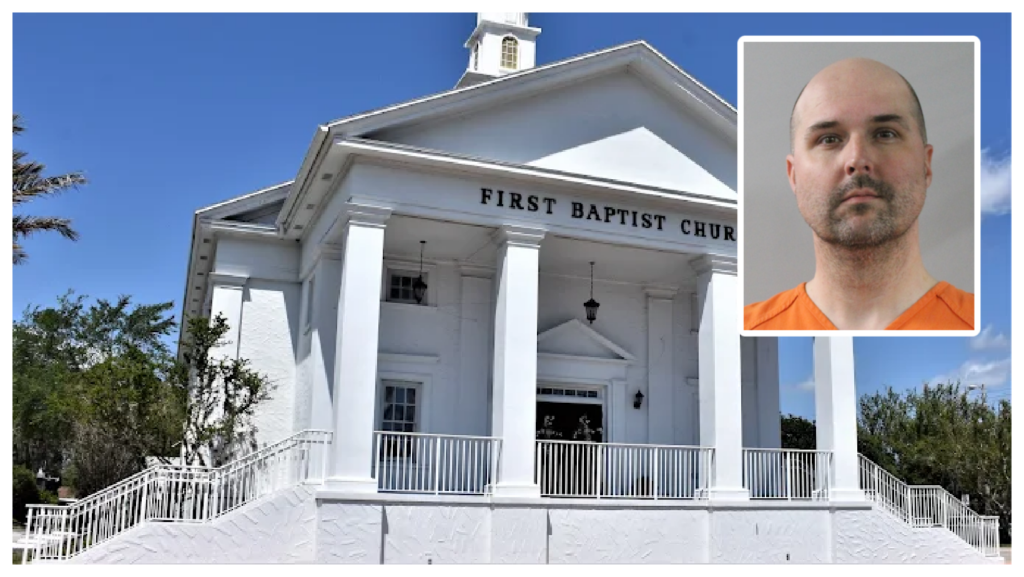
Tom Johnson is the senior pastor of First Baptist Church of Auburndale, Florida. Last week, he sent a text message to church members thanking them for their response after his son-in-law, Drew McGaffigan, was arrested and jailed.
McGaffigan’s alleged crimes came to light after the National Center for Missing & Exploited Children notified investigators that an electronic service provider had reported him for using his phone to download child pornography images.

Detectives with the Polk County Sheriff’s Office obtained a search warrant for his phone and discovered 30 files depicting children being sexually assaulted. Following his arrest, investigators searched more electronic devices and found 46 additional explicit images and videos. Roys Report notes:
Several images had captions justifying child rape, according to the sheriff’s office. McGaffigan’s files also contained several videos showing little girls being raped. One showed a child with obscene instructions written on her body with a black pen, according to court documents.
The victims in the material ranged in age from six months to 12 years old and included images of a child being forced to commit sexual acts with a dog.
McGaffigan has three daughters, and it is unclear whether any of the images depict them.
Pastor Johnson told congregants in the message: “It is very encouraging to see you be exactly what the church should be in circumstances like these. Please remember this is a spiritual battle, and we need to stand in the armor of God, always trusting God.”
Noting that McGaffigan has pleaded “not guilty,” Johnson advised that whatever has so far been publicly revealed about the content he allegedly downloaded “may or may not be true” and “should not determine his guilt or innocence.”
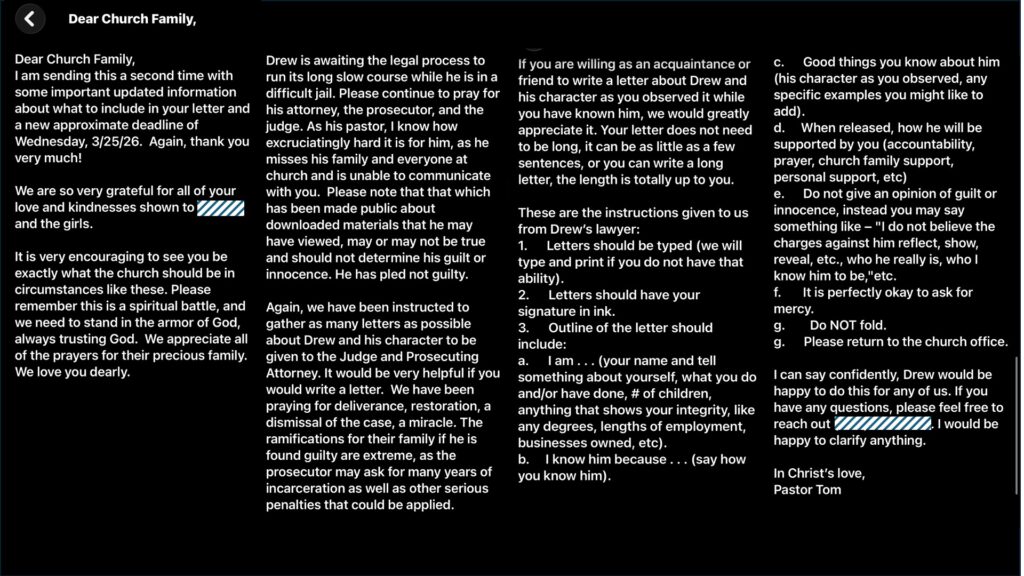
“It would be very helpful if you would write a letter. We have been praying for deliverance, restoration, a dismissal of the case, a miracle.
The ramifications for their family if he is found guilty are extreme, as the prosecutor may ask for many years of incarceration as well as other serious penalties that could be applied.
If you are willing, as an acquaintance or friend, to write a letter about Drew and his character as you observed it while you have known him, we would greatly appreciate it.”
Florida is one of the harshest states in punishing those convicted of possessing child sexual abuse material. McGaffigan faces 76 criminal counts, each carrying up to five years in prison.
Johnson said the letters, which are being requested by McGaffigan’s attorney, should follow this outline:
- a. I am… (your name and tell something about yourself—what you do and/or have done, number of children, anything that shows your integrity, such as degrees, length of employment, businesses owned, etc.).
- b. I know him because… (say how you know him).
- c. Good things you know about him (his character as you observed it, with any specific examples you might like to add).
- d. When released, how he will be supported by you (accountability, prayer, church family support, personal support, etc.).
- e. Do not give an opinion of guilt or innocence. Instead, you may say something like, “I do not believe the charges against him reflect who he really is” or “who I know him to be.”
- f. It is perfectly okay to ask for mercy.



























3 responses to “SBC Pastor Asks Congregation to Write Character Letters for Son-in-Law Accused of Possessing CSAM”
Sounds as if they admit he did do it but want leniency, just because. Sorry, but my compassion is reserved for the children who need counseling to recover from sexual abuse, not for their abusers.
This is not biblical, and the pastor should know better. It is sinful partiality and perversion of justice. And it also sets a very bad precedent that essentially attempts to determine guilt or the degree of guilt dependent on what others think of character, when the truth is that such reputation is irrelevant. What happens, then, when someone who has no family or friends, or is not very well thought of, is falsely accused? Like Jesus, who was despised. Like the Apostles who were despised.
The lawyer, like many these days, is actually working to destroy law and justice. Who needs courts, judges, and juries when guilt or innocence and severity of punishment, is to be determined by how well-liked someone might be, and by how many? One of these days all these lawyers who are doing nothing but ripping the foundations right out from under the law, essentially asking courts to rule against the existence of law, are going to put themselves out of a job. (or would, if God didn’t unleash His judgment first)
It is extremely antithetical to scripture. Sinful perversion of justice, which God strictly condemns. And sinful partiality, which He also condemns.
I would add here, as a former software engineer, for those who do not know, the existence of such images on a device does not necessarily indicate guilt. Everything that pops up in your browser is downloaded. It all goes into a local browser cache. It depends on how the images got there, where they were stored, and so on. If you’re browsing along, and all there’s some popup ad, a redirect, a site opens up another site, and so on, that’s not indicative of guilt. Malicious sites can also trigger a download of a file – redirect to a link to a file of a type that is not displayable, but also is not an executable, like a zip file containing images for example, and it can download the file to the current downloads folder without asking for your permission. So he is certainly entitled to due process. But he is not entitled, nor should be subjected, to partiality or perversion of justice, one way or the other. If the law says images on the device, regardless of how they got there, then a malicious prosecutor could also engage in partial perversion of justice, in order to target someone. There aren’t many internet users in existence who do not have questionable pictures and content in their browser cache, or even their downloads folder, because of malicious sites, ads, and so on. If you configure your browser to delete the cache too often, then you lose performance. And the same with cookies, if you delete those, you lose the beneficial ones. And when clearing out the downloads, you’ve got to know what you’re doing, being careful not to run a malicious executable. So few people will clear out the cache very often. (disclaimer – it’s been a while since I did any serious web development, and things might’ve changed, so take what I’ve said with a grain of salt)
If the applicable laws are dependent on character to determine innocence or guilt, then that’s a problem with those laws themselves being partial perversions of justice. The law must prove his guilt, and prove exactly what he’s guilty of.
If there is a necessity for his defense to prove good character, then it could be that the laws on the books are the problem, or a significant part of the problem – that the laws themselves demand partiality and perversion of justice.