

“To have lawsuits at all with one another is already a defeat for you. Why not rather suffer wrong? Why not rather be defrauded?”
— 1 Corinthians 6:7
In October 2025, Apologia Church and several of its elders — including Jeff Durbin — filed a civil defamation lawsuit in Maricopa County Superior Court against former congregant Hailey Merris, her husband Cameron Merris, and Sarah Young, editor of the Christian watchdog site Check My Church, along with her husband Joe Young.
Durbin, Luke Pierson, and Zach Morgan accused the defendants of defamation per se and false light. After a thorough analysis of the original complaint (full disclosure: I’m not a lawyer, even though I’ve represented myself in federal civil court), I’m shocked that they found a lawyer willing to file such a legally absurd complaint, but knowing what I know about these guys, I’m not surprised that the complaint exists.
Rather than issue a public rebuttal to accusations made about their ministry — or even decline comment — a group of pastors “founding elders” chose instead to file a civil lawsuit seeking damages and an injunction against further speech.
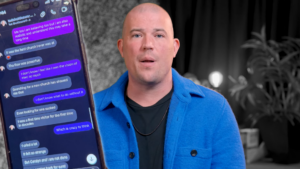
The suit arose after Merris publicly described her experience seeking pastoral counsel at Apologia, alleging that deeply personal information shared in confidence later appeared in private group text messages involving family members of church leadership. Young subsequently reported on Merris’s account, publishing commentary and documentation while explicitly inviting Apologia Church to respond, rebut, or correct any alleged factual errors before publication.
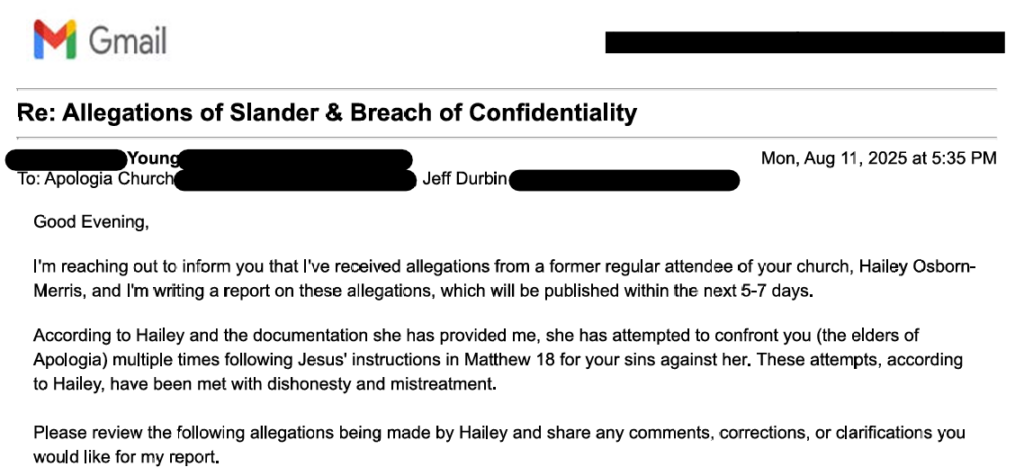
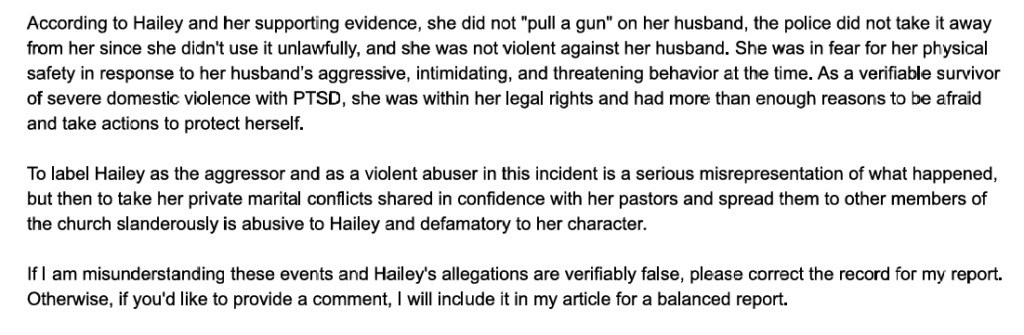
According to Young’s correspondence with Durbin, she wrote:
“Please review the following allegations being made by Hailey and share any comments, corrections, or clarifications you would like for my report.”
She further offered:
“If I am misrepresenting these events and Hailey’s allegations are verifiably false, please correct the record for my report. Otherwise, if you’d like to provide a comment, I will include it in my article for a balanced report.”
Durbin declined.
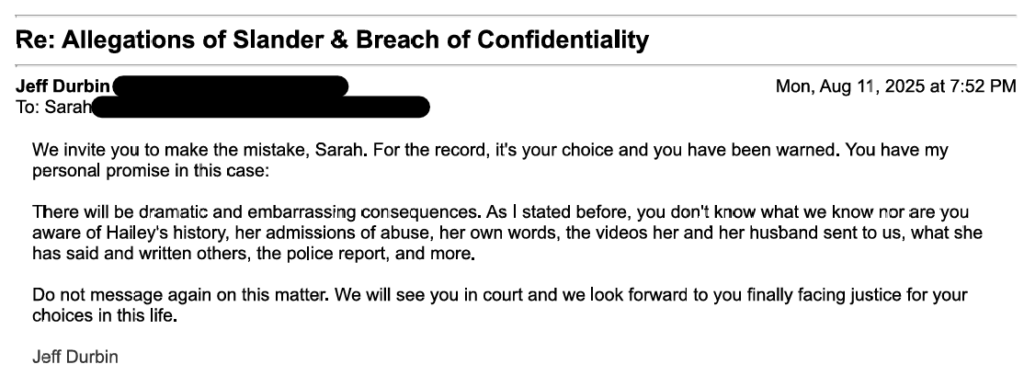
Instead, after a few additional back-and-forth emails, he warned that publishing the allegations would result in litigation and promised “dramatic and embarrassing consequences” through depositions and court proceedings. He also wrote that he was prepared to share more confidential information from Hailey’s counseling, and “look[ed] forward to [Sarah] finally facing justice for your choices in this life,” apparently desiring that Sarah would die unsaved and be thrown into hell.
The lawsuit soon followed, alleging defamation, false light, and civil conspiracy, and requesting that the court prohibit the defendants from continuing to speak about the matter publicly.
That request alone is remarkable, and telling about what Durbin and Co. apparently expect: demands for silence are met.
Because courts almost never issue injunctions prohibiting speech in defamation disputes. Such orders function as prior restraints on speech, something American courts treat with extreme skepticism.
Yet that is precisely what Apologia asked the court to do.
When Criticism Is Automatically “Slander”
One dynamic that repeatedly appears in controversies surrounding Apologia’s leadership is the reflexive labeling of criticism as “slander.” In public responses to critics over the years, Jeff Durbin has often framed disputes in stark moral language — describing criticism as “lies,” “false witness,” “abuse,” or “slander.”
But the biblical and legal definitions of slander are far more precise. Slander is not simply criticism. It is not disagreement. It is not harsh rhetoric.
Slander is false statements of fact made with the intent to harm reputation.
That distinction matters.
Much like constant and reflexive claims of “racism” and “sexism,” when every criticism is immediately labeled “slander,” the word stops functioning morally and becomes a whiny rhetorical cudgel. If public criticism is always presumed sinful (and the Apologia’s ecclesiology grants this special dispensation to its elders), then critics become categorical sinners.
The discussion is no longer about whether the allegations are true. It becomes about punishing the people who raised them. This punishment can be excommunication. Or anonymously releasing secretly recorded phone calls. Or in this case, attempting to sue a congregant into silence.
Jeff Durbin Is a Public Figure — By Any Reasonable Measure
American defamation law also distinguishes between private individuals and public figures. Private individuals generally must show that a false statement was made negligently. Public figures, however, face a far higher bar established by the Supreme Court in New York Times v. Sullivan: they must prove “actual malice,” meaning the speaker either knew the statement was false or recklessly disregarded whether it was true. The Apologia plaintiffs have also alleged defamation per se, a category of statements that are presumed to cause reputational harm — such as accusations of criminal behavior, professional misconduct, or sexual immorality. But even in cases of alleged defamation per se, public figures must still prove actual malice, meaning the constitutional standard for public-figure defamation remains the central hurdle in cases like this one.
In other words, even when a plaintiff alleges defamation per se, the Constitution does not allow public figures to sidestep the actual-malice requirement simply by asserting that criticism of their conduct is inherently defamatory.
Apologia’s own complaint describes a ministry that reaches more than one million people per month through livestreams, social media, and online distribution.
Durbin himself is:
- a national conference speaker
- a prominent anti-abortion activist
- a media personality
- a figure who has appeared in national media coverage
- someone who regularly injects himself into public political and theological controversy
At minimum, that makes him a limited-purpose public figure.
Public figures operate under a different legal standard. They do not receive defamation law as insulation from criticism. They receive scrutiny. That is the constitutional trade-off.
We Have Seen This Pattern Before
This is not the first time Jeff Durbin has responded aggressively to critics.
Years ago, Pulpit and Pen and Protestia reported that Durbin secretly recorded a private phone conversation with Christian apologist Tim Hurd during an online dispute, where Hurd had apologized and asked for forgiveness for his sinful motivation in critiques of Durbin, and Durbin had purportedly forgiven him.
Yet in August of 2019, in response to a mild critique of Durbin’s evangelistic method, Durbin gave the audio recording to JD Hall (who at that time hosted Polemics Report on Tim Hurd’s Bible Thumping Wingnut Network), telling Hall that he was only sharing the audio with him for now, undoubtedly assuming the veiled threat to share the audio further would convince Hall to pressure Tim Hurd into either apologizing again or ceasing further criticism. Hall declined, saying he was not going to listen and would rather mind his own business.
Apparently not satisfied with the lack of cooperation from Hall (and any others Durbin sent the recording to), Durbin released the recording on a new, anonymous YouTube channel on November 11th, 2019. Hurd reportedly found the anonymous “Tim Hurd Confession” YouTube channel with the single video containing the audio from the May 2017 phone call. Hurd confronted Durbin, asking to discuss Durbin’s release of the call, but was met with a veiled threat from Apologia pastor James White, who, through mutual friend Nathan Todd Fischer, said, “Tim, I have listened to the phone call” on November 19th. Notably, James White was not part of Apologia in 2017, making Durbin’s sharing of the call with White nothing but gossip.
In response to being called out for the utterly disqualifying behavior of secretly recording penitent phone calls and releasing them years later for retaliatory purposes, Durbin, Pierson, and White released a 3-hour-long podcast attacking Hurd. I discuss it on Protestia Tonight here:
Arizona is a one-party consent state, meaning the act of recording a phone call without both parties consenting was not illegal.
But the controversy was never primarily about legality.
It was about the ethics of secretly recording penitent conversations and releasing them publicly during disputes with critics and offering forgiveness only to withdraw it the moment the forgiven person does something you don’t like — particularly for church leaders who exercise pastoral authority over members.
Hard Shepherding for Thee, Civil Courts for Me
The present-day lawsuit intersects with longstanding criticism of Apologia’s leadership structure (as discussed in the above Protestia Tonight).
Apologia doesn’t practice Baptist-style congregationalism (despite Jame White’s Baptist self-description). It doesn’t even practice biblically-ordained elder plurality. Rather, it practices a cult-like model often described as hard shepherding, under the unilateral spiritual control of so-called “founding elders.”
Interestingly, the publicly published ministerial requirements that vest unilateral control in the “founding elders” do not seem to appear on the church’s website until 2021, years after White became an elder at the church.
The term “founding elder” itself is revealing in its hierarchical utility. In historic Baptist polity, authority flows from the congregation. Elders serve the church; they do not constitutionally rule it. A permanent class of “founding elders” exercising enduring authority represents a very different model of church governance.
Under such systems:
- elders adjudicate disputes
- elders define discipline
- elders determine credibility
- criticism is expected to be routed through the same authority structure being criticized
This is why Durbin and fellow Apologia elder James White have repeatedly insisted that Christians who raise concerns online should not do so publicly but instead bring complaints “elder to elder.”
In other words:
Criticism must pass through the authority structure it is criticizing. No priesthood of all believers, but rather good old fashioned clericalism.
Picking on Women Is Not Courage
There is also an ugliness to this lawsuit that deserves to be acknowledged plainly. Durbin did not sue seasoned male critics who have publicly excoriated him for years — myself included.
We have published harsher things about Jeff Durbin than either Hailey Merris or Sarah Young ever did.
Yet I was not sued. They were. Two women.
One is a former congregant, and one is an independent watchdog journalist.
That is not bravery. That is not strength. That is not pastoral leadership or making oneself of low reputation. It is dominionist bullying — cloaked in a thin veneer of “postmillennial dominionism “justice.”
And it is precisely the kind of self-gratifying lawfare Arizona’s anti-SLAPP statutes are designed to restrain.
When Forgiveness Becomes Conditional
In the three-hour whiny screed defending himself against Tim Hurd, Durbin argued that forgiveness granted under Matthew 18 can be rescinded if the forgiven individual is later accused of similar offenses. The Christian Indian giver model Durbin and co-founding pastor Luke Pierson argue for is diametrically opposed to the nature of Christian forgiveness itself, to the point where it distorts the unconditionality of the gospel itself.
Under such a framework:
- forgiveness is be granted
- repentance is accepted
- reconciliation supposedly occurs
…but if the forgiven individual later sins again — or (in the case of Hurd) isn’t even biblically accused of doing so — prior conflicts can be reopened, prior forgiveness pulled back, and Matthew 18 discipline simply escalated from the point where it stopped.
As any Awana 1st-grader will tell you, this is not how Jesus describes forgiveness. Rather, He commands believers to forgive “seventy times seven.” The point is not arithmetic. It is permanence. Forgiveness is not probation or purgatory, where the forgiven sinner has to either work off sin or avoid it until the forgiver is satisfied.
A supposed believer in Christ whose forgiveness is conditioned on future sinlessness drops squarely into the category of those whom the Father will not forgive either (Matt. 6:14-15). When this kind of Christ-rejecting nonsense is taught by supposed pastors, it doesn’t matter what they think they founded – they are utterly disqualified from ministry.
Placed alongside Apologia’s willingness to pursue civil litigation against former congregants and critics, the theological pattern becomes difficult to ignore. Church leaders who exalt themselves above the rest of the Body, and who treat forgiveness as conditional on compliance, will inevitably treat personal offense not as persecution to be endured but as sacrilege to be avenged (yes, this naturally leads to a broader discussion of the practical implications of pre vs postmill, but we’ll leave that to another day).
Again, the video clips and receipts for this disqualifying teaching are in the video above.
The Lawsuit and Arizona’s Anti-SLAPP Law
Arizona, like many states, has enacted an anti-SLAPP statute. SLAPP stands for Strategic Lawsuit Against Public Participation.
These laws exist to prevent individuals or institutions from using litigation itself as a means of deterring or punishing speech on matters of public concern.
As court records show, Durbin claimed in a church meeting some time after Hailey Merris’s accusations were publicized that his daughter overheard him discussing the particulars of the Merris’s counseling. He argues that this proves that there was no intentional breach of confidentiality, thus Hailey’s claims of intent are defamatory. The problem for Durbin is that the admission that confidentiality was broken renders Hailey’s claims understandable, whether or not they are provable. And this is all it takes to disprove malice, which is required to defame a public figure like Durbin.
The fact that the church meeting occurred before the lawsuit was filed bolsters the defense’s appeal to SLAPP, as Durbin clearly knew confidentiality had been breached (and therefore, Hailey’s claims were not clearly malicious) prior to filing suit.
Many of the statements described in the complaint also fall into the category of opinion or interpretation, such as describing conduct as “abusive,” “spiritually manipulative,” or similar characterizations. Courts generally treat those kinds of statements as protected opinion, especially when they arise in debates about religious leadership or church governance.
Add to this the fact that Durbin was given ample opportunity to respond in kind and offer rebuttal but chose not to (while threatening legal action), and the lawsuit begins to look like a textbook example of the exact kind of lawfare that results in plaintiffs not only losing, but paying the defense’s costs under SLAPP.
Yes, you read that right. If a court determines that a lawsuit was filed primarily to deter protected speech, it can dismiss the case early and require the plaintiffs to pay the defendants’ legal fees.
The defendants’ pending motion argues that several elements of this case point in that direction:
- the speech concerns a public figure and public ministry
- the allegations involve pastoral conduct
- the defendants relied on firsthand testimony and documentation
- the plaintiffs were offered an opportunity to respond and declined
- the lawsuit seeks to restrict future speech through an injunction
Whether the court ultimately agrees remains to be seen.
Implications of McRaney vs NAMB
Interestingly, the recent 5th Circuit Court of Appeals decision to dismiss Will McRaney’s defamation case could be used by the defense to render this case moot, even if the Maricopa County Circuit Court does not grant the defense’s SLAPP motion. The decision establishes, at least for the foreseeable future, both an affirmative defense against defamation and a jurisdictional subject matter disqualification for legal disputes where the subject matter is religious in nature. In other words, because the North American Mission Board and Will McRaney were voluntarily involved with one another, and the involvement was religious in nature, the court determined that juducial review would categorically encroach on religious subject matter particulars, and therefore the First Amendment protected NAMB from defamation liablity. It is hard to see how – if NAMB’s potential defamation against McRaney is out of bounds based on the religious subject matter of their relationship, why the Merrises’ and the Youngs’ potential defamation against Apologia remains in bounds.
The Irony
Durbin says the lawsuit is about defending the truth. But truth does not require silence. Truth does not require injunctions against speech. Truth invites scrutiny.
Litigation invites something else. Discovery. Emails. Text messages. Internal communications.
If this case proceeds, the lawsuit filed to defend reputation may expose far more information than any TikTok video ever could. It is not unreasonable to suspect that this is the reason Zack Morgan voluntarily removed himself as a plaintiff was that his daughter’s involvement in the text thread may have created a discovery vulnerability.
What Happens Next
If the court grants the anti-SLAPP motion:
- the case will be dismissed
- discovery will never open
- the defendants’ speech will remain protected
- the plaintiffs could be ordered to pay the defendants’ legal fees
Not as punishment. As deterrence. Anti-SLAPP laws exist precisely to discourage the use of litigation as a tool for suppressing speech on matters of public concern.
Defamation law is not church discipline or reputation management, and it’s not a substitute for public rebuttal. It can be a weapon wielded by those who know they are in the wrong and are concerned that admitting it will harm their carefully curated reputation.
When a public-figure pastor responds to criticism not with transparency but with litigation, he risks strengthening the very criticism he hoped to silence. If the court concludes this lawsuit was an attempt to deter protected speech, Jeff Durbin and Apologia will not be an example of Christians witnessing to Caesar, but of Christians so far away from righteousness that they had to be rebuked by Caesar.




















34 responses to “Jeff Durbin and Apologia Are About to Get SLAPPed”
Sigh! This is not good. Thanks for the update.
I don’t have a dog in this race. But two different AI detectors revealed that between 75% and 97% of this article was written by AI.
AI “detectors” have also found much of my writing before AI was a thing to be “AI” 🤣 I wrote and stand by every word.
You laugh, but… I mean… you even kept the headings, the embolded words, the bullet points, etc. Just try harder next time.
Go back to 2022 and read my articles on Julie Roys. Headings, bold, italics. You realize that AI scrapes and trains on real writing, right?
If you don’t agree with what I wrote, there are better ways to challenge it than claiming your AI says it’s AI.
Pretty sure with David is open he uses AI to help with editing. Which, I do not see as an issue at all. Plus, you can tell David wrote it if you have red any of my articles, it is very much in “his voice”. So, nice try.
Similar pattern to what the local “church” did to my family and I when I took to the church the matter of fraud, theft, coercion, enslavement, and otherwise severe violations of our rights, according to Matt. 18. (posted more details a week or two ago)
While I’d patiently nearly begged for repentance, in accordance with Matt. 18, for years, they themselves did not honor Matt. 18. Just as Durbin did not honor it when he ignored Young’s willingness to hear his side. So the elders of the church themselves completely skipped the process in Matt. 18, and went straight to treating her as “gentile or tax collector”.
Another similarity is the preying on women. In my case it was the same. Neither the “pastor” nor the man who committed the wrongs against us have had the guts to confront me. Instead, they went running to the women. Which is indeed whiny and cowardly, but it is also sinful. Of course the reason they do so is because they know they can more easily emotionally sway, manipulate, scare, and otherwise move the women. I could tell you some things the wrongdoers and some in the church have said and done to my Mother in particular, that would disgust you so badly it would be all you could do to hold back the vomit.
The cultish (and sinful) behavior is very similar (and there are several more similarities – such as trying to silence me by threatening to report me to federal authorities for the supposed crime of saying the “pastor” should either repent or be fired, because the only thing he did about it was to encourage the wealthy member who defrauded and badly violated our rights to continue in his sins). And in our case, it’s an SBC church. (and the Executive Committee – Jeff Lorg – also told me it wasn’t a matter for the church, which was also a rejection of Matt. 18. He said because fraud and theft are crimes. I responded, aren’t they also sins? And shouldn’t an SBC church be put on notice, if not face discipline, for encouraging members to continue in the commission of crimes?)
In most cases it’s denying justice to the poor. It’s opportunistic advantage-taking. And those too are very serious sins. God says “You SHALL NOT pervert the justice due to your poor” – Exodus 23:6. At least that’s the situation in our case. We cannot afford to defend ourselves to see a lawsuit through.
I’m just about convinced we are witnessing the foretold final falling away (2 Thess. 2, 2 Tim. 3, etc.). Could be wrong, but I don’t know of any time in history that the church has been in worse state as it is now. If they’re not hanging out the flag of perversion saying “sin is good”, they’re doing things like Durbin and Apologia (and also my local church) have done, which is also saying “sin is good”. It’s happening everywhere, all over the world.
Jesus warned us of how bad it would become, and to be careful that we ourselves do not fall away …
“1“I have said all these things to you to keep you from falling away. 2 They will put you out of the synagogues. Indeed, the hour is coming when whoever kills you will think he is offering service to God. 3 And they will do these things because they have not known the Father, nor me. 4 But I have said these things to you, that when their hour comes you may remember that I told them to you.” – John 16:1-4
I had some egregious stuff happen to me a few years ago by a pastor, and because of the nature of the sin, I did went straight to the leadership, when it became obvious they would not help, I ledt. Don’t keep yourself in a situation like that. I also believe it is a bit different when we are dealing with pastors or elders, they are held to higher standards. I have seen some bad stuff in my life in the church. And if someone clearly is not repentant AND the church leadership is corrupt, Matthew 18, will not work. It can’t. How can you disfellowship someone if the church the pastor is pastoring covers up his sins? You can’t.
I’ve considered such things, but you know at the end of the day we’ve got to recognize that God’s way always works. And it’s not for us to question. It’s for us to obey. I further elaborated on it in subsequent posts below. The result may not necessarily be resolution of the particular dispute in question, but it does have a way of separating the wheat from the chaff. There’s a lot more to it than just whether or not someone is disfellowshipped. You know when Jesus spoke those words, the church was in the worst state it’s ever been. He instructed people to take it to the church when the church was the same institution infested with corrupt pharisees, and was nothing but a satan-serving brood of vipers and den of thieves. (much like the church is now becoming as it falls away)
Nobody knew this pastor was that bad before all this happened. Now we know. Now others have been warned. Now it has been made fairly public. And that serves the Lord’s purpose. And His purpose is far more important. It’s not their church. Right. It’s His church. It’s bad for their business, but it’s good for the one true church universal, the Body of Christ. It divides the wheat from the chaff. It threshes. And we find out who’s who. All who’ve done wrong are called to repentance. All being led astray are warned of it. It works.
We’ve got to trust the Lord and do what He says to do, whether or not we think it will work. He has ways of making things work that we could never even dream of. He’s quite a bit smarter than us 🙂
Everyone in this household has left that church.
Understand that the word for “church” in Matt. 18:17 is “ekklésia”
You’ve been taught (by leaders no less) that Matt. 18 means one should go to the leadership, and if the leadership does nothing you should stop there. NO, the word ekklésia means the entire congregation, and everyone in it.
Now you see how Matt. 18, when properly interpreted, in the original language absolutely does work. If the leadership doesn’t do their job, what do you do? You tell the entire ekklésia.
It becomes more and more public the longer there is a refusal to repent. That’s the process described in Matt. 18.
And we also must remember the following verses – it does have eternal consequences, therefore we could never say it doesn’t work. We may never see justice until the day of judgement, but we absolutely will see justice. ‘For we know him who said, “Vengeance is mine; I will repay.” And again, “The Lord will judge his people.”’ – Heb. 10:30
NEVER does doing what the Lord says to do “not work”. If He tells us to do something, then we can be assured it will always work, maybe not in ways we can understand or realize, but that’s why it’s called faith. We’ve got to trust Him.
Things stop working when we look at scripture, and look at what God tells us to do, and say to ourselves “that won’t work”. That’s when things stop truly won’t work.
See, when we’re doing what He tells us to do, at that point we’re out of His way, and those who have done us wrong are then not up against us, they’re up against Him.
And that’s a huge difference. It not only works, it’s guaranteed to work. When they’re up against Him, they’re guaranteed to lose.
The pastor got angry and defiant. I’d seen that impenitent attitude in him before, but others, such as my Mother, were shocked by it. He said “this has nothing to do with the church”. Well, at that point he’s blatantly defying scripture, ignoring scripture, and disobeying the Lord’s instruction. If God says the church is to settle disputes, then by God (literally by God), the church is to settle disputes. If God says it has something to do with the church, then by God it has something to do with the church.
The spirits are tested. We find out who’s truly born again, indwelled by the Holy Spirit, and who is not. We find out who is “ever learning, but never coming to a knowledge of the truth”. Right. As stated in subsequent posts, if they’re saying they don’t know right from wrong and can’t do the job, that’s ultimately blasphemy of the Holy Spirit. It is, in fact, denying the Gospel of Jesus Christ.
There are a lot more important things than our own concerns, and whether or not we receive justice in the immediate term. The most important is the souls of the lost. We must remember, the reason we’re here is because of them. Remember 2 Peter 3:9 – the Lord is not slow in his promise (which includes the promise of justice), but is longsuffering, not willing that any should perish. What He wants is for them to repent. And that should also be our own first and most important concern.
It all accomplishes His purpose. And that’s what it’s all about. We know we’ll receive justice. That’s not in question. It will happen, even if it must wait until the day of judgement, but it absolutely will happen. In the meantime, we put the Lord and His purpose first. (and again, when we do that, then at that point they’re not up against us, they’re up against Him – and are guaranteed to lose).
God’s way always works. And that’s how it works.
Accountability …
The pastor, trying to throw weight around that he doesn’t have, trying to intimidate. It’s very sinful. He said if I would shut up and quit speaking the truth, then he’d call the sheriff and tell him not to come here, and that nothing would happen to me. (as if he’s taken the place of God)
I told him, as I immediately continued to speak the truth even louder than before, well, you tell the sheriff 1) not to step foot here without a warrant, and 2) to just let me know when he has his warrant, and I’ll go turn myself in, because there’s not reason to waste taxpayer money and resources coming here when he doesn’t need to do so.
The sheriff, up for re-election, he claims to be a Christian. There’s a big cross on his campaign signs all over the county. Do you think he’s about to come arrest a man for doing what Jesus said to do? That would be an excellent way to end his career.
To get that warrant, a judge would have to see the supposed evidence. And for that to happen, the judge would see all the evidence against the real bullies and harassers (them) in all my messages. Do you think they’re about to put that evidence against his wealthy church member in front of a judge, when he’s already told that wealthy member to continue in his sins, and made himself complicit? Nah, I don’t think so. As I said, right now, they cannot lift a finger. They’ve cornered themselves, and God almighty is standing there, giving them no possible way out but to repent. I didn’t do it. He did it. All I did was obey Him and do what He said to do. Matt. 18 absolutely has worked, and it has worked in ways that I never thought it would work. Sure, the matter has not been settled, but there is absolutely nothing that can be done to have us removed from here. So there is far less conflict in this household. The ladies are no longer afraid. There is a peace here that hasn’t existed for a good while, because their view was similar to yours, Manilla. As the head of the household, and the man here, it took some work to get everyone on board. For a long time, I stood alone, fought alone, and was seen by them as the problem. But now they see and understand.
A lawyer tells me the typical penalty for such fraud (which he’s seen quite a bit of in recent years), the nasty switcheroo from loan to lease (worse in our case, because we’d already worked for, paid for, and owned a big chunk of equity), is that the court would hand the deed to the ones who were defrauded, free and clear, and as punishment for the fraud (and in our case, theft and enslavement), the fraudster would lose every penny he has in it.
Additionally, in order to win, they’d have to walk into the courtroom, as multi-millionaires, with the sole purpose of taking from broke relatives, would have to severely lie in order to do so – in very clear violation of scripture – and even then would easily be proved wrong. We’ve got the receipts.
They’re not about to try to step into a courtroom. So the wrongdoer has a choice. He can repent and do what’s right, or he can sit there and fume about it like a 2-year-old from now to the day he dies, and then with unrepentant sin, and then passing his sins and the consequences thereof to his son (which would constitute fraudulent conveyance, and then make his son complicit).
God has them so cornered, it’s not even funny. Meanwhile his lawyer has been sitting in his office the last six months trying to figure out how to wave a magic wand and magically make his client innocent, and as long as that’s his goal, he’ll be sitting there until the end of days, because he too will never defeat almighty God.
We’re not as powerless as we sometimes might think. On the contrary, the Lord has all power. All power. It may seem like things don’t work the way God says things work. Well, that’s wrong. Things work the way God says things work. We’ve got to believe it, live it, act on it, and truly trust Him, at which point that believing becomes seeing. Even to our own dismay. As I said, it’s amazing, but shouldn’t be any surprise, right, that things work the way He says things work. That shouldn’t be a shock to us, but all too often it is.
I busted my tail here. I honored 1 Tim. 5:8, and always have, probably more than most. I sat all my customers’ projects on hold, and they were on board with it, because I will only work for good people. (I follow scripture in that regard also – do not get entangled with the wicked). I remodeled the first floor, completely finished the basement, nearly rebuilt parts of the house, rerouting stairs and such – just about gutted the place, and still only did what was necessary. For 18 months before all had moved in (and before the nasty switcheroo – which occurred right after he was paid a $60K down payment).
Because I honored 1 Tim. 5:8, even by secular law, I own a significant stake in this house – at this point, I own half. I did the work, so the fact that I have ownership is indisputable.
This means that he could prey on the women all he wants, try to scare and intimidate and manipulate them, using ever serpentine tactic in existence, to get them to “fall into transgression”, to get away with the swindle, but it wouldn’t get him anywhere at all, because he will never be able to do diddly squat without my agreement. Even if I weren’t the head of the household. Without my agreement, he has no agreement. And that because I honored the Lord and did what He says to do, busting my tail to provide for and take care of my family, rightly according to ordo amoris.
Just do what He says to do. If you find yourself thinking it won’t work, then smack yourself upside the head and consider how and why in the world you would ever think that what perfect, infinite, all-powerful, almighty God, Creator of the universe, who made it all work in the first place, could possibly ever tell you to do something that wouldn’t work.
He is not a liar …
It does hurt. I’m not going to lie to you. When you find out that all those people, even relatives, don’t give a hoot about you. It’s painful. Nobody in that church stood up and spoke for us. Nobody. And it’s in a part of the county where my people are from. We have a bunch of relatives in that church. None stood up.
But what’s worse, is that they do the same to the Lord. They say they love Him, but they don’t. They don’t care about Him. They pretty much hate Him. Dragging His name through the mud. Essentially telling Him that doing what He said to do will not work, right there in His own house. Turning His house into a den of thieves.
It gives you a whole new understanding of why He says “if you love me, you will keep my commandments”.
Ultimately, what they’ve done to Him is far worse than what they’ve done to us.
They will hate us because they first hated Him. (John 15:18)
By doing what He says to do, we show them this fact. We show them that they are not truly born again. We share with them the real Gospel. And the Lord calls them to repentance. Their worst dispute is against Him. And that’s the first dispute that must be settled. Until it’s settled, no other disputes can be rightly settled. Without the indwelling of the Holy Spirit, they are not capable of rightly settling disputes. It may be a pastor who’s stood behind the pulpit for decades, but if he’s not saved, he’s not saved. In the process of it all, this is what happens. The Lord uses us.
You’d better believe His way works. Don’t ever fool yourself into believing otherwise. And don’t let the wicked world fool you either.
It’s not over yet. Right. Just because the “church” didn’t do anything doesn’t mean it’s over. God is not done yet. He’s longsuffering, not willing that they should perish, but that they should come to … what’s it say? … repentance (2 Pet. 3:9)
His way absolutely has worked, and it will absolutely work. I know it, and know it enough to be posting all this right now even while nothing has been settled. Early-calling oneself is stupid. But it’s never stupid to early-call the Lord. If He says he’ll do something, then you can be assured He absolutely will.
I also must say, for the sake of others who may read, and who find themselves in similar circumstances. Trust the Lord. All you have to do is honor Him, obey Him, and yourself not stoop to sinning. Do that, and then about all you’ve got to do is stay alive. It’s that easy.
In the case of my household, the more they’ve sinned against us, the more it has backfired. They forgot that while we may not be able to afford to initiate civil action, we are guaranteed the right to defend ourselves should action be taken against us. And in that case, I could walk into the courtroom and present our evidence without it costing me a dime. And they cannot have us removed from this property without going to court.
So there you go. Boiling it down, they went to war against their Creator, and they inevitably lost.
But that only works when we ourselves do what’s right, and do things God’s way. When we do that, we’re staying out of His way. And that’s about all we’ve got to do – just stay out of His way.
I can tell you as bad as our situation might be, it has also been a wonder watching God work. For years, across years. Nobody saw it coming. But it is truly amazing. The wrongdoers have backed themselves into such a corner, that they can’t hardly even lift a finger right now without admitting guilt, repenting, and doing what’s right. He called their bluff. They lost. Badly lost.
If you find yourself in similar circumstances, take heart and be encouraged. Do not fear. It’s a sin (Rev. 21:8). Trust the Lord. He will not fail you. He does not lie.
Not a good look for the church…….
Exact reasons why just because someone holds the title of “pastor” or “elder” does not make them god-like (except in their minds).
The majority of pastors I have worked with have been horrible, vile and mean spirited people. One I worked with the longest would tell church members things I said about them in confidence in staff meetings. I noticed people that I had cordial relationships with becoming surly and rude towards me, but I didn’t connect it. I had a deacon who ran our sound system literally in my face before the morning service screaming at me on 3 separate Sundays. I had to compose myself each time before going in to rehearse the choir because of the abuse.
About 4 weeks later, I went to meet as usual with the pastor before the service to just go through the service bulletin. He abruptly said “we need to go see John Doe. He needs to see you right now.” I couldn’t figure out what it could be about, but I went because the deacon also handled the presentation slides in the service that I always prepared (that was what the screaming was about – he wasn’t about to learn the system and told me I was being paid to do them.) I go up to the sound room. He is on my left and the pastor is on my right in this small area blocking the door behind him. The deacon proceeds to SCREAM at me again. I was so flustered and had to keep my concentration on fixing one slide that had a mistake on it so I wouldn’t bust into tears. The pastor did nothing.
Long story short, I found out the pastor had been telling the demon (oh, I meant deacon – NOT) everything I had been confiding in him about (the man was horrible to work with and had run off many capable men to have sole control of the sound system – that was also one thing he screamed at me about – that I was rude to the sound people. 100% untrue because I bend over backwards to give them everything they need well in advance so a service runs smoothly especially special services). To make it worse, the church secretary (who was in my choir) knew it was going to happen and did nothing.
I am always super cautious now in dealing with ministers. Most have no business being in that role except to the be CEO of their church and run it like their little money making business. I always say that most church members have no idea what goes on “behind the veil” of the church. But then would those same church members do anything about it if they did, highly doubtful so the cycle just continues.
The article is spot on, except for . . . (yes, this naturally leads to a broader discussion of the practical implications of pre vs postmill, but we’ll leave that to another day).
Post-Millenilism has no basis in scripture. Not much of a debate to have. Preterism is makes more sense, and I am not defending preterism. When your eschatological view contradicts what the Bible says about things getting worse and worse, you have a massive problem.
I used to follow Durbin, but his behavior has clearly disqualified him to teach, period.
Apologia Church obviously does not know Scripture, for 1 Corinthians 6 forbids lawsuits within the Body of Christ.
Verses 9-11 would indicate that it also refers to lawsuits against unbelievers, as would Matt. 5:39. Verse 7 specifically references fraud, and he goes on to specifically include thieves, greedy, swindlers in the list given in verses 9-11. The point being that there will be justice, and that no one will ever get away with their sins, but will suffer the consequences for eternity. In the previous chapter, he makes the point that kicking the sexually immoral individual out of the church was for his own benefit. And in the same manner, I’m not sure that chapter 6 strictly forbids lawsuits. I’d say it would depend. Because we are told to hold one another accountable. Why are we doing it. If the focus is not only on ourselves, but on their eternal fate, to show them their sins, and to compel them to repentance, for example, then we have not ignored the fact that justice will be done if not now, then on the day of judgment. And what sort of punishment or compensation would we be seeking. And is it a good witness or a bad witness.
We ourselves cannot justify wickedness (Prov. 17:15), or pervert the grace of God into a license to sin (Jude, 2 Pet. 2, etc.). There are certainly times when we must demand repentance. We cannot enable the wrongdoer. Certainly a Body of Christ that is full of wrongdoers who are never held accountable is as bad as one that runs to Caesar every time there is a dispute.
It is sinful to ignore justice, or to deprive others of justice. And doing so is certainly a defeat as bad, if not worse, as running to Caesar every time there’s a dispute.
Notice 1 Cor. 6:5. He is not saying that disputes should not be settled. He is not saying that anyone should be deprived of justice, or that wrongdoers should not be held accountable. He’s saying it’s absolutely pathetic that the one people on the planet who are supposed to know right from wrong, indwelled with the Holy Spirit, and with the implanted word, don’t at least make a legitimate effort to settle disputes themselves, before running to the wicked world, to ask unbelievers to determine what’s right and wrong. It’s a total disgrace. But he’s also not saying that disputes should go unsettled.
I believe the overall point is that though we should hold one another accountable, and that we should stand for justice, and that sin does and must have consequences, including in the here and now, we must also understand that there is a limit to what we should do in that pursuit of justice, how far we should take it, how we should go about it, and for what reasons. I’ve been wrestling with this, seeking out the scripture, for years, because of the mess that has been done to me and my household. And I’ve concluded, thus far, that Paul is saying a lot more in 1 Cor. 6, than many may notice.
There’s a lot to consider. It’s a tough call for me. I don’t believe it strictly forbids lawsuits, and do not read that anywhere in the text. But there’s no question, even if it doesn’t, running to Caesar should be the last resort and should be done rightly and for the right reasons. Truth be told, in my own experience, it’s rare to hear an innocent man say that lawsuits are forbidden. About nine out of ten times (in my own experience), whoever’s saying it has likely done something bad enough to deserve to be sued.
When it comes to settling disputes ourselves, there is in fact an urgency. Scripture teaches that we must not delay. Let not the sun go down on your wrath (Eph. 4:26). When Jesus says to do so (Matt. 18, Luke 17, etc.), then that’s almighty God talking. Right? We do what He says to do without hesitation.
So it is not saying that disputes should go unsettled. What Paul is saying is that it is an absolute shameful disgrace that the Body of Christ, which is the most equipped group of people on the planet, equipped by God Himself, with the indwelling of the Holy Spirit, and the implanted Word written on the heart – the people most equipped to rightly settle disputes – goes running to unbelievers and to the wicked world every time a dispute needs to be settled.
Right. Jeff Lorg told me himself in an email, that the SBC does not have the resources. Without even looking at my evidence. He has no idea how much investigation would be needed (the truth is none at all – the evidence is ironclad). Basically he said “we’re not equipped”. And that’s what’s counter to 1 Cor. 6. To say “we’re not equipped”, or “it’s not our job”, and so on. That’s what’s the disgrace. If you’re truly born again, indwelled by the Holy Spirit, with the implanted Word, then dagnabbit, you’re equipped. If you’re not equipped, then you need to be considering the possibility that you aren’t truly born again. And that’s the point. That’s why Paul immediately and directly points to eternal consequences in verses 9-11, and why Jesus does so in Matt. 18:18-20. When they become as “gentile or tax collector”, that’s when you know they’re not truly born again. And when they, even pastors, do not honor Matt. 18 at all, that’s when you know they’re not truly born again. Boiling it down, the question is pretty much “is you is or is you ain’t?” …
Technically, it is blasphemy of the Holy Spirit. If one is going around claiming to be a born again Christian, indwelled by the Holy Spirit, while also essentially saying he doesn’t know right from wrong, he is blaspheming the Holy Spirit. Scripture couldn’t be more clear, showing us right from wrong, convicting us of it, giving comfort and courage to do what’s right, is not only the absolute first and foremost work of the Holy Spirit … IT IS THE GOSPEL … so they’re essentially denying the Gospel, essentially saying that God has not overcome the corruption from the sin of Adam. It’s a form of Godliness, but denying the power thereof (2 Tim. 3)
This is why the faithless and cowardly will NOT inherit the kingdom of God. (Rev. 21:8) … because if they were truly born again, indwelled by the Holy Spirit, with the implanted word (James 1:21, the Word “in us” – 1 John), they would not be faithless and cowardly. Plain and simple. One who is born of God will not continue in sin (1 John). One who is born of God will not continue in sin (1 John 3). The commandments of God are not grievous (1 John 5). God is not a liar (the first sin in the garden all the way to the last – calling God a liar).
Verses 9-11 again … the unrighteous will not inherit the Kingdom of God. Certainly then, the passage does not mean that we should not care about righteousness, or should not practice it. That’s the opposite of what it means. What it means is that one who is born again is supposed to know what’s righteous and do what’s righteous, rather than cowardly and faithlessly saying he doesn’t know right from wrong and isn’t equipped to know right from wrong. That’s blasphemy of the Holy Spirit, worse than what the Pharisees did when Jesus responded with those words to them, claiming that the Holy Spirit wasn’t casting out the demons (Matt. 12:22-32).
It boils down to that question … is you is or is you ain’t.
In the case at hand, the pastors bypassed Matt. 18 and went running to Caesar, specifically because they know they did wrong, but are unrepentant. They are intentionally setting aside the commandments of God, and appealing to the commandments of men. And that impenitent attitude is also a tell-tale sign. I don’t care if every word of their doctrine is academically correct, if they have no conviction or conscience, then the Holy Spirit is not present. They’re not truly born again. They badly fail the testing of the spirits.
Very similar was done to me. The “pastor” texted my Mother (preying on the women), demanding that I quit “telling it to the church” (ekklesia) in accordance with Matt. 18, because he didn’t want the church to know about it, threatening to call the sheriff. Right, that’s how it works in small towns – the same way I had a magistrate tell me that there couldn’t possibly be a crime involved in what would otherwise be a civil contract. (Jeff Lorg also told me to report it to local law enforcement – good grief, they’re the last people I could trust, because I’m dealing with a wealthy and influential man around here, none of the lawyers within a fifty mile radius want any “conflict” with his lawyers, and so on.)
David is spot on in his article here. But he’s nicer, and has to be more diplomatic about it than an anonymous poster such as myself. The truth is when they try to silence you, to hide their sin, they are not truly born again. That’s the truth. They are not our brothers.
Of course, what I did in response was fire off several dozen emails, including the church’s main account, and told him that I would not honor the dictates of a wicked man, making it clear to him that I was not about to be intimidated. The sheriff knows better than to try to come harass me without any warrant or probable cause of crime. He’s not the “pastor’s” personal enforcer, and I’d have him in a boatload of trouble if he were to try. What I did in those emails was to essentially share with him and the entire church the Gospel of Jesus Christ. And I made it obvious to all that he doesn’t himself truly believe that Gospel he’s been preaching all these years. Punching the bullies in the nose, but doing it rightly and without sinning – just as Jesus and the Apostles did and taught us to do by their example.
The cultish behavior is very similar. It’s almost as if they’re going by the same playbook. (not almost – they are – that playbook is called “teaching as doctrine, the commandments of men”). They are hypocritical pharisees up one side and down the other. (just as the pharisees went running to Caesar to bellyache about Jesus). They tried to silence Jesus. They tried to silence the Apostles (Acts 5 comes to mind). What did Jesus and the Apostles do? They ignored the commands of wicked men. They obeyed the Lord. And I made all this clear to them – who told me to “take it to the church”. I’ll obey Him, not them.
So when I say do things rightly without sinning, I’m not saying to do nothing. I’m saying to stand and fight as Jesus did, and as the Apostles did. There’s a right way to do it and a wrong way.
More accurately, there’s one right way, and an infinitude of wrong ways …
They are like spoiled brat children. A bunch of grown men acting like little schoolgirls I tell you, if the situation weren’t so serious, there are times it would be hilarious.
The entire uproar was over one post I made on the church’s facebook page. The one and only post I’ve made there. And of course, that uproar was because he and the deacons didn’t want the church to know what they’d done.
He texted my Mother (never the guts to contact me directly – they go to my Mommy, and I’m in my mid fifties, the head of this household, and the only man in a house with five women) and he told her to tell me that they’d reported me to facebook. 😂 … as if I would give a flying hoot. But for them, they just about live on there all day every day, I suppose it would be a big deal. To me, it’s hilarious. I told him he might as well have threatened to report me to the church of satan. But that’s the fairytale world they live in – the reprobate mind.
Anyhow, I’m saying what I need to say. Not directed specifically to you, Charlie. And I need to go get some work done today. I’ve said enough for now.
I reminded them of that also. I said, if you pharisees get me thrown in Caesar’s jail, you’d better be ready to get over here and do some major work, and also open up your checkbooks to pay some bills. A very quick and simple lesson on the reality of God’s created order. To nobody’s dismay, they haven’t said a word about it, issued any such threats, or tried to bully or intimidate me, ever since.
God always gives us the answer. There’s no angle the wicked could ever dream up, that He hasn’t already foreseen. The more they try to corner us, the more they only corner themselves. And through it all, God separates the wheat from the chaff. Their wickedness is revealed. The sheep’s clothing starts to fall off the wolf underneath. The fruits become more obvious. When we do what He says to do, that’s what happens.
…that’s a good example of what I’ve been talking about. I honor 1 Tim. 5:8, and always have. I’ve done what the Lord says to do. And that’s why their wickedness backfired on them. Situations may be difficult. But dealing with them is very easy. Just honor the Lord, do what He says to do, stay out of His way, and at that point then, they’re not up against you, they’re up against Him. At that point, all we’ve got to do is just stay alive, and when they come at you just hold up the sword of God’s word. (of course, that’s why those in my case don’t confront me directly – and that’s why Durbin and Co won’t confront Protestia directly – because they know they’re dealing with people who are able to wield the sword of God’s word)
I’ve posted a lot here, but this time, I’m not sure I’ve said too much. These things need to be said. When we do what God says to do, the enemy cannot penetrate that armor. They come at us, and about all we’ve got to do is just step aside and let them run headlong right into the cross. If they’re up against us, they can win. But if they’re up against the Lord, they can only lose.
As the assistant to the Elders at Apologia Church, anyone reading this needs to know that these are false accusations and lies. The writer of this piece needs to present two to three witnesses that can prove all that he writes is true He cannot. If you choose to believe anything you read, know that Satan is the prince of lies and deceitful above all others. Go to the Bible for your truth and to God, he is the Only Authority
Interesting. Where are the two or three witnesses who witnessed her supposedly pull a gun on her husband? … I wonder who first violated Duet. 19. Looks to me like it was the hypocritical pharisees.
Just for the record, you know 1 Tim. 5:19 does not mean that teh burden of proof is higher for charges against elders. It means just about the opposite. Because, by Deut. 19, no charges against anyone should ever be made without two or three witnesses and diligent inquiry. What it means is that elders should be afforded the same due process as everyone else. But in this case, since they didn’t afford her any due process, and rumors were spread that were not true, then let them be held to the same standard they imposed on others (Matt. 7:2, reap what you sow, die by the same sword you wield, etc.). False accusations were spread about her with zero due process. What then makes the elders think they’re entitled to any due process themselves? When there is concrete evidence, then anyone who looks at that evidence is a witness. But they did not afford her that courtesy either. They didn’t even look at the police report. The thousands who have reviewed the evidence in Sarah’s article are witnesses to that evidence. False rumors were spread about the lady, and for that there is fairly solid evidence, but the elders bellyache about supposed false rumors being spread about them in return. What David said is spot on. They whiny crybabies who dish it out but can’t take it. Accusing others of doing what they did themselves. They very likely will indeed be slapped out of court. David is correct about that. Watch and see.
They claim to have a duty to protect others from harm, while they’re doing harm to others … pharisees up one side and down the other. And the only thing this lawsuit accomplishes pretty much an implicit admission that they know that false accusation is a serious sin, and knew it when they themselves falsely accused.
There are no such double standards in God’s word. Nor will there be any in the courtroom.
“25 But Jesus called them to him and said, “You know that the rulers of the Gentiles lord it over them, and their great ones exercise authority over them. 26 It shall not be so among you. But whoever would be great among you must be your servant, 27 and whoever would be first among you must be your slave, 28 even as the Son of Man came not to be served but to serve, and to give his life as a ransom for many.” – Matt. 20:25-28
If they have a duty to protect others from harm, then they have a duty to explain themselves, justify what they do, and accept being held accountable. They were given that opportunity, and didn’t do so. What they did was essentially further incriminating – talking about her past and so on, mess that is entirely irrelevant to the issue at hand, whether or not she pulled a gun on her husband. They dodged. And that by itself is pretty much an admission of guilt.
An defiant, prideful, impenitent attitude is a tell-tale sign. That is not resisting the wicked one. That’s defiance against the Lord.
It’s ridiculous. A pastor defending himself by saying she sinned in her past. Does he know the Gospel? Who hasn’t sinned in their past?
And it’s stupid. Right. What sort of argument is “she absolutely did pull a gun on her husband, because she was abusive in the past, and even admitted it in her own words” ???
That’s a dumb argument, if I’ve ever seen one. By that “reasoning” everybody’s guilty just by virtue of being accused, because everybody has sinned in their past, and every rumor and false accusation spread is automatically true, because so-and-so sinned in their past.
Would the elders want the same standard applied to them? Would you?
It’s the sort of “argument” men like Charles Darwin and Sigmund Freud would make. It’s teaching as doctrine the commandments of men. The stupid assumption that she must be guilty because she was guilty of something in the past.
I’m just being flat-out honest, Chris. It’s stupid … It’s wrong, and it’s stupid. It’s cultish, that’s what it is. And based on what I’ve read about it, they’re pretty much about to be laughed out of the courtroom.
“she was abusive in the past, therefore she pulled a gun on her husband”
That’s the reasoning in his response to Sarah … with zero witnesses, no diligent inquiry, quite a bit of stupidity, and even more defiant wickedness. He might as well have just said “yes, I’m guilty”, because that’s basically what he said in so many words, if his only proof is that she sinned sometime in the past.
The reason for reiterating the necessity for due process in 1 Tim. 5:19 is that elders are to be held more accountable (and will be held more accountable on the day of judgment – James 3:1, etc). So Paul is saying absolutely they must be held accountable more than anyone else, but they also should be afforded the same due process as everyone else – pretty much the opposite as it is often understood. Many pastors these days it seems would prefer it to mean that they’re beyond reproach and can never be questioned. Nah, it pretty much means the opposite.
When leaders of the church spread accusations and rumors without two or three witnesses or diligent inquiry, it’s worse. Far worse. If they weren’t complicit in spreading the false accusations/rumors, then they should’ve rebuked the congregation for doing so, and should’ve addressed the matter – which Sarah gave them further opportunities to do, right up to the last minute.
The net result here is that they are the ones who are being the abusive bullies. If the woman didn’t pull the gun, then she didn’t pull the gun. And they need to just repent for even allowing that rumor to spread, and for not correcting the congregation, even if they weren’t themselves complicit. If they have a duty to protect others from harm, then that would include the same woman they themselves in their texts to her said, in so many words, was a part of the church body. They shouldn’t be harming her either. Right.