
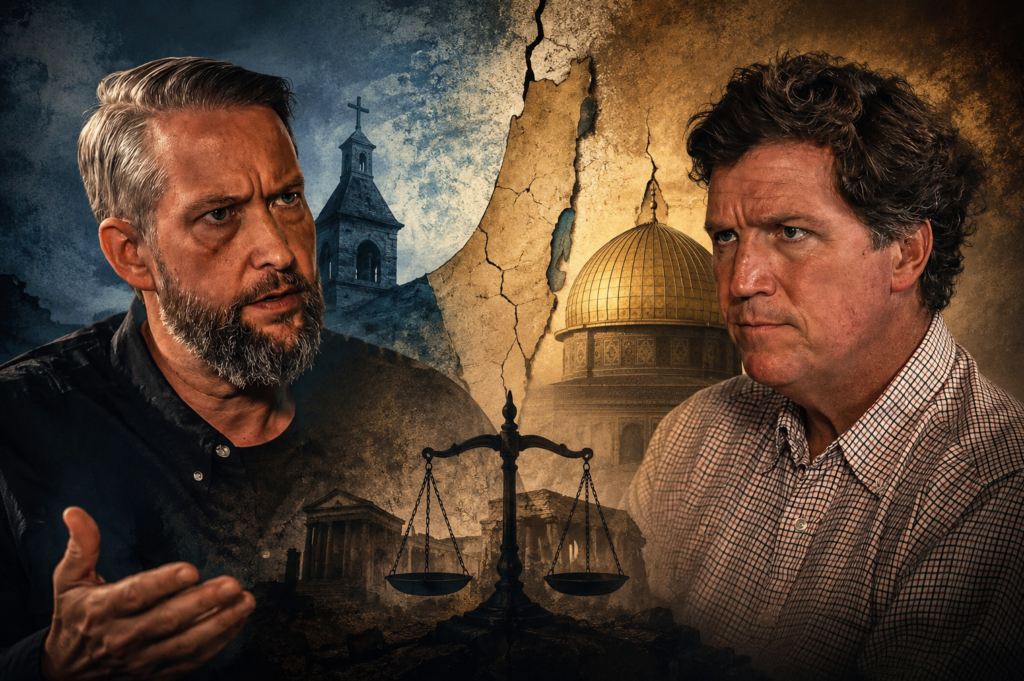

The recent Tucker Carlson interview with JD Hall has generated exactly the reaction one might expect. Christian Zionists are fuming. Anti-Zionists are celebrating. Covenant theologians are declaring victory. Dispensationalists are sounding alarms.
A good amount of the discussion, however, has proceeded from a false premise that, once Tucker Carlson’s questions become sufficiently focused on Israel, these questions should be viewed as theological rather than sociopolitical. There’s just one problem. Tucker Carlson is not a theologian.
He is not presenting a systematic doctrine of Israel. He is not attempting to engage centuries of debate regarding covenant theology, dispensationalism, or eschatology.

He is a journalist asking questions, or at least maintains plausible deniability regarding opponents’ claims about his real motivations and ideology.
Since leaving Fox News, Tucker’s public trajectory has uncoincidentally been marked by increasing skepticism toward elite institutions, foreign intervention, intelligence agencies, and political narratives that appear protected from criticism. His interest in Israel emerged from that broader skepticism, particularly in light of continuing and undeniable special interest lobbying of the US government on behalf of Israel.
The progression seems fairly obvious: Questions about American foreign policy led him toward Israel. Questions about Israel led him toward Christian Zionism. Questions about Christian Zionism eventually led him toward the theological matters that JD Hall has been writing about, nearly obsessively, for a few years now.
That distinction matters because many criticisms of Tucker proceed as though he is attempting to construct a comprehensive theological system. He is not. He is asking questions and interviewing people who claim to have answers (albeit answers that align with his broader positions rather than opposing them).
What JD Gets Right
For those familiar with Protestia’s history, the temptation will be either to dismiss JD Hall entirely or to embrace him uncritically. Both approaches would be mistakes. JD raises several points that evangelical Christians genuinely still need to hear. He is correct that Genesis 12:3 is routinely abused. He is correct that Jews are not saved apart from faith in Jesus Christ. He is correct that the modern State of Israel is not the Kingdom of God. He is correct that Christians may criticize Israeli policies just as they criticize the policies of any other nation. He is correct that Christian Zionism is not Christianity.
He is correct that Christians need not have a particular allegiance to the State of Israel on the basis that we are charged with bringing about God’s eschatological Jewish ingathering by any other means than the Great Commission (more on this “Jewish Nationalism” irony later).
Many evangelicals have never seriously considered these arguments because support for Israel has become so culturally embedded within American evangelicalism that questioning it often produces accusations of anti-Semitism, theological compromise, or disloyalty to Scripture. Yet these are legitimate questions, and snuffing them out before they can be discussed has seemingly resulted in backlash among younger Christian men, and a digital, racialist-tinged, special category of condemnation for anyone with “stein” in their name.
The Real Problem Is Jurisdiction
I’ve written about it on many occasions, and I will continue to beat the drum – the deeper issue in terms of the Christian’s approach to Israel is not dispensationalism versus covenant theology. It is jurisdiction.
As I have previously discussed in critiques of Christian Nationalism, Romans 13 and 1 Peter 2 teach plainly that God establishes distinct jurisdictions with distinct responsibilities.
He establishes the family (Gen. 2:24, Eph. 5:31-32), but with limited jurisdictional authority (Luke 14:26, Mark 3:31-35).
He establishes the church (Matt. 16:18-19, Matt. 18:17-20, Eph. 4:11-12), but with limited jurisdictional authority (1 Pet. 5:2-3, 2 Cor. 1:24, Acts 5:29).
He establishes civil government (Rom. 13:1-4, 1 Pet. 2:13-14), but with limited jurisdictional authority (Acts 5:29, Daniel 3, Daniel 6).
Each possesses real but limited authority. Each possesses authority delegated by God for specific purposes. And this jurisdictional framework applies to all of human civilization, with no Jewish exception. Confusion in this conversation begins when Christians encourage one jurisdiction to exercise authority God never assigned to it.
This principle applies to the modern debate over Israel. The debate is often framed as a conflict between supporters and opponents of Israel. Yet too often, both sides commit the same fundamental error. That is, both collapse categories that Scripture keeps separate.
The Category Collapse Behind Modern Zionism
Christian Zionists often speak as though Jewish genetic or cultural lineage, Judaism, the modern State of Israel, and biblical Israel are essentially interchangeable concepts. Ironically, many anti-Zionists make the exact same move.
One side collapses these categories and demands Christian allegiance to Israel, while the other collapses the categories and demands Christian condemnation of Israel. Yet scripture does not assume nor permit this collapse, no matter which formula one believes holds the moral high ground.
One of Paul’s primary concerns in Romans and Galatians is separating spiritual, worldly, and practical jurisdictional categories that fallen men instinctively merge together. Not all Israel is Israel (Rom. 9:6). Not all descendants of Abraham are children of Abraham (Rom. 9:7-8). Not all covenant members are ethnic descendants (Gal. 3:7, 3:29, Rom. 4:11-12). Not all ethnic descendants possess covenant blessings (Rom. 2:28-29, 9:30-32, Gal. 4:21-31).
The New Testament repeatedly disentangles categories that modern political discourse around the State of Israel continuously combines. Once those distinctions are recovered, much of this debate begins to look very different.
The Right of Return and the Problem of Covenant Identity
One of the strongest observations raised by JD Hall concerns Israel’s religious discrimination against Jews who profess faith in Jesus Christ. For decades, Israel’s Law of Return has created a kind of second-class status for returning Jews who convert to Christianity (or any other religion, for that matter). The precise legal details have evolved through court decisions and exceptions, but the underlying principle remains revealing: A Jew who embraces Christ is denied the ethnic privilege afforded to a Jew who embraces secularism, agnosticism, or atheism. That should immediately raise questions for Christian Zionists.
Many Christian Zionists speak as though the modern State of Israel represents biblical Israel. Yet the state itself frequently operates from explicitly rabbinic assumptions regarding Jewish identity, begging the question of why a supposed ingathering of God’s people is marked by an explicit rejection of Jews who have embraced the Messiah.
A Christian should at least pause when the nation supposedly representing God’s covenant people treats belief in Christ as a disqualifying characteristic.
That does not prove Israel has no future significance in God’s plan, but it does demonstrate that the modern state cannot simply be equated with the covenant people of God. If we reject the idea that Christians are obligated to materially support Christians around the world, insisting on this kind of obligation for non-Christians veers into the absurd, absent a jurisdiction-collapsing hermeneutic that blurs categories that scripture keeps distinct.
And yet, this is one of the places where both Christian Zionists and many anti-Zionists adopt the same framework. Both are too willing to wrap ethnicity, religion, citizenship, and covenant status into the same moral category.
Scripture separates them.
Muslim Rule, Christian Sites, and Protestant Questions
JD Hall’s comments regarding Muslim treatment of Christians deserve a similar qualification.
He is correct that many evangelicals possess an idealized view of Jewish-Christian relations and an exaggerated view of perpetual Muslim hostility. History is more complicated than this.
The Ottoman Empire often permitted Christian communities to exist, worship, and administer their own affairs. Certain Christian sites were preserved under Muslim rule for centuries. Those are historical realities.
Yet Christians under Islamic rule were typically second-class subjects. They faced legal disabilities, special taxation, and civil restrictions. Failing to submit to Islamic rulers often resulted in vicious persecution. As would be expected from an anti-Christ religion like Islam, the overall historical record is hardly favorable.
JD Hall has long argued that false expressions of Christianity and even Islam possess a (at least practically) higher view of Jesus than Rabbinic Judaism because they affirm a figure called “Jesus,” while Rabbinic Judaism explicitly condemns Jesus by name.
Viewed through that lens, JD’s appreciation for Muslim preservation of Christian sites becomes easier to understand. On the surface, Muslim rulers preserving what they believed to be Christian institutions may represent a form of respect toward Jesus, while the fact that some Rabbinic traditions teach that Jesus is burning in Gehenna would seem a more hostile posture, and exclusion of Jewish believers in Jesus from Israeli immigration may be viewed as an explicit condemnation of Christ Himself (it should be noted that Christians can immigrate to Israel and become citizens, just not under the special avenue granted to those considered Jews by the Israeli government).
Yet as those who believe that promotion of a false Jesus is no less condemnation-worthy than explicit rejection of the real One (and even Jews who claim overt opposition to Jesus do not know the real Christ they are supposedly condemning), we must remind ourselves that defending God’s name/honor is not our job (Deut. 32:35), and a religion that exalts a fake version of Jesus is no closer to obedience than one that condemns Him outright.
Why Reformed Christians Should Be Skeptical of Holy Geography
Even if we grant JD’s distinction, the Protestant question remains: Why should preservation of Christian sites carry theological significance in the first place? Is this not the same error committed by Christian Zionists who seek to tie a special Jews-only covenant to a consecrated piece of land? Under the overriding understanding of the Great Commission, we do not attach spiritual significance to geography. The New Testament consistently relocates holy identity away from geography and toward Christ and His people.
Jesus told the Samaritan woman that the hour was coming when worship would occur neither on Mount Gerizim nor in Jerusalem. The temple, sacrifices, and priesthood – all fulfilled in Christ.
The church becomes God’s temple. Believers become living stones. The kingdom is not tied to a patch of dirt.
This means the Protestant should be cautious when hearing Christian Zionists speak about preserving Jewish control of the land, and he should be equally cautious when hearing others praise Muslim stewardship of Christian sites.
Future Israel and Present Israel Are Not the Same Question
One clarification is necessary because some readers will inevitably assume that any criticism of Christian Zionism amounts to covenant theology or replacement theology.
A Reformed premillennialist can affirm a future large-scale conversion of ethnic Jews while rejecting the claim that a present, carnal, disobedient people group is God’s chosen vehicle to maintain an escatological remnant rather than the vehicle of the Word of God. To borrow phraseology from Galatians 3:28, there is no Jew nor Greek when it comes to the necessity of the Great Commission, for all are equal in their depravity, and all are brought to Christ by the preaching of the Word rather than special ethnic identity.
Romans 11 remains a significant text for many Reformed premillennialists. The Apostle Paul plainly asks whether God has cast away His people and answers in the negative. He speaks of a future ingathering that many respected theologians have understood as involving ethnic Israel.
John Murray believed it. S. Lewis Johnson believed it. John MacArthur believes it. Many others have as well, and one does not need to embrace classical dispensationalism to recognize that Romans 11 presents a serious biblical case for a future turning of Jews to Christ.
The crucial point is that Romans 11 does not automatically establish the covenant status of the modern Israeli state.
Future Israel and present Israel are not identical categories, and indeed might be entirely separate people groups.
A future conversion of Jews does not require Christians to sanctify Israeli foreign policy, nor treat the modern State of Israel as though it were the Kingdom of God. Indeed, if the primary ingathering of Jews occurs in connection with Christ’s return, many popular assumptions regarding present-day Zionism become far less certain. The question is not whether God may yet show remarkable mercy to ethnic Jews and bring them to Christ. The question is whether Christians are authorized to assign covenant significance to a modern civil government.
Christian Nationalism and Christian Zionism Share a Common Error
One of the more interesting implications of this framework is how it challenges both Christian Zionism and certain forms of Christian nationalism. Both movements often assign spiritual significance to political realities that belong within the sphere of civil government.
One seeks the advancement of Christendom through political influence. The other seeks the advancement of prophetic Israel through political influence.
Both risk confusing political developments with kingdom developments. Both risk treating territorial control as evidence of redemptive progress. Both can drift toward a kingdom-now mindset.
The New Testament places the church in a different posture, where Christ builds His church (Matt. 16:18), the gospel advances (Matt. 24:14), the nations remain fallen (Psalm 2:1-3, 2 Tim. 3:1-5, 2 Tim. 3:13), and civil governments rise and fall (Dan. 2:21, 4:17, Rom. 13:1). Then Christ returns. The kingdom arrives physically when the King arrives physically (Matt. 25:31, Rev. 11:15).
Recovering Biblical Categories
The modern Israel debate often becomes confusing because both defenders and critics of Israel collapse categories that God keeps separate.
The State of Israel is a civil government. It possesses civil authority. It deserves the same type of moral evaluation Christians should apply to every other civil government on earth.
The church remains the covenant people of God, as Christ draws Jews, Greeks, and peoples from every tribe, tongue, and nation. It does not involve a fast track or exception for Jews, nor does it categorically reject them in any sense other than their exclusivity as God’s chosen.
The issue is not whether Christians should be pro-Israel or anti-Israel. The issue is whether Christians will respect the categories Scripture itself establishes.
When those distinctions are recovered, many of the fiercest arguments surrounding Israel begin to look far less complicated than they first appeared.

















24 responses to “Israel, Jurisdiction, and the Category Confusion Behind the Debate”
JD Hall and Tucker giving us the distorted Islamic version of history. Wrong on so many points, and as usual doing Tucker’s very best to hate on joooos.
It is one of the most anti-Christian videos that could be made.
Anyone focusing obsessively and I might add derogatorily without fail about Israel and Jewish People isn’t deceived, but is a deceiver. Those figures of Christian ‘authority’ fomenting this obsession to the flock are wolfs in sheep’s clothing. Tucker? Oy Vey already.
Thank you for providing a very good guide to understanding the role of modern-day Israel.
We do, however, need to recognize basic rights including the state of Israel to exist in peace with her neighbors.
This is an excellently fair treatment of the subject that recognizes categories properly and respects the arduous process of theologians disentangling the subject. I really appreciate that you do not just completely disregard and dismiss those of a dispensational (or Futuristic Premillennial as John MacArthur would have called it, and with which I agree). It is refreshing to not be a laughing stock online
We are grafted in. Adopted. And so we have a kinship. They are our kin. And that does have limits.
Jurisdiction and scope are indeed important, but regardless of jurisdiction and scope, the limits remain the same. There is one dividing line and one set of limits established by God. Only one.
So they may be like the extremely wayward and wicked cousins that we should avoid for moral reasons, but who we also would not wish any harm, and would not write off completely to the point that we wouldn’t care whether or not they were slaughtered by terrorist muslims.
Right, Jesus did say that one must hate his father and mother (Luke 14), but He also slammed the Pharisees in Matt 15 for depriving a man of his ability to keep the commandments of God to honor his father and mother. The key distinction is loving God first and putting Him first. Note the point of Luke 14. He also said one must hate his own life. In other words, the Lord must come first, and if we are truly born again we will serve and obey Him regardless of the cost, even to death.
I don’t have all the answers, but I’d say a good starting point would be to understand and remember that they are our kin. What that means and what we should do in given circumstances, how we should put the Lord first and what it would mean to put the Lord first, is worthy of discussion, but we should not forget our kinship. The Israeli government might indeed be terribly wicked. But so is the government of Canada these days, along with the government of many other allies. Right. They’re still an ally.
As it pertains to the Iran war, and many other situations, our interests extend beyond just Israel. That’s a part of the Iran war, but that’s not all of what its about. Right, a ton of the world’s oil is shipped through the strait of hormuz. Iran had to be stopped from interfering with that supply, constantly terrorizing ships traveling through those waters. Those who make it all about Israel, and essentially say without Israel there wouldn’t be any conflict with Iran, are betraying their own wickedness. They are the same who essentially claim any and all wickedness is the fault of the Jews, and thereby deny the Gospel by denying the source of wickedness, the corruption of mankind and all of creation from the sin of Adam.
There needs to be more elaboration on the concept of new covenant and saying the promise was never [only] for the Jews. Because what JD said there is correct, but it can come across the wrong way if people do not understand. And it can also appear to be a conflicting statement (which would mean the scripture would conflict)
In a certain sense, it is still the same covenant God made with Abraham. Remember the covenant was that Abraham would be the father of many nations. The phrase is repeated in Romans 4, where the Greek word translated as “nations” is ethnos.
But we’re also told that it is a new covenant in passages such as Heb 8. And so we’ve got to understand how those concepts do not conflict, and how the scripture doesn’t conflict with itself. It’s the same promise, but a new covenant. What does that mean? That’s what we’ve got to consider.
It is critical to understand that the Gospel has existed since the beginning. God’s covenant with Abraham is the Gospel. It’s not replaced by the Gospel. It is the Gospel. Just before Jesus ascended, He told the disciples that He was next going to preach the Gospel to the dead (John 5:25, 2 Pet. 4:6, etc.) That is all who came before, Jew and Gentile. The New Testament explains that the Gospel reached back through time to save those who lived by faith (Heb 10 and 11, Galatians 3, etc.) There is only one way to the Father, and that one way has existed since the beginning.
The Gospel is for the Jew first and then the Gentile. (Romans first few chapters)
JD touched on all of this, but I believe there needs to be more explanation. Particularly concerning what is meant by “new covenant”. It does not mean that the existent promise is replaced, but rather that it was fulfilled. The New Covenant applies to all who come after. That is, if they blatantly reject Jesus having heard the Gospel in this life, then then they will not be saved. They will not be preached the Gospel when they’re dead, as those who came before. But the way all this was presented and said could come across the wrong way. It’s not a subject that can be easily explained in a short interview, and I’m not sure I understand it all perfectly. But enough explanation needs to be given such that it does not come across the wrong way.
The Hebrew word translated as “nations” in Genesis 17 is “Goy”. It means Gentile. And it’s a word that is thrown around all the time, yet it’s the very same word used in God’s covenant with Abraham.
The promise was always for Jew and Gentile.
And all throughout the Old Testament we read of gentiles who knew God. Remember, the first few chapters of Romans reminds us, the moral law, God’s standard of right and wrong, is inherent from Adam. It is the conscience – the God-breathed spirit of man, from Creation. It is evident in Creation, such that all who have ever lived are without excuse (Romans 1), whether Jew or Gentile.
The New Covenant does not replace all of the Old Covenant. That’s what we’ve got to understand. It’s not entirely different. It is very much the same. And the main difference is pretty much the fact that Jesus fulfilled the ceremonial law. That’s about all that has been “replaced”. The rest pretty much overlaps and remains the same.
I didn’t write that correctly. The new covenant does replace the old covenant in that it makes it obsolete (Heb 8:13), because Jesus fulfilled the old covenant. What I meant was that the new covenant doesn’t replace all of the old covenant. They are essentially the same covenant, in an sense, and differ by the ceremonial law, the Gospel no longer preached to the dead, and so on. It’s difficult to explain, and I’m not sure I understand it all myself.
I just wish they would stop trying to soften Islam. I get what they are doing, but Judaism and Islam are both evil, none of their practices should be in the West. You don’t have to soften Islam to preach the evils of Judaism. They are both Christless, pagan systems.
A fascinating interview, and my equally fascinating essay on it:
The Dangers of Post-Liberal Christian Nationalism: JD Hall, Christian Zionism, and the Politics of Religious Identity
The Tucker Carlson interview with JD Hall offers a revealing look into a growing current within American Christianity: a coalition of Reformed, post-liberal, anti-dispensational, and Christian-nationalist thinkers who view Christian Zionism not merely as a theological error, but as a civilizational threat. Hall’s critique of Christian Zionism is not simply an argument about biblical prophecy. It is part of a broader attempt to redefine Christian political identity in opposition to both liberalism and what he portrays as excessive Jewish influence within American religious and political life.
Some of Hall’s criticisms deserve serious consideration. Many historians agree that modern Christian Zionism emerged primarily in the nineteenth century through dispensationalist theology associated with John Nelson Darby rather than from the mainstream traditions of Catholicism, Orthodoxy, or Protestantism. Likewise, it is reasonable to question whether support for the modern State of Israel should be treated as a religious obligation for Christians. Hall is also correct that many Christians have never examined the theological assumptions behind popular slogans such as “bless Israel and God will bless you.”
The problem is not that Hall raises these questions. The problem is how he answers them.
Throughout the interview, Hall moves beyond criticism of Christian Zionism and begins constructing a narrative in which Judaism itself becomes suspect. He repeatedly characterizes Rabbinic Judaism as an invented religion, claims that modern Judaism bears little resemblance to ancient Judaism, and implies that contemporary Jewish religious practice is animated by hostility toward Christians and Gentiles. At several points, he describes Judaism not merely as a religion that rejects Christian claims, but as something fundamentally alien to the moral and spiritual values he associates with Christianity.
This tendency becomes most apparent when Hall discusses violence and atonement. He speculates that because the Temple sacrifices ended in 70 CE, Rabbinic Judaism developed an alternative source of symbolic bloodshed through warfare. He suggests that Jews may view war against Gentiles as a form of spiritual accomplishment or atonement. Yet in the interview he provides no textual evidence, no rabbinic sources, and no historical scholarship supporting this claim. It is presented as an inference rather than a documented belief. Such assertions are especially dangerous because they echo centuries-old accusations that Jewish religion is inherently bloodthirsty or uniquely violent.
Similarly troubling is Hall’s description of Judaism as a religion centered on hatred of outsiders. His discussion of Passover prayers, particularly “Pour Out Your Wrath,” presents them as evidence of a desire for the destruction of nations. What is omitted is that these prayers are largely derived from biblical texts and have historically been understood in the context of persecution and exile. By removing the historical context, Hall encourages listeners to view Jewish religious practice through a lens of suspicion.
These arguments reflect a broader pattern increasingly visible in certain post-liberal and Christian-nationalist circles. The central claim is not merely that Christian Zionism is wrong. Rather, the argument evolves into a narrative in which American Christians have been manipulated by foreign interests, deceived by political elites, and spiritually corrupted by a theology that allegedly elevates Jews above Christians. Hall’s references to organized propaganda campaigns, foreign influence operations, and what he elsewhere has described as an “Israeli Ponzi scheme” fit within this framework. The danger is that criticism of Israeli policy can gradually become criticism of Jews as a collective group, and criticism of Christian Zionism can become suspicion toward Jewish participation in public life.
This is not to say that Israel should be immune from criticism. Democracies, including Israel and the United States, should be subject to scrutiny and debate. Nor should Christian Zionism be exempt from theological criticism. Christians have every right to question whether support for a modern nation-state should be treated as a religious obligation.
The danger arises when theological disagreement becomes civilizational conflict. When Jews are portrayed as uniquely manipulative, uniquely hostile to Christianity, or uniquely responsible for political corruption, the discussion begins to resemble older conspiratorial narratives that have repeatedly produced social division and hostility. History shows how easily theological disputes can be transformed into ethnic and political antagonisms.
The broader Christian-nationalist movement often presents itself as a defense of traditional faith against secular liberalism. Yet its rhetoric can sometimes create new forms of tribalism. By defining Christianity primarily through opposition to perceived enemies—whether secularists, immigrants, Muslims, liberals, or Jews—it risks replacing a universal religious message with a politics of resentment. Christianity’s historical claim has been that salvation transcends ethnicity, nationality, and tribe. When political identity becomes primary, that universal message can be diminished.
The challenge for Christians who reject Christian Zionism is therefore to distinguish between legitimate theological critique and narratives that foster suspicion toward entire religious communities. One can oppose dispensationalism without portraying Judaism as inherently malicious. One can criticize Israeli government policy without embracing conspiratorial explanations of world events. One can defend Christian doctrine without reducing complex historical relationships to stories of collective guilt or civilizational struggle.
JD Hall’s interview demonstrates both the strengths and weaknesses of the contemporary anti-Zionist Christian movement. Its strongest arguments concern theology and church history. Its weakest arguments emerge when criticism of ideas shifts toward sweeping claims about Jews, Judaism, and Jewish influence. The future of this debate will depend on whether critics of Christian Zionism can maintain that distinction—or whether opposition to a political ideology becomes entangled with older and more dangerous patterns of religious hostility.
So you’re saying when Jewish people get together in groups, regardless of time or place, they don’t act on those interests and those interests are never in conflict with Christianity?
Most excellent.
The Ottoman Empire was not “kind” to Christians. They were oppressed, a million were slaughtered. Their sons were kidnapped to be made in Janissaries. Their churches were taxed heavily. Christians were forbidden to do a lot of things other people did.
JD Hall is wrong all the way through
That is correct. The Ottomans specifically went to war against the Christian Byzantines, and conquered and changed the name of Constantinople.
Many, if not most, of the manuscripts that make up our New Testament are Byzantine manuscripts.
I have not had time to watch the entire interview. It sounds to me like JD has gone considerably awry.
[…] Israel, Jurisdiction, and the Category Confusion Behind the Debate […]
The most powerfully well thought out and thorough treatment on any mass conversion of the Jews that I have seen to date is that found in the book by Dr. Robert Sungenis: Why There Will Not Be A Mass Conversion of the Jews — A Critique of “If You Believed Moses”.
JD Hall is neither a theologian nor a Biblical scholar in any sense of the term. He is a defrocked Antinomian leaning Southern Baptist Evangelical pastor who is no longer in the ministry. And while I do not agree with many of the false accusations made against him by his former church that led him to court and trial proceedings and a plea of no contest, it is abundantly clear that he has no place in the ministry, no place in preaching or teaching the Word of God, and no place in any type of ministry of Apologetics or Polemics. There are enough reasons to judge him, according to Scripture and Christian discernment, to be disqualified from every form of Christian ministry. Why Tucker would hail him as a great theologian on the subject, “the very best on the internet,” is a damnable lie and ruse of flattery to serve his Neo-Orthodox and anti-Israel agenda. Even JD considers himself unfit for the ministry! So why would JD accept such wicked flattery as well as an invitation from Tucker to get involved in Tucker’s ongoing promotion of his Neo-Orthodox and pro-Islamic heretical views is deeply tragic. JD Hall is completely ignorant of the origins and the rise of “Christian Zionism” in church history. You can read my original 4 part post in response. It seems that JD is doing this not merely to refute the heresy of Dispensationalism; but also for the sake of filthy lucre, and to try to sinfully resurrect his failed ministry? JD Hall, has already dragged his lovely wife and beloved children through a shit-hole of scandal, controversy, miseries, and evils over the last decade on account of his own sins and addictions and his personal vanity; and he doesn’t seem to be entirely repentant. He is a fool and a jackass that needs to get a job outside of any form of Christian ministry, to overcome the various debilitating sins and idolatries that he is entangled in, and to resist the temptation of the Devil and his own personal vanity that leads him speak on issues of Christian truth, other than in his own community. The church is sadly full of false teachers, heretics, charlatans, religious hypocrites, and also Christian men who are simple unqualified for the ministry on account of: 1. Ignorance of Scripture and sound doctrine. 2. Lack of moral virtue and practical godliness in personal and family life. 3. A sinful accommodation to heresy, idolatry, false doctrine, and philosophies as well as political ideologies that are contrary to the authority of Scripture and Christ’s sovereign Lordship. or 4. Evidence of scandal from immorality, ungodliness, covetousness, corruption, laziness, or other vices incompatible with the Christian ministry. The truth is, the vast majority of so-called pastors, ministers, preachers, priests, clerics, teachers, and/or counselors in Christian churches are unfit for the ministry. And I am not even including here the cults, false religions, and deviant forms of Christianity that pervert the Gospel and are on the road to hell and damnation: Liberals, Mormons, Pentecostals, Broad Evangelical, Neo-Orthodox, Roman Catholic, etc… They are called by men, and not by Christ! JD seems to be an Evangelical Christian with many personal and spiritual problems; and he is in rehab for heresy, idolatry, stupidity, moral depravity, and personal vanity. And I do not think he knows how serious his problems are! For Tucker to have him on his show to give a false account of “Christian Zionism” as well as a whole lot of damnable lies and propaganda in regard to the history of Islam is utterly perverse and wicked! Romans 1:18 “The wrath of God is revealed from heaven against all ungodliness and unrighteousness of men who suppress the truth in unrighteousness.”
Powerful.
What most do not realize is that Zionism has nothing to do with Genesis 12, but with Genesis 15/17. In short, the Covenant of Circumcision. The Old Covenant has nothing to do with the Covenant of Circumcision. Behavior of the Jews doesn’t matter. They still get that land, no matter what.
JD Hall has lost any credibility he might have possessed. His portrayal of a tolerant Islam does not match history. Listen to or read Raymond Ibrahim who is an expert on the subject and you will discover JD utterly mischaracterized Islam and its reaction to Christians and Christianity.
I was driving when I heard Tucker had JD on there. JD is a mentally disturbed person who I saw through about 12 months before his arrest. People were buying his excuses for his erratic behavior when I knew there had to be more to it. I watched the interview with his wife and spotted a narcissist right away. The fact that TC would scoop from the bottom of the barrel is even laughable. JD just found a platform that must not have checked out his background before he was on the show. To give him a national platform is laughable and I see he hasn’t changed one bit. Just changed to be able to act like an expert on something again to try to gain credibility.
He never was. He played the game and put on a persona until he was caught and then exposed. Sadly many will listen to him and not bother to look up his past. David and I debated the fact that he was still not accepting responsibility for his actions on that video he did with his wife when he still tried to shift blame elsewhere. My favorite was someone who defended JD’s claim about his drug issues was that it was due to a vitamin D deficiency after gastric bypass surgery. I laughed for two reasons. A vitamin D deficiency doesn’t cause what he was claiming and as someone who had the same surgery almost 20 years ago, you get your annual bloodwork so you stay on top of any issues even if it was true. He was lying to everyone, but no one remembers those things with how fast someone’s lies and deceptions can get “erased” in two weeks when another story captures the people’s attention. He was still lying in the video with his wife and you could tell it. Nothing has changed. Some bozo was so desperate to get TC a guest who agreed with his views that they scraped the bottom of the barrel.
Good article. Keep up the good work Protestia.
Sugya intergrity קידושין – the 6th sugya: 5a to 5b. שתקנה
This sugya makes a משנה תורה – t’shuva which learns Rabbi Akiva’s רבוי מיעט. While the רבוי מיעט not in and off itself a general הוויה אמינא וקמ״ל process – its operates and accomplishes the same result. Therefore practically speaking the “tap code” of הווא אמינא … קמ”ל, since it functionally duplicates the rabbinic middah of רבוי מיעט therefore our sugya in under examination a 4th midda and not simply 3 middot! It transforms from a simple three-part refutation into a highly sophisticated, four-tiered grid of inductive legal reasoning.
The immediate functional result of the Kal V’Chomer. It operates as an inductive Ribuy, conceptually widening the boundaries of the Mishnah’s original matrix to bring an unlisted, 4th mode of entry (Chuppah) into the legal domain of Kinyan – קמ”ל. The logic of the Kal V’Chomer expansive like the הווא אמינא\רבוי.
The precedent בנין אב functions like a fractional “common denominator” wherein the Mishna language equates acquisition of “Title” to the נפש עולם הבא of the woman based upon the Torah בנין אב brit cut between the pieces where Avram cut a brit upon his future born seed (עולם הבא).
The prophetic mussar of the Torah rejects the Nazi racism which modern racists call DNA after Jewish scientists made this discovery in 1953! Any person can convert and embrace the Sinai revelation of Torah common law justice – and many Goyim in point of fact have done just that. Post Shoah where European antisemites slaughtered 75% of Western European Jewry in less than 3 years – this team effort depended upon the British White Paper which influenced the decision of Washington to not duplicate its Good Eye policy of permitting Jewish refugees expelled from the collapsing Czarist empire into the United States at the turn of the 20th Century!
The Nazi “inferior race” racism post Shoah antisemites now employ DNA as a fig leaf to cover their diseased minds. By treating the expansive logic of the Kal V’Chomer as an operational Ribuy, and the restrictive Tzad HaShaveh as a structural Miuat, a scholar can map the middot “finger-print” of this 6th sugya of קידושין and through detective sleuth work compare this “fingerprint” to other Similar sugyot across the Sha’s Bavli and Yerushalmi. משנה תורה-common law stands upon the יסוד of precedents.
When a Gemara 6th sugya turns back upon itself 2nd sugya, this “drosh” makes a depth analysis of rabbinic middot language. This depth analysis of rabbinic middot, like as explained above permits down stream generations to make a שד השווה to other related גזרה שווה sugyot across the Sha’s.
The editors of the Vilna Sha’s, their wisdom employs the * to achieve this inductive reasoning which compares different sugyot (always and forever chained to interpret the language/phrase of a specific Mishna), and then expands this צד השווה common denominator גזרה שווה language.
The precedent search to different sugyot compares the language of one specific Mishna to other specific Mishnaot! The first * common denominator following .ג (second sugya), compares the language of our Av Mishah to the thesis statement: 10a איבעיא להו ביאה נשואין עושה או אירוסין עושה? The language נפקא מינה the rabbinic understanding of רוב חסד – the Torah middah of discernment or understanding which compares like from like – akin to the mitzva of separating t’ruma, ma’asser, chol\Israel (Chol not common or profane. Rather House of Aaron, Levi, and Israel’s portion inheritance to the oath sworn lands). The common false translation which views the 6 day of Chol as separate from Shabbat, another example of טיפש פשט “box thinking”.
The actual צד השווה on dof 10b., and this sugya terminates on 11a. When the common law commentary Baali Tosafot jumps off the dof in search of a common law precedent, the simplest way to understand the wisdom of the grand-children of Rashi; understand … each and every sugya of Gemara exceptionally structured and highly edited. In this sense a sugya of Gemara compares to the 13 lines which defines a sonnet of poetry! Not that a Gemara sugya – a sonnet טיפש פשט stupidity. Rather for the poet to structure a sonnet requires a refined Order and structure, so too each and every sugya of the Talmud. Each sugya opens and closes with a similar thesis statement; the shortest distance between two points – a straight line or sh’itta. Hence the precedent specific which the Baali Tosafot brings must rest along this sh’itta line of thought.
A sugya of Gemara likewise resembles to a blue-print which a building contractor requires to construct a 3 dimensional building. Torah courtroom law, the Talmud attempts to duplicate how different eye-witnesses see the New Moon, based upon their fixed but different perspectives. Hence a blue-print requires a Front, Top, Side views! Reading the Mishna and how much more so the T’NaCH from a literal reading of words טיפש פשט compares to the church inquisition “trial” (what a joke), of 1633 which condemned Galileo for rejecting Aristotle theory of heliocentrism – the Sun revolves around the Earth.
Copernicus published De revolutionibus but had the arrogant gall to die in 1543 before Rome to murder him for the sin of heresy! Church dogmatism shaped hatred against Jews till the 2nd Vatican Council formally repudiated the post War Polish pogroms and rat-lines consequences of Pope Pius XII alliance (like the Lutheran church) with Hitler against Communism.
While neither Plato or Aristotle taught ‘Flat Earth’. Cosmas Indicopleustes (6th century) proposed a flat universe/world in his ‘Christian Topography’ and argued against spherical (and moving heavenly) models. But his influence played a marginal – even nonexistent – role in the heresy trial of Galileo. This digression attempts to show that reading Talmudic common law texts without a ‘good-eye’ to inductive comparative precedents, as reactionary as Rambam and Karo’s statute law religious codes – written to cope with the darkest ages of Human moral depravity and barbarism which culminated in the ‘evil-eye’ – Shoah & Arab ’48 and ’67 – repeated attempts to exterminate the Jewish people; great power imperialism efforts to restore the Roman empire colonialism which renamed conquered Judea to Palestine – the British ’39 White Paper and UN SC Resolution 446 – 2334.
גופא: The next sugya precedent to compare its Mishnaic phrase through the fixed perspective of a sugya of Gemara פרט-כלל — mesechta Ketubot 57b to 58a. The Mishna clause הגיע זמן לאו נישאו. The Gemara sugya opens with אמר עולא and ends with מסר והלך. The next * גזרה שווה jumps to קידושין כא. פרט. This sugya כלל begins on dof 20a ת”ר and terminates on 21b – ברציעה. This sugya an Aggadic so comparing the similar relationship between the halachic 7, 10, 13 middot to the Aggadic 32 middot — their overlap merits close observation. The central question which of these sugyot most resembles our rabbinic middot fingerprint?
Kiddushin 10a – 11a — איבעיא להו ביאה נשואין עושה או אירוסין עושה — Chuppa functions comparable to a house private domain. Whereas אירוסין, in the time of the Gemara – the woman arranged her “house” prior to affixing a shared domain with her chatan/groom-to-be under the chuppa. Hence the woman referred to as בית.
Ketubot 57b – 58a — הגיע זמן ולא נישאו – דתנן: נותנין לבתולה שנים עשר חודש
If the agreed-upon time for marriage arrives and the wedding has not occurred, the woman begins eating terumah at her father-in-law’s expense. The Gemara opens with Ulla and tracks the mechanics down to מסר והלך. Ulla’s thesis, the Gemara attempts to extend the boundaries ‘terumah rights דאורייתא’ determined through false logical assumptions through a צד השווה regarding the domains of responsibility where the chatan replaces the father to דאורייתא annul a vow made by his wife.
The kal v’chomer argues that if a עבד עברי possible to a Goy; the “owner” should likewise possess the power to sell himself. But this middah of logic fails to weigh the reason of theft, which caused the case עבד עברי – does not at all resemble to the case of קידושין. The 6 months window which permits a father to marry his daughter prior to losing this authority – when she reaches the age of בגרת – shares no common ground with an עבד עברי.
Despite both sugyot employing kal v’chomer, Ribuy, Tzad HaShave, Miuat sequences, this similarity accentuates the fundamental differences which separates the mitzva דאורייתא of קידושין – גט from עבד עברי slaves. While slaves can eat t’ruma, they simply do not compare to acquisition of future born children to sanctify from generation to generation the oath sworn brit of the Cohen seed never going extinct like as do great and powerful empires (like the British and USSR) by means of the Torah wisdom time-oriented commandments which the Chuppa symbolizes. The chosen Cohen brit inheritance to conquer the lands of Canaan לשמה the essence of the first Sinai commandment. Israel did not attain liberty from g’lut Egypt to duplicate that g’lut slavery in the brit lands of Canaan. Yovel frees the עבד עברי רציעה.
Its my sincere hope that my digression which addresses Zionism causes the Talmud to breath and live post Shoah. Every sugya possesses an internal sequence of inductive legal operations—a “middot fingerprint.” By identifying that fingerprint, one can compare sugyot through precedent, explain why Tosafot links particular passages, and reconstruct the editorial architecture of the Bavli and Yerushalmi as a system of common-law reasoning, rather than as isolated religious statute law codes – written as a g’lut coping mechanism. This approach treats the Gemara’s הווה אמינא–קמ”ל dialectic as functionally equivalent to the expansive and restrictive dynamics of רבי עקיבא’s ריבוי ומיעוט, thereby revealing a deeper layer of sugya integrity.