


On a recent episode of the Apologetics Canada podcast with Wes Huff, Duck Dynasty granddaughter Sadie Robertson Huff walked through the origin of her ministry and described the moment everything shifted. She recounts attending a conference, seeing a woman preach for the first time, and being deeply moved by it.
“And then a woman comes out to preach… I was so moved by her message… something about just seeing her do that… I was like, wow, this is so powerful.”
That moment didn’t just inspire her. It reframed her understanding of what she could do:
“I was like, if God… used me in such a way like that, that would make fame make sense.”
From there, the doors opened, the platform expanded, and she stepped into what she herself calls preaching:

“I started sharing about my faith… kind of not knowing I was preaching, but preaching.”
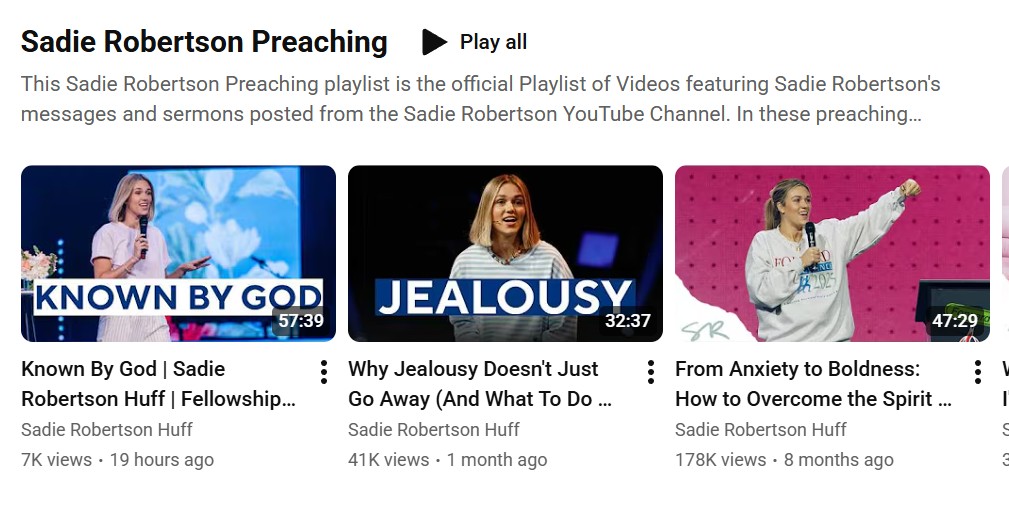
That is her category. And the apologetics guys on the podcast didn’t correct it.
Not when she centers her trajectory on seeing a female preacher. Not when she describes her own activity as preaching.
Not when she explains that this is now her ongoing ministry to mixed audiences.
Instead, Troy Lydiate closes the conversation by affirming her “boldness to preach and to teach and be in the public square.” And self-described complementarian Wes Huff says nothing.
To be fair, the conversation itself was not naïve about fame. Much of it wrestled honestly with the pressures of platform, the temptation to perform, and the disorienting effects of being known. Sadie spoke openly about the struggles of public life and the need for authenticity.
But the most obvious question never came up: What if the desire for platform doesn’t just tempt behavior, but shapes theology? What if the same forces that make fame appealing also make public ministry feel like calling? What if the impulse to be seen, heard, and followed doesn’t disappear in Christian spaces, but simply rebrands itself in spiritual language?
That question was never asked, although, to be fair, it’s largely been ignored across the breadth of modern evangelicalism.
Instead, Sadie’s narrative moves predictably. Opportunity opens. Influence grows. Doors multiply. And all of it is interpreted as confirmation that God must be behind it. The problem is, scripture doesn’t teach this. And once a person claims, “God called me to preach,” they are making a theological claim that must be tested against Scripture. And Scripture is not unclear.
The Apostle Paul does not say, “I do not permit a woman to teach or exercise authority over a man unless she has a compelling platform.” He does not carve out exceptions for conferences, podcasts, or parachurch environments. He grounds the prohibition in creation itself (1 Tim. 2:12-14).
That means it is not cultural. It is not situational. It is not overridden by perceived calling, nor by a woman’s supposed superior ability to deliver sermons. And yet our feminist culture continues to demand we find exceptions and loopholes, and we seem fully willing to accommodate, even in the context of Christian apologetics.
In this case, a woman says God called her to preach to mixed audiences. A complementarian apologist nods along. A host publicly affirms it. And no one feels the need to reconcile that with Scripture. What makes this even more revealing is that we are now seeing multiple versions of this same problem emerge from different angles.
Take Allie Beth Stuckey and the “Side B feminism” dynamic we recently addressed. Stuckey, to her credit, affirms the biblical restriction. She does not claim to preach to men. She says she will not step into the pulpit because Scripture forbids it. But listen carefully to how that argument is framed.
The emphasis (as demonstrated in a 2023 clip from Stuckey’s show Relatable) is often that women can preach just as well as men and are equally capable, equally gifted, and equally able to handle the task. The only reason they don’t is submission to the scriptural technicality. That framing concedes the premise.
From the clip:
“So that means – and forgive me if this sounds braggadocious in any way, because that’s not my intent – it’s actually trying to express how submission to God and His will looks for different people. Like, even if we feel a certain way, very strongly – even if we feel like we have what it takes to do something that falls outside of his bounds. So all of this means that even though – even though I know I am mentally and physically capable of stepping into a pulpit on Sunday morning and delivering a more Biblically sound, exegetically exquisite, persuasive and dynamic sermon than many male pastors in America today, I can’t do it. Because that is not the realm to which God has called me as a woman. And you know what? Like, of course, pride would have a struggle with that. Pride would have us…one of the parts of the curse is that Eve, your desire will be for your husband, but he will rule over you. The hierarchy is not a part of the fall, but our desire to usurp that authority and to exercise our own authority – that is a part of sin. That is a part of the fall. But ultimately, because I know that God is wiser and infinitely better than I am, I am thankful that even though I am physically and mentally capable of doing some things, but I’m not called to doing all of those things, even if it is just because of the gender that God providentially gave me…”
Much of her explanation was correct. She rightly noted that feelings do not equate to purpose or truth, that male-female hierarchy is not a result of the fall (often egalitarian apologists claim the opposite), and that the cursed desire of the woman would be for her husband’s authority. Yet she maintained the ontological equation – that some women may be “mentally and physically capable” of what God’s Word has specifically reserved for men.
Her framing accepts the egalitarian assumption that preaching is fundamentally about communication ability, gifting, or modern presentation competence, and then applies a restraint on top of it. But that is not how Scripture frames the issue. Scripture does not say women are equally qualified but restricted for arbitrary reasons, as if God flipped a coin or men got there first and called dibs. It ties the teaching office to pre-fall created design, order, headship, authority, and to the structure of the church itself.
In keeping with the Biblical pattern, God’s ordination of men to the role of doctrinal leading/teaching/preaching turns the modern assumption that preaching belongs to whoever is best at it on its head. The power of the Spirit exercised through the plain preaching of the Word does not depend on the most compelling communicator, the strongest personality, or the one who can “hold a room.” Scripture consistently cuts against that. Moses objects that he is slow of speech. Jeremiah says he is too young. Paul admits his speech is unimpressive. Again and again, God uses men who do not necessarily desire the role, do not feel qualified for it, and are not naturally gifted at it. That is the point. The power on display is God’s, not theirs.
In terms of design and purpose, preaching is not merely a matter of what women are allowed to do. It is a matter of what they are called and designed to do. And that is exactly where Sadie’s “God called me” claim collapses. Because once you adopt the underlying assumption that women are just as capable and just as suited for preaching, it becomes only a matter of time before someone says what Sadie says, and functionally charismatic male voices who have already ceded the scriptural ground stay silent. If the only barrier is a textual technicality, then experience, opportunity, and perceived calling will eventually override it. This is how you move from Stuckey’s “I choose not to preach” to Robertson Huff’s “God called me to preach.” Same underlying premise. Different preferential conclusion.
We must note, at this point, the ontological similarity between even Stuckey’s “I don’t preach even though I could” position and Revoice, “Side B” theology.
“Side B” LGBT theology:
- Same-sex attraction is an innate part of a person
- Faithfulness means not acting on it
Stuckey’s “Side B” complementarianism:
- Women possess the same leadership and teaching capacities as men
- Faithfulness means not acting on those capacities in the office of pastor
Same structure. Same logic. In both cases, the desire/capability is affirmed, but the expression is restricted and framed as obedience. And the implication is the same:
God has created a person with desires that do not align with their created purpose, and expects lifelong suppression.
This is not a biblical understanding of human nature, but rather a culturally-submissive compromise built on unstable exegesis – the exact kind of exegesis that Christian apologists task themselves with opposing.
Yet again, we see the broader tendency within the online apologetics world not to stand firm on the truth of the Word, but to maintain the relational tone that feeds the platform, affirm anyone claiming Christ where possible, and avoid the direct confrontation that Jesus and his apostles specialized in.
Wes Huff knows the text. He has wrestled with it. Yet long before anyone knew him from his appearance on the Joe Rogan Experience, Huff had already articulated a functionally compromised version of complementarianism that has no defense for a claim that God called a woman to preach.
Rewinding the clock back to April 2020, Huff spent over an hour with YouTube apologist Susan Morales on a video titled, “Who First Taught Women Are Equal To Men?” where Huff defines equality as “agency in terms of equality of opportunity” (19:19), and even argues that Christianity teaches women should have “the exact equal opportunities as men” (1:03:00). He affirms that women cannot hold “authoritative roles in the church” (49:22), but never defines that category in a way that would clearly exclude public teaching to mixed audiences. Instead, authority is softened, submission is reframed as mutual, and the entire discussion is driven by modern equality language rather than creation order.
In other words, Huff’s complementarianism affirms restriction in theory, but redefines equality in such modern terms that it lacks the categories to enforce that restriction in practice. Huff didn’t push back against Sadie Robertson Huff because he agrees with her.
And this compromise is not isolated.
It shows up when annihilationism is treated as a matter of insufficient engagement rather than a doctrinal boundary. It shows up when foundational issues like creation are handled with strategic ambiguity. It shows up when theological lines are affirmed in theory but softened in practice. And now it shows up here.
A clear issue. A direct contradiction. No correction. This is how doctrinal drift happens. Not through bold denials, but through quiet tolerance. Not through rejection of Scripture, but through selective silence.
Sadie Robertson Huff, like so many other women preachers, is not the root problem. She is the predictable product of a system that has trained people to interpret impressions and desires as divine calling and external success as confirmation.
Sadie explicitly reveals this exact turning point.
“I never saw a woman preach… that was not on my radar.”
Then she sees it once, feels something powerful, and everything changes.
That is not a call, it’s experience and desire being reinterpreted as authority. And in a robust and biblical apologetics environment, someone would have said so – gently, clearly, and without hesitation. But they didn’t.
Because in the world of platform Christianity, the greater temptation is not always fame in the traditional sense. It is simply the need to maintain the platform.
Sadie Robertson Huff was not called by God to preach. Allie Beth Stuckey was not equipped by God to do what He forbids. And it is time that Christian men who have been divinely designed to fight, deliver hard truth, and pay the price for it, rebuke our publicly ministering brothers who effeminately refuse to say it.


















5 responses to “No, Sadie Robertson Huff Was Not Called By God to Preach”
It would be prudent to point out there is no relationship between Sadie and Wes. it’s otherwise confusing.
You mean because of her married last name being Huff? Fair point 😉
Wherever there’s a woman astray, there’s a man who first strayed. In this case, it was her father Willy. I remember when the show was cancelled, in response to Phil preaching on 1 Cor. 6:9-11. In that sermon he spoke about the very issue of doctrinal drift, and diversion farther and farther off the straight and narrow, and to get the point across essentially asked “what’s next?”, “where will this lead?”. And now we can see where it has led. Legalizing perverted marriage, which many were trying to claim was no big deal, and was basically just a little step off the straight and narrow, did not appease the wicked. It has led to worse and worse wickedness. Now the efforts to normalize all manner of wickedness, pedophilia, butchering children, and so on, have only intensified.
But at that time, Phil’s family distanced themselves. When pressed for a response, Willy said that he did not agree with what Phil had said in that sermon.
And now we see in Sadie some of the fruit of that cowardice and faithlessness of her father. Ironically, she is proving her grandfather correct, because the entire reason the show was canceled was because Phil had the courage to address the very issue of doctrinal drift, and of divergence farther and farther off the straight and narrow. Rather, proving scripture correct, because Phil was only asking the same questions that scripture compels us to consider, because it addresses that same issue, and Jesus addressed it many times. Today it’s one toe off track. Tomorrow one foot. The next day the other foot. Time passes, and the next thing you know, the diversion is light-years off the straight and narrow. We are supposed to consider where and what things will lead to. Phil did that. But Willy chickened out, in deference to his own wallet and fame – in service to mammon, friendship with, and fear of, the world.
Wherever there’s a woman who has strayed, there’s always a man who first strayed, who failed to fulfill his responsibility to lead. Just as Wes failed to lead in the interview in question.
Let us all be reminded who God will hold accountable for the failure to lead. Men who fail to lead are just as far out of line as women who try to lead. But, just as sin entered the world because of Adam’s failure to lead, men will bear the brunt of that blame.
We will all, men and women alike, answer on the day of judgment for whether or not we’re doing what the Lord has told us to do.
Every woman who even so much as thinks she could preach has failed to comprehend 1 Timothy 2:11-15, as well as Old Testament priesthood and New Testament offices.
1 Tim. 2:12-14 was not written by Paul.
And even if it was…who cares what Paul says? That’s his opinion.
Unless you think that Paul founded Christianity on his own beliefs instead of what Jesus taught?