


Logos Bible Software is perhaps the world’s most prominent and popular sermon preparation and Bible study software. Released in 1992 by Faithlife Corporation, this digital library application contains over 100,000 titles and theological resources in over a dozen languages. It has been endorsed by everyone from John MacArthur to Beth Moore.
We covered them a few years ago after our investigation discovered they were selling hundreds of erotic and pornographic books through their platform- something they ignored until we raised enough ruckus about it.
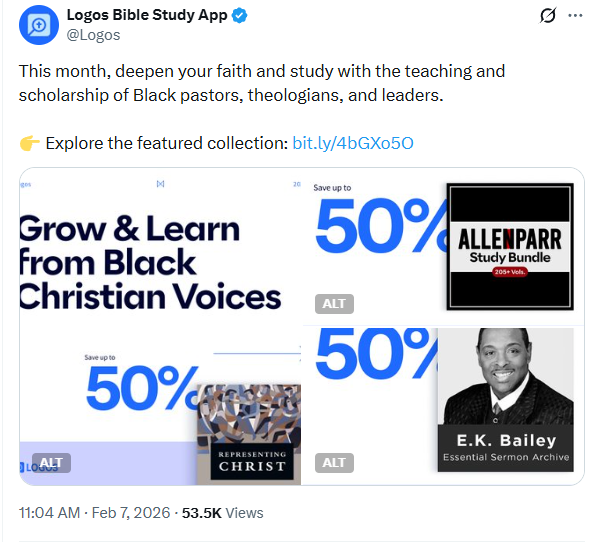
They recently came under fire after advertising a 50% discount on books by Black authors to celebrate Black History Month.
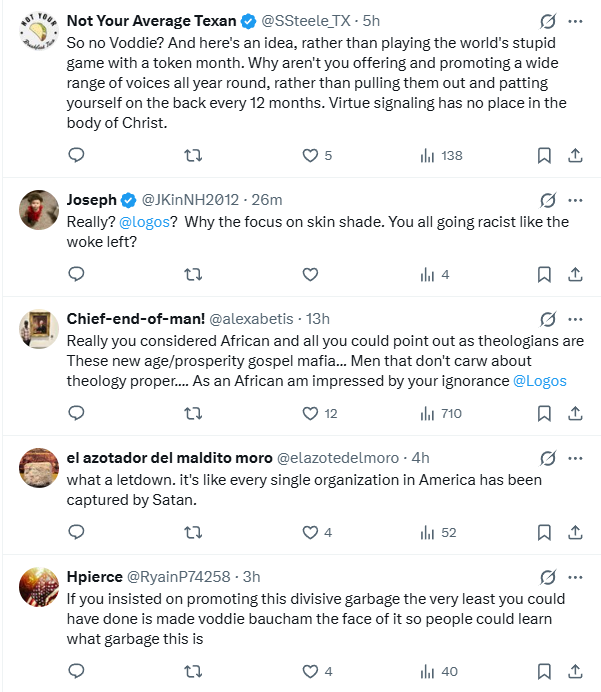
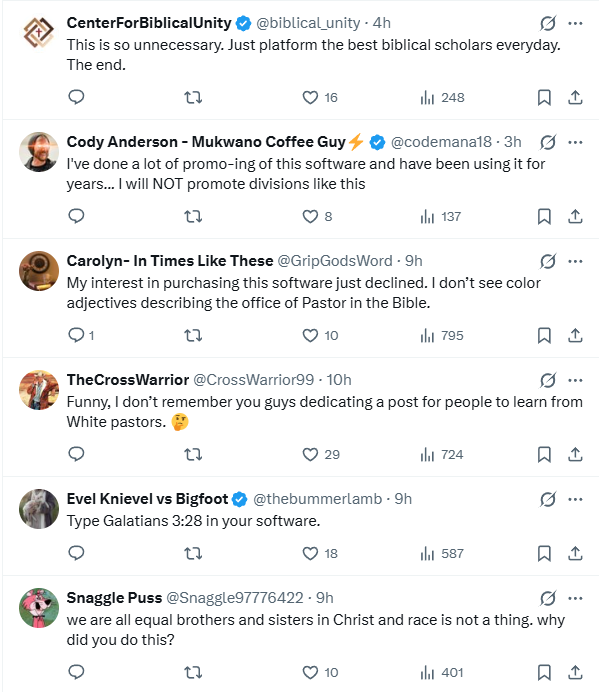
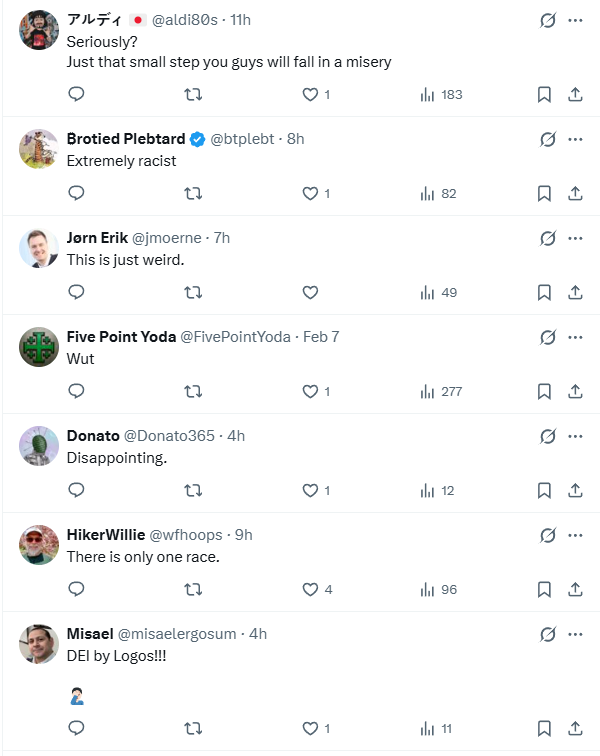
One commenter, Rebecca, argued “The color of skin should have no bearing on what solid Christian teaching is recommended. My work promotes Logos often to students, but Logos issues of late are causing us to think twice.” Another, Dustin, added “What does the amount of melanin in someone’s skin make them more to be listened to? This makes no sense. There’s time to delete this partiality”
At the time of writing the post was repeatedly ratioed, garnering 70 reactions, all of them negative.
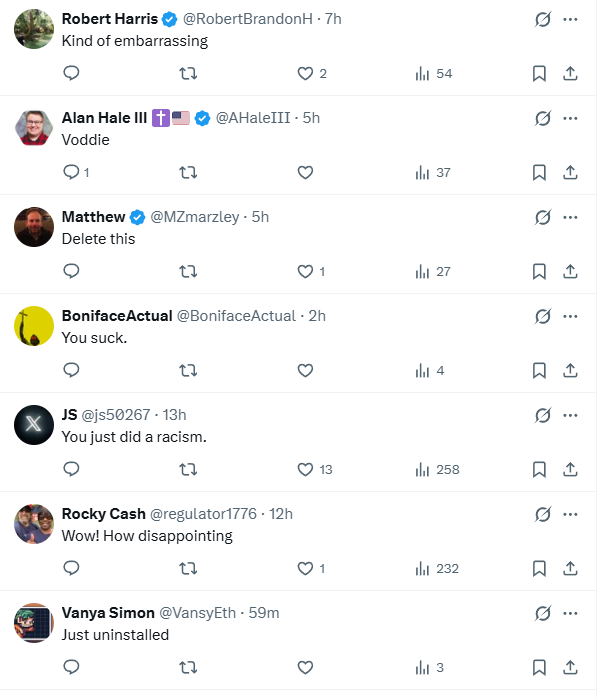
That aside, we couldn’t help but notice that their list of recommended Black authors is less than ideal. Along with solid resources by Voddie Baucham Jr. and H.B. Charles Jr., they also included more progressive offerings such as Jemar Tisby, and Thabiti M. Anyabwile.
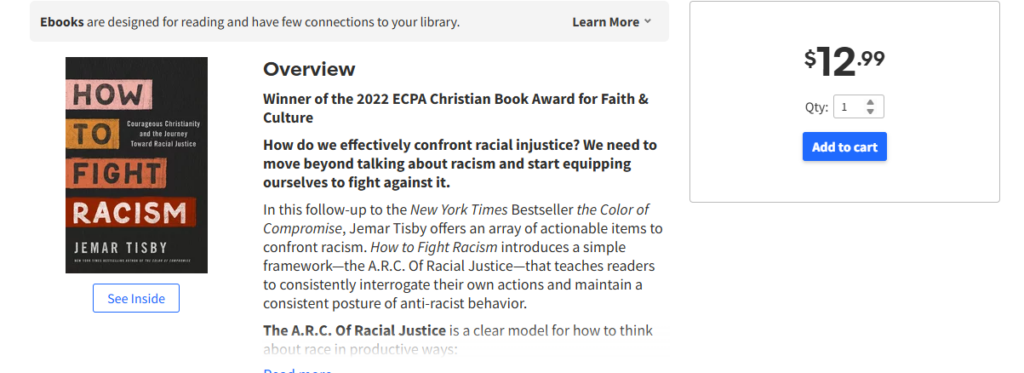
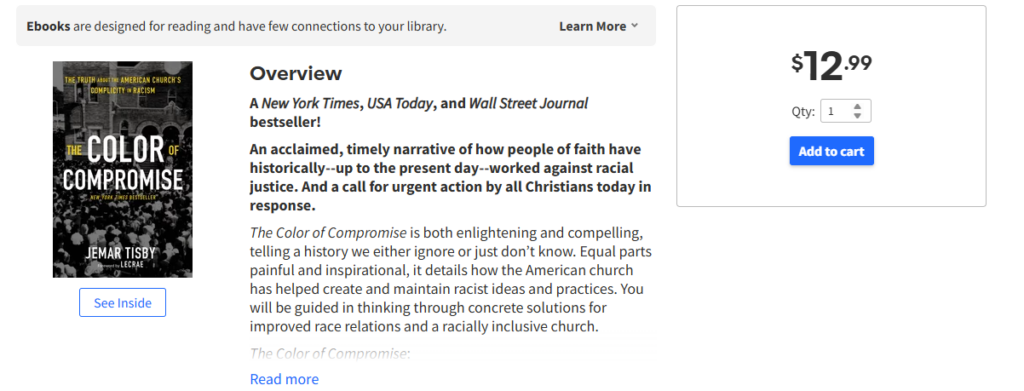
Notably, one of the first books on the list is a commentary by Willie James Jennings. Jennings is an ordained Baptist minister who teaches systematic theology and Africana studies at Yale University Divinity School. He is also a committed LGBTQ-affirming progressive, teaching liberation theology and championing intersectionality DEI.
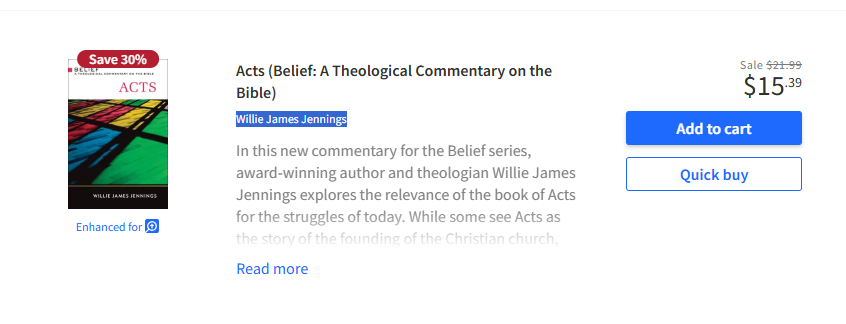
In his commentary featured by Logos, Jennings argues for homosexual marriage and then seems to suggest that the gospel writer Luke cannot be trusted. He first writes:
“Coupling in this regard is a wonder to be shared by all who wish it, whether heterosexual or homosexual, and marriage should be grasped by all who would mark their life together as a life inside the way of disciples.” p58
“There is joy in coupling that should be celebrated and shared by all who wish life together, especially for gay sisters and brothers whose lives of love are yet to receive the celebratory embrace by the church that they greatly deserve.
Even among churches that affirm homosexual marriage, the sound and songs of celebration ring much too quietly and sometimes not at all. … This is why gay marriage must be celebrated just as strongly, as loudly, and as intensely as any marriage of disciples, because what begins in civil toleration when touched by the Spirit of the living God becomes joyous and extravagant celebration.” p60
Furthermore, he suggests that Luke, who is being guided by the Holy Spirit, is wrong on several points, and has erroneously brought in his own biases and baggage into the text:
Such a way of thinking reflects a profoundly chivalric and masculine vision of progress and success where truth wins out through combat and violence, and in the end power begets more power. Luke shows us his susceptibility to such a vision” p171
“The problem is that Luke does not perceive them as a disciple of Jesus ought to perceive them. We know this only because he exposes the other aspect of this troublesome optic when he tells us of “Jewish jealousy”
… Luke at this moment has lost the gospel even as he tells us of its opposition. To be fair to Luke, he is captured in narrating to us the willingness of these men to operate as violent quasi-mercenaries, so their wickedness is not in question. Yet others have incited mobs, participated in mobs, and escaped such labeling. Here Luke’s class distinctions participate in the very wickedness that he is describing to us.” p172
But hey, at least the book is 30% off.

















3 responses to “‘Logos’ Under Fire For Offering ‘Racist’ Discount, Featuring LGBTQ-Affirming Author”
It appears that Jennings wolf does nothing but defend the wicked. In the case of sexual immorality, perversion of marriage, and war against the created order, it goes without saying. But also in the case of the mob that persecuted Paul and Barnabas (Acts 13:50-52), with his defense (excuse) being about as mature as a four-year-old … “other people incited mobs too!”. Ironically, to turn his own wicked “logic” back at him, he does so in an attempt to be chivalrous and masculine in the defense of the wicked women described in Acts 13:56.
While a significant part of the lesson there in that passage, which he has entirely set aside, is that wicked men prey on the women (as is also reiterated in Jude, and 2 Peter 2). Just as the serpent preyed on Eve. And so in a very real sense, Jennings himself is preying on the women, to stir up mobs, to persecute men who speak the truth of the Gospel.
At the end of the day, his “liberation theology” is all about liberation from his Creator, under the guise of liberation from mankind. The snake oil he’s selling is, in reality, enslavement to sin.
The liberation of the Gospel is about liberation from the wicked flesh, corrupted from Adam’s sin. That’s true freedom. That’s the real Gospel. And that’s far different from the false gospel Jennings is peddling.
Why are such a man’s books listed on Logos at all? God’s standards of right and wrong clearly don’t matter to him. It’s all about one group versus another, without regard for what God says is sinful or righteous. He perverts the grace of God into a license to sin (Jude, 2 Peter 2). He justifies wickedness and condemns righteousness (Prov. 17:15). He’s clearly a false prophet and wolf in sheep’s clothing. He’s clearly not a born again Christian – that fruit is readily observed, and spirits are easily tested, there is no work of the Holy Spirit in him. He’s clearly an impostor. Why are his books even listed at all? All of his books need to be removed. Kick him off. And don’t limit the system capabilities to just flagging the books. Flag the authors (which is the proper approach in accordance with scripture). “From such turn away”
There is freedom in the Gospel, because our Lord, Savior, and Master is infinitely perfect. Everybody serves something or someone. So if you want freedom, then that’s who you should submit to – the one and only one who’s perfect. A man who is enslaved to his flesh will never be free. He will never be satisfied. And for that reason, he’ll always enslave himself to men, in order to try to satisfy his bullying flesh. This is how and why we are “called to freedom” (Gal. 5:13), but not to continue in sin while blaming others as if they are the source of the slavery, rather than the sin (same verse).
The “liberation theology” of this false prophet Jennings does not liberate anyone. It enslaves. It is an extremely false gospel, which promotes enslavement to the corrupt and wicked flesh rather than freedom from it, pretty much entirely opposite to the Gospel of Jesus Christ.
Kick him off, and all other wolves like him. Enough is enough. I don’t care what color of skin anyone has, a false prophet is a false prophet, and a false gospel is a false gospel. It’s long past time to kick these wolves out of the church, and take their books off the websites. Let them sell their wicked drivel over on the church of satan website, where it belongs.
GREAT