
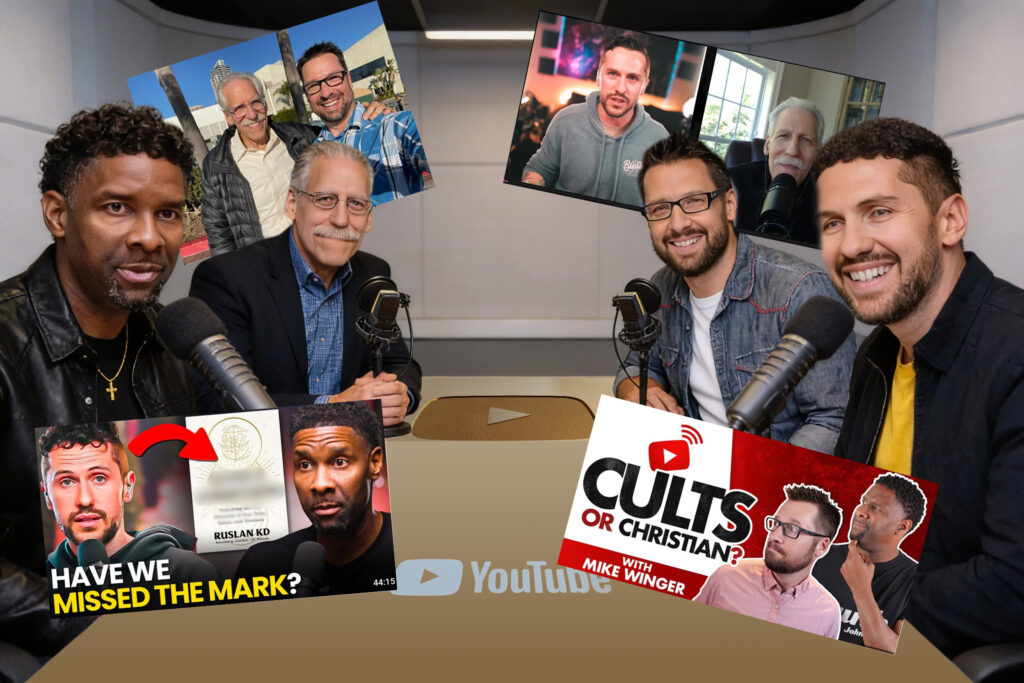

In November 2022, Protestia published Mike Winger, Allen Parr, and the Darker Side of Christian YouTube. The concern then was not primarily about personalities. It was about methodology — a new model of “discernment” that critiqued error while refusing to draw biblical conclusions about false teachers themselves.
At the time, many dismissed the warning as overly harsh.
Three years later, the evidence suggests the opposite: what we identified in 2022 was not an overreaction. It was an earlier diagnosis of a ministerial strategy now defining large portions of Christian influencer culture, pulled from the church-growth marketing of Warren/Hybels and grafted onto the online influencer economy. And the problem is the same: Doctrinal minimalism.
And it is reshaping how an entire generation understands discernment, authority, and the sufficiency of Scripture.
The Prediction of 2022
The original article observed a growing pattern among major Christian YouTube figures:
- Serious theological errors were acknowledged.
- False teachings were analyzed.
- But false teachers themselves were rarely identified plainly, much less called to be marked and avoided.
Discernment became informational rather than protective. As Allen Parr encouraged, viewers were supposed to “eat the meat and spit out the bones,” or in other words, do exactly what Romans 16:17 specifically teaches us not to do.
Viewers were encouraged to “use wisdom,” “take the good,” and “keep conversations going,” while biblical commands to separate from persistent false teaching were quietly sidelined. What looked like charity increasingly functioned as theological indecision. Since then, Protestia’s reporting has repeatedly documented where that trajectory leads.
Case Study: When Discernment Celebrates Failure
In 2025, the collapse surrounding Todd White produced what should have been a defining moment for modern discernment ministries. Instead, as documented in The Todd White Exposé Is a Discernment Loss, many prominent voices treated the scandal as a learning opportunity rather than a confirmation of long-standing warnings.
The issue was not a lack of information. Todd White’s abusive theological problems had been publicly documented for years. The issue was the refusal to draw actionable, biblical conclusions. Discernment, redefined by charismatic epitemological expansion as dialogue rather than protection, proved incapable of preventing predictable outcomes.
Case Study: The Michael Brown Return — When Accountability Becomes Optional
If the Todd White episode demonstrated the failure of modern discernment to prevent predictable scandal, the 2025 return of Dr. Michael Brown revealed something even more troubling: the growing inability of charismatic institutions — and their online defenders — to enforce meaningful accountability even after wrongdoing is established.
As Protestia reported, Brown resumed public ministry following allegations of sexual misconduct that prompted a six-month sabbatical and a third-party investigation. The investigation concluded that Brown had engaged in sexually abusive misconduct, yet an internal elder board rejected that characterization, redefining the behavior instead as “moral indiscretions” and (predictably) clearing him to return to ministry.
Brown’s public appeal upon returning was not centered on repentance or disqualification standards, but generalized, Jesus-juking unity: “Please don’t divide over me. Unite around Jesus instead.”
On its surface, the language sounded conciliatory. In practice, it reflected the same doctrinal minimalism reshaping Christian YouTube (of which Brown is a big part).
The issue quietly shifted from whether a leader met biblical qualifications to whether discussing the issue itself was divisive.
Redefining the Standard
Historically, Christian ministry operated under clear qualifications: leaders were to be above reproach, demonstrating moral credibility both inside and outside the church.
But within modern charismatic culture and the online influencer Christianity it supports, accountability is frequently reframed through relational and experiential categories rather than biblical ones:
- misconduct becomes “mistakes,”
- investigation findings become “interpretations,”
- and calls for disqualification become accusations of division.
The Brown case illustrated how institutional loyalty and platform preservation can override the corrective function of discernment itself. Even after investigative findings documented inappropriate conduct that violated ministerial boundaries, the practical outcome was restoration without meaningful structural consequence — followed by public celebration in sympathetic charismatic circles.
The message received by audiences was unmistakable: platform continuity matters more than pastoral qualification.
The Same Pattern, One Step Further
This is not separate from the problems identified in Christian YouTube culture; it is their logical extension. The same theological instincts that prevent influencers from clearly identifying false teachers also prevent movements from clearly removing compromised leaders.
Both arise from the same underlying assumptions:
- doctrinal certainty is viewed as harsh,
- judgment is framed as unloving,
- and unity is defined as the absence of actionable boundaries rather than fidelity to truth.
When discernment refuses to draw theological lines, discipline eventually refuses to draw moral ones. The result is a carnal culture where restoration is about personal influence rather than holiness.
The Ruslan Problem: Ministry or Marketplace?
Few figures better illustrate the shift than Ruslan KD, whose platform has repeatedly blurred the lines between ministry, entertainment, and influencer branding. Note: To be fair, Ruslan was quite critical of Michael Brown’s elders’ rejection of the conclusions of the third-party investigation, which Brown assured everyone would exonerate him.
Protestia has documented a pattern spanning years:
- Undiscerning participation alongside prosperity and NAR figures in promotional events (later framed by Ruslan as evangelism).
- Public defense of high-priced VIP and children’s tickets for Christian conferences.
- Cultural commentary endorsing explicitly immoral entertainment while dismissing criticism as “low-level thinking.”
- Repeated positioning of essential doctrines of the faith as secondary concerns.
Individually, each incident might be dismissed as poor judgment.
Collectively, they reveal a philosophy: maximize audience reach by minimizing doctrinal boundaries. This is not accidental. It is structural. Online platforms reward breadth of appeal, not theological precision or obedience to scriptural commands not to associate (even amid disagreement) with false teachers or brethren (1 Cor. 5:9, Rom. 16:17).
The Engine Behind It All: Charismatic Doctrinal Minimalism
The emerging rule within Christian YouTube can be summarized simply: If someone says “Jesus,” nearly everything else becomes negotiable.
The language used is familiar — “essentials vs. non-essentials.” But in practice, the category of non-essential has expanded to include doctrines historically considered foundational.
We have already seen the logical endpoint. In 2023, a prominent Christian influencer publicly suggested belief in the Trinity could be treated as a non-essential doctrine — a claim unimaginable within historic Christianity but perfectly consistent within doctrinal minimalism. Once doctrinal boundaries soften enough, no clear stopping point remains, and the commonality becomes Jesus-y culture rather than biblical truth – a perfect breeding ground for influencer Christianity.
Why Discernment Never Reaches Conclusions
The deeper issue is theological, not merely cultural.
Much of this ecosystem operates within charismatic theological assumptions that implicitly undermine the sufficiency of Scripture.
As explored in Bolz Isn’t Enough: The Deeper Rot Inside the Charismatic Movement, the ongoing expectation of new revelation creates permanent epistemological instability.
If God may still speak authoritatively outside Scripture, then Scripture can never fully settle doctrinal disputes. Every correction becomes provisional. Every judgment becomes premature. Every controversy becomes another conversation instead of a conclusion.
This framework produces exactly what online platforms require:
- endless discussion,
- perpetual uncertainty,
- continuous content generation.
The algorithm thrives on unresolved theology.
Association Without Accountability
Scripture treats public association as meaningful. The apostles repeatedly warn believers not to partner ministerially with those teaching false doctrine. Yet modern influencer Christianity increasingly treats shared platforms as neutral, strategic, or worse, evangelical.
Creators defend appearances with questionable teachers by appealing to dialogue, outreach, or influence-building. But the biblical command is not to platform error in hopes of balance or even correction; it is to expose and avoid it.
As continuationist Bible prophecy teacher Joel Richardson recently demonstrated in reply to my critique of Ruslan, the distinction between evangelizing sinners and partnering with false teachers continues to be deliberately blurred beyond recognition.
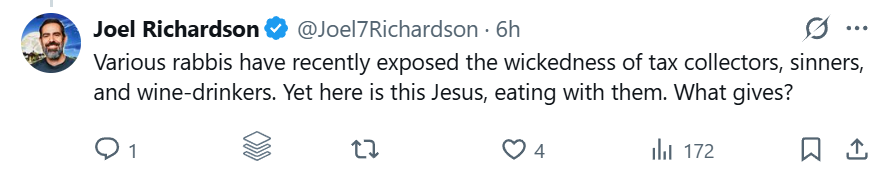
Note: Joel Richardson was highly critical of Michael Brown’s Line of Fire elders restoring brown to ministry.
When Ministry Becomes a Brand
Another defining feature of the new model is the dual identity of influencer ministries.
When Christian credibility and the particular benefits of brotherly trust are needed, platforms present themselves as Christian ministries deserving trust and solidarity. When accountability arises, they become businesses “advancing dialog” and/or simply trying to survive in a difficult economy.
Scripture allows no such toggle switch.
Publicly representing Christ carries heightened responsibility to remain above reproach regardless of business model, subscriber count, or monetization strategy.
The Real Outcome: Perpetual Confusion
The cumulative effect is a generation of Christians trained to believe that public Christian engagement is demonstrated by doctrinal charity:
- doctrine should be endlessly negotiable and subjected to continual questioning,
- theological certainty is immature, Pharisaical, and unloving,
- disagreement on anything/everything is virtuous.
Questions never end because the answers that require identifying and separating from false teachers (and thus, decreasing one’s audience) are never allowed to finalize. Confusion, dissonance, and uncertainty become the fuel that sustains platforms.
The Irony: Discernment That Cannot Discern
The tragedy is not that online apologetics exists. Faithful teachers using modern tools can serve the church well. The tragedy is that discernment has been redefined into something Scripture never intended — a content genre rather than a protective duty.
Three years ago, Protestia warned that Christian YouTube was fueled by doctrinal minimalism. Today, that drift has solidified into standard practice, and the lack of true discernment among online apologists has resulted in a trail of spiritual, sexual, and financial abuse at the hands of false apostles, prophets, and hucksters – many of whom popular online apologists still refuse to call false brethren.
Unless online Christians set aside the desperate felt need for peace (when there is no peace), exercise confidence in the sufficiency and final authority of Scripture (when it is hard), the cycle will continue. There will be more dialogue, more platforms insisting on trust in Jesus’ name, more looking the other way as the faithful are fleeced and abused.















2 responses to “Platform Charity vs Doctrinal Clarity”
[…] Platform Charity vs Doctrinal ClarityVermont Backs Down, Won’t Stop Christians From Adopting Children‘We’re Baby Christians. ‘Jelly Roll’s Wife Insists She And Husband Are ‘Not Role Models’ In New InterviewExclusive: Ted Shuttlesworth Jr. Steps Down From Ministry After Cheating On WifeJim Bakker’s Son Refutes Rumors of Father’s Death ‘Thankfully, He is Still Alive’ […]
[…] Driscoll has defended Joel Osteen as a true Christian minister. Although to be fair, the newer, digital ecumenical movement does this too, with apologists like Mike Winger previously vouching for Osteen’s salvation, […]