
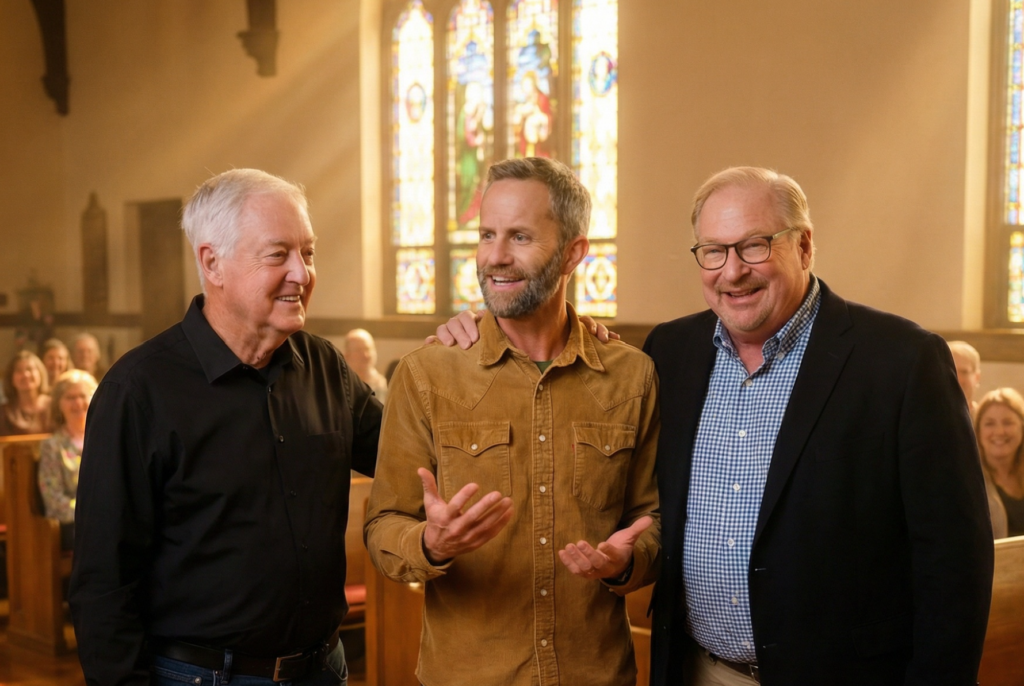

American evangelicalism has not simply changed its methods in the last three decades — it has quietly changed how it knows truth. That epistemological shift isn’t abstract. Instead, it can be traced in the trajectory of public ministers like Kirk Cameron.
In 2001, a 31-year-old Cameron — already a well-known Christian voice — wrote the foreword to Ray Comfort’s Revival’s Golden Key. Comfort’s book was unapologetically premised on eternal conscious torment (ECT). It argued that modern evangelicals avoided hell because they feared offending sinners, that the law must wound before grace can heal, and that the reality of everlasting punishment is what gives the gospel its urgency.
In arguing for the importance of preaching the fearfulness of the eternal wrath of God in evangelism, Comfort wrote on page 116:
Perhaps modern evangelicalism’s reticence to preach what produces fear is simply due to concern about the reaction of sinners. Some may worry that the message may be aligned with what is commonly called “hell-fire” preaching. Yet there is a vast difference between the use of the Law and hell-fire preaching. Understandably, the thought of the existence of hell, without the use of the Law to justify its existence, is unreasonable to a sinner’s mind. How could a God of love create a place of eternal torment? Imagine if the police suddenly burst into your home, thrust you into prison, and angrily shouted, “You are going away for a long time!” Such conduct would undoubtedly leave you bewildered and angry. What they have done is unreasonable.
However, if the law burst into your home and instead told you specifically why you were in trouble by saying, “We have discovered 10,000 marijuana plants growing in your backyard. You are going away for a long time!” at least you would understand why you are in trouble. Knowledge of the law translated fear into understanding.
Despite Kirk’s claim to hold to ECT because it was just “what he had been taught,” he was not ignorant of its scriptural, logical, and evangelistic necessity. He endorsed it. He called the book “powerful and life-changing,” urged “every Christian” to read it, and prayed that it would deepen their understanding of God’s truth and “empower you with His own passion to reach the lost.” This was not the posture of a confused novice who had simply inherited a doctrine from trusted elders. It was the posture of a mature believer who had studied, affirmed, and publicly promoted a clear and compelling case for preaching the fear of God’s eternal wrath.
For years, Cameron’s ministry orbit reflected that confidence. His work with Ray Comfort and Way of the Master was defined by a confrontational, law-driven evangelistic method that assumed eternal torment as the backdrop of every gospel appeal. It was confessional, sharp-edged, and unembarrassed about doctrinal boundaries. Plain, public truth-telling was not a scandal; it was part of both evangelism and discipleship.
Note: Ray Comfort’s associational discernment is not without its own issues. He has historically been willing to partner with, or at least be platformed alongside, Word-of-Faith heretics, although more recently he has platformed critics such as Justin Peters.
For years, “our little growing pain” Kirk (to quote Todd Friel) ministered alongside Todd (of Wretched Radio/Fortis Institute) and Ray Comfort as part of The Way of the Master, and co-hosted The Way of the Master Radio, where Kirk often and brilliantly explained the doctrines of law, gospel, and yes, hell.
Not long ago, Kirk and Todd dismantled one of universalist Rob Bell’s NOOMA videos characturizing a fundamentalist street preacher who insisted on teaching the reality of hell. Ironically, Kirk has now adopted part of Bell’s “Love Wins” heresy, teaching “that the prospect of a place of eternal torment seems irreconcilable with the God of love.”
Todd and Kirk Tear Apart Rob Bell’s Video:
Unfortunately, sometime around 2009–2011, Cameron’s formation took an unfortunate turn.
During that period, he and his family began attending Conejo Church in Southern California, founded and led by pastor and missionary Rex Holt—a Southern Baptist congregation that, by 2010, was firmly situated within the Rick Warren/Saddleback/Purpose-Driven ecosystem. Its stated values — “Relationships win out over rules,” “Acceptance brings healing,” “Encouragement imparts grace” — were classic seeker-sensitive slogans. Its affiliations included IMB, NAMB, the California Southern Baptist Convention, and Warren’s PEACE Plan. A sermon series titled “The Secret” reflected therapeutic, motivational framing rather than confessional exposition. In keeping with Purpose Driven methods, any spiritual fad was fair game.

In an interesting coincidence, the church met in an Adventist school for its first ten years, then partnered with an Adventist church to share space in 2018. While not an uncommon arrangement considering Adventists meet on Saturday, it seems to indicate that the church must not have strongly opposed the Adventists’ doctrine of annihilationism – at least not enough to be concerned about continuing to share facilities. Unsurprisingly, several Adventist writers have celebrated Kirk Cameron’s recent embrace of the doctrine as “Annihilationism’s Moment.”
At the same time Kirk was interviewing Holt (as a guest host on TBN’s Praise the Lord) about the African who reportedly prophesied the birth of Holt’s first child (while twisting Habakkuk 2’s prophecy about the fall of Babylon into a statement about the child’s “appointed time”), and partnering in ministry with Mormon Glenn Beck, Warren himself was busy advocating contemplative mysticism, and Conejo Church was opening up sermons with 4-minute clips from The Matrix.
This was not simply a different style of ministry; it was a different way of knowing. In the Purpose-Driven world, the center of gravity shifts from creed to usefulness, from confessions to community, from boundary-keeping to relational belonging. Doctrine is not denied outright, but it is de-prioritized in favor of relational ethos, tone, and perceived accessibility.
Rex Holt embodied this all-too-common shift. In the early 90s, his friend David Miller described him as a “strong Calvinist” who preached unconditional election from the pulpit of Central Baptist Church in Jonesboro, Arkansas. Yet at some point, the temptation of ecclesiastical growth hormone apparently became irresistible.
Holt wasn’t just a local shepherd to Cameron; he was also a longtime ministry collaborator across films and media projects. Kirk’s continued description of Holt as “my pastor” thus came to function less as a marker of formal, local-church accountability and more as a trusted relational advisor within Cameron’s broader ministry network.
Meanwhile, Cameron’s formal relationship with Living Waters seemed to fade, even though personal friendships and cooperation seemed to continue even after formal affiliation had ended. By his own admission (and later confirmed by Ray Comfort), Kirk had ceased working “officially” with the ministry “well over ten years” before the 2025 controversy—roughly coinciding with the period during which he was being formed within a Purpose-Driven church culture.
The result is visible in his handling of the “Hellgate” controversy.
When Cameron began entertaining — and platforming — annihilationism, he presented the issue not as a clear doctrinal boundary question but as a matter of humble inquiry and relational conversation. When other pastors and ministries publicly critiqued him, he responded not by naming names or engaging arguments, but by accusing unnamed “heresy hunters” of acting like unbelievers and of lacking Christian charity. He cast public correction as inherently suspect, even though he himself had previously endorsed a book that unapologetically pressed sinners with the reality of eternal judgment.
He portrayed his earlier belief in ECT as something he had merely absorbed from people he loved and trusted, as if he had never seriously engaged the doctrine before encountering Edward Fudge. That retelling is untenable. He had read, endorsed, and promoted Revival’s Golden Key two decades earlier — a book that explicitly assumed eternal torment and rebuked evangelical reticence on the subject. Kirk preached on the essentialness of leading with the convicting law of God in evangelism, 24 years before teaching the “good news” of annihilation.
What changed was not that Cameron finally encountered the arguments; it was that his formation changed.
In a seeker-sensitive ecosystem, epistemology expands: intuition, experience, and relational harmony begin to share authority with Scripture and confessions. Hospitality becomes a theological virtue that blunts discernment. Tone becomes a gatekeeper that filters out the hard truth. Public rebuke comes to feel unloving, even when the error is public. Doctrinal “questions” are elevated to the level of virtue, while settled convictions are recast as arrogance.
Under that regime, annihilationism no longer appears as a grave departure from historic orthodoxy; it becomes one more permissible option within a broad “conversation.” Likewise, those who publicly correct are no longer seen as defenders of the faith but as transgressors of Christlikeness. The axis of judgment shifts from “Is this true?” to “Is this cordial?”
This is not a uniquely Kirk Cameron story. It is a parable of modern evangelicalism.
When churches catechize their people in G.R.A.C.E. acronyms, therapeutic series, and “relationships over rules,” they do not simply change how people feel about church. They change how people reason about doctrine. They habituate leaders to prize consensus over clarity, to treat the process of sharpening doctrine as a barrier to growth, and to interpret disagreement as a tone problem rather than a truth problem.
That formation does not create heresy overnight. It erodes the habits of mind that make heresy recognizable.
Cameron’s journey from Revival’s Golden Key to “Hellgate” thus illustrates a larger pattern: seeker-sensitive culture does not stop at responding to worship style preferences — it continues its submission to fleshly preferences until it’s telling lost people the “good news” that hell isn’t as bad as the church has always taught.
What begins as a pragmatic church-growth strategy ends up functioning as an epistemological WD-40, loosening doctrines that previous generations treated as long settled and fundamental.
None of this requires denying that Cameron is a brother in Christ. Nor does it require labeling him a heretic. The concern is deeper: it is about the integrity of how Christians engage one another in public, and how pastors steward the truth entrusted to them. And of course, with Kirk Cameron continuing to refer to Holt as his pastor long after leaving his church, the concern over whether or not Kirk is a member of a church at all, or if Holt is just a “spiritual Gandolf” like the unnamed Presbyterian
Public teaching requires public accountability. When error is spoken from a platform, correction must be spoken from a platform — by name, in daylight, with arguments, not relegated behind closed doors. Demanding private confrontation as the default is not biblical fidelity; it is, in practice, a way of shielding public teachers from examination and leaving the wider church exposed to confusion.
In that sense, the issue isn’t merely whether Cameron has landed on annihilationism. The question is whether the current generation raised on seeker-sensitive epistemology still knows how to defend, clarify, and contend for the faith once delivered to the saints—or whether it has been trained to prefer comfort, conversation, and the emotional anesthetics of “grace culture” over doctrinal clarity.
Cameron’s own past shows he once knew the difference. The tragedy is that his present posture demonstrates the trainwreck of being catechized out of it.


























2 responses to “From Revival’s Golden Key to “Hellgate”: How Seeker-Sensitive Formation Rewrote Kirk Cameron’s Theology”
Very well said. The only thing I’m led to further emphasize is to expound a bit on the fact that it doesn’t happen overnight, that the fundamental beginnings of the “purpose driven” diversion off the straight and narrow are not contrary to scripture. God does have a purpose for us (Rom. 8:28, etc.), and it is indeed about His desire that none should perish (2 Peter 3:9, etc.). It’s not where it starts that’s the problem, it’s where it ends up. Which is that it reaches a point where, for some reason, God’s purpose is deemed to be contrary to His word. It morphs from humbly submitting to Him all the way to essentially trying to take His place, believing one knows better than He knows, such that it’s no longer about His purpose at all. It reaches the point where they begin to believe they are more loving than God is, that they care more than He does, that they know better than He knows, watering down scripture and the gospel, in an attempt to make it more palatable and appealing to the wicked, to the point that it is no longer the Gospel of Jesus Christ.
There develops a fixation on only one side of things. Right. A fixation on that lost loved one, for example, while entirely forgetting the lost rapist and murderer, and forgetting the fact that God is just. And it is in recognizing the perfect justice of our perfect Creator, that we can begin to understand how concepts we may perceive to be conflicting do not conflict, in reality. Justice is where there is both love and fear.
The proper response is to be careful to not take a side in a false dichotomy, but rather to shine the light of scripture, that there is no conflict between the commandments of God and the love of God. That sin is always harmful to others. That if we love others, therefore, we will not sin. And that the lost who are enslaved to sin are harming others in ways that we cannot possibly know or comprehend, because we don’t know what God knows. When we start saying “relationships over rules”, what we’re implying is that there is a conflict between the two, which is essentially the same as implying that the commandments of God are unloving and bad for relationships. And at that point, then, the message essentially becomes “sin is good”. At which point, ironically, we are essentially in defiant rebellion against God’s purpose. When what scripture clearly teaches, and what is plainly evident in the fact that a loving God also sets loving rules, is that “rules are relationship” (1 John 5). There is no conflict between rules and love. Because God is just, and He’s not fixated on any one person forgetting the rest, but rather sees and knows the entire big picture, far beyond anything we could ever understand or comprehend.
[…] […]