
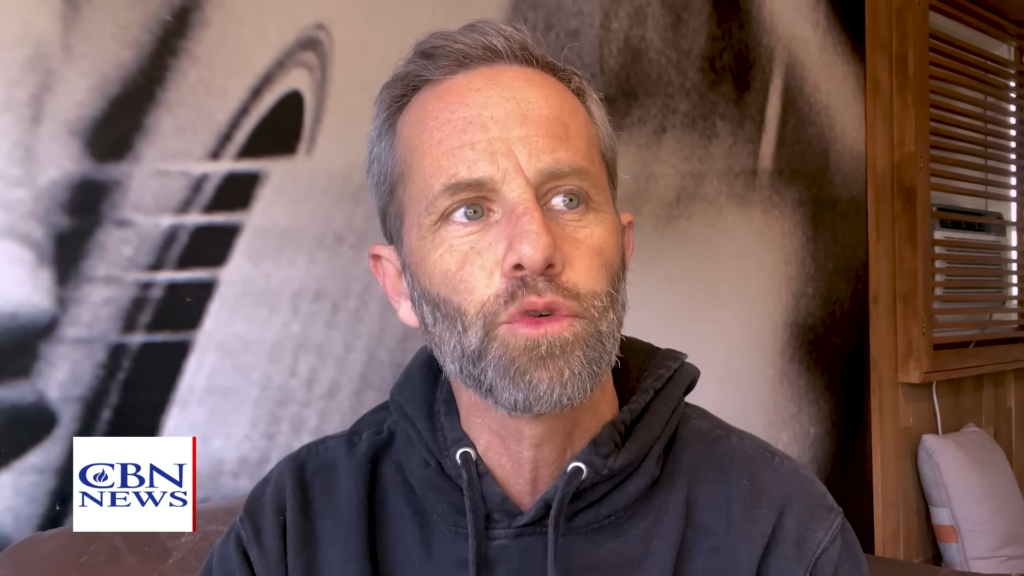

We’re posting this video compilation (at the end) and explanation to document contradictions and moral/ethical inconsistencies in how Kirk Cameron has handled public criticism following his promotion of annihilationism. We’re also publicly calling him to repent – not so much for his false and dangerous beliefs about hell, but about how he has sinfully responded to disagreement and correction.
This became necessary after Kirk went to CBN (a platform that has promoted Benny Hinn, Joyce Meyer, Kenneth Copeland, T.D. Jakes, Rick Warren, Joel Osteen, Todd White, Bill Johnson, etc.) to whitewash the record and level accusations against his brothers yet again.
This is not about tone, personality, or online drama. It is about accountability for public teaching.
Before anything else, I want to be clear about what I am and am not saying. I am not accusing Kirk Cameron of being an unbeliever. I am not claiming he is outside the faith. I am not “outing” him as something other than a brother in Christ. And although I believe annihilationism is a formal theological heresy, I am not declaring Kirk himself to be a heretic. I do not know him personally.
My concern is not personal animus, but repentance where error exists, and more broadly, the integrity of Christian engagement with one another online, which must be governed by Scripture even when that engagement is difficult or uncomfortable.
Because @Protestia was the original “heresy hunter” website that drew 3rd-party attention to Kirk’s podcast, I also want to clarify something plainly. Protestia accurately characterized and quoted Kirk.
We did not rebuke him. We did not accuse him of heresy. We did not editorialize on his theology. We quoted his words directly, provided clips, and linked to his full podcast. Our reporting brought the issue into the open, led to dozens, if not hundreds, of corrective sermons around the country. Men like Albert Mohler, Justin Peters, Ray Comfort and Todd Friel provided lengthy, corrective responses.
In response to Kirk’s rebuke of “sin sniffers” and “heresy hunters,” looking for people to attack so our “ministries don’t dry up,” it must be said that neither Protestia nor I, as its publisher, earn any profit from this work. I operate without a salary, without ad profit tied to outrage, and without financial incentive to manufacture controversy. We also publish a clear, accessible set of doctrinal and editorial standards that invite accountability. Readers are encouraged to evaluate our reporting against those standards at any time.
With sadness, I report the following ongoing hypocrisies, errors, and sins, call for public repentance, and call on fellow public Christian ministers who confirm the public witness of the evidence to call Kirk to repentance as well:
First, Kirk repeatedly characterizes annihilationism as a secondary issue, something Christians may disagree on without serious consequence. Yet in Episode 86, he frames the potential error of teaching ECTorment as a first-tier moral offense, calling it a “severe misrepresentation of God’s character” and “a great sin and mistake.” In effect, annihilationism’s potential error is treated as second-tier, while ECT’s potential error is framed as first-tier. His critics are condemned for strong language, even though his own framing assigns a clear double standard.
Second, Kirk continues to publicly accuse unnamed brothers of unspecified sins against him. He speaks of “sin sniffers,” “heresy hunters,” and brothers behaving like unbelievers, yet never names who supposedly sinned or what sin was committed. Scripture does not authorize anonymous moral indictment. Accusation without identification prevents repentance, response, or clarification.
Third, Kirk makes public claims about what Scripture teaches, on a public platform, for a mass audience, while insisting that responses to those claims must occur privately. This is incoherent. Public teaching creates public responsibility. A teacher cannot embrace the delegated authority of public instruction while exempting himself from open, public evaluation.
Fourth, in the CBN interview, Kirk reframes the controversy as a surprising overreaction to an off-the-cuff question from his son. The episode itself shows otherwise. Episode 86 was planned, structured, cited, and presented as a “dangerous conversation.” He named specific theological positions, referenced Edward Fudge, and declared a personal conclusion. This was not accidental commentary, and it was not unexpected that it would draw strong reaction.
Fifth, Kirk gives contradictory explanations for how he formed his beliefs. In attempting to minimize the doctrinal seriousness of ECT, he says he held to it only because of tradition, then says “verses” brought him to it, and continues to insinuate that ECT proponents today rely on tradition rather than Scripture.
Sixth, Kirk repeatedly accuses online critics of illegitimate financial motives, claiming their analysis and arguments were driven by clicks, outrage, or income. At the same time, he presents his own financial concerns, canceled events, and lost opportunities as legitimate considerations. Financial motive is treated as sinful when attributed to others and understandable when attributed to himself.
Seventh, Kirk appealed to many ECT teachers as fellow serious scriptural scholars, yet only listed figures who had passed away and could neither reject his conclusions nor correct his use of their authority. Living theologians who object are portrayed as divisive; dead ones are cited as allies.
Eighth, Kirk openly admits that he wants annihilationism to be true, calls it a “great relief,” and imagines the joy of presenting annihilationism as “good news” to unbelievers who reject a God who eternally punishes. This is not a neutral inquiry. It is not merely “asking questions.” It is doctrinal modification shaped by emotional desires – precisely the method Scripture warns against.
Scripture does not require private confrontation before public correction when the teaching itself was public. Matthew 18 governs private interpersonal sin, not public doctrine.
When error is public, correction must be public for the sake of those who heard it. Paul rebuked Peter publicly because the error was public. Elders are commanded to refute false teaching openly. Demanding private correction for public doctrine protects the teacher while leaving the audience confused. That is not loving. It prioritizes reputation over truth and the flock over no one.
Public correction is not unchristian. It is biblical. It protects those exposed to error and provides clarity rather than silence.
Jesus’ parable in Luke 16 about stewardship applies here. Teachers are not owners of doctrine; they are stewards of it. The steward is condemned not for dishonesty alone, but for handling what belonged to another according to his own preferences. Doctrine is not ours to reshape according to emotional comfort or perceived evangelistic usefulness. Faithfulness, not palatability, is the measure of stewardship.
The gospel cannot be separated from what Christ saves us from. Hell is not a minor doctrine, and it is not ours to soften for relief or rhetorical safety.
This video is not about malice. It is about accountability, witness, and loving a brother enough to call him out.
I’m posting this video compilation and explanation to document contradictions and moral/ethical inconsistencies in how @KirkCameron has handled public criticism following his promotion of annihilationism, and to publicly call him to repent – not so much for his false and… pic.twitter.com/xCRGVEsMBl
— David Morrill (@coconservative7) February 2, 2026



















10 responses to “Op-Ed: Protestia Calls on Kirk Cameron to Repent”
As the percentage of Believers decreases, more Believers will have to wrestle with what to think and how to think about those whom they love who do not identify as Christian. They will do so through the eyes of compassion, love, and wisdom.
There will be voices like yours which will continue to insist that the God they worship has deemed it right that their loved ones who reject the Gospel as others have presented it to them proceed to eternal conscious torment.
And there will be voices which more closely align with the heart of God, who identifies Himself *as* Agape Love in 1 John 4, the perfect representation of 1 Corinthians 13.
They will also pay closer attention to voices which whisper, “God is omnipresent; it’s impossible to be where God is not.”
And there will also be renewed awareness of how fire consistently represents the presence of activity of God in the Bible.
Voices like yours will indeed continue on. But they will be fade. The Biblical metanarrative as a whole will itself sing a song that’s louder and more hopeful and more truly loving.
Were God to truly be the sort to send to ECT those who had rejected Him because of imperfect and deeply flawed portrayals of His character that they had witnessed among those who claimed to speak for Him, He would indeed be worthy of worship and terror. But He would not be worthy of a little child’s love.
Uh huh, and if a pedophile sees it the same way, then what’s that do for the children? When you’ve essentially given that pedophile a license to sin, helped to sear his/her conscience, such that he/she has no fear of the Lord?
If you have a child running out into traffic, you’ll be as mean as you have to be to get that child to stop, up to and including grabbing him and jerking him back.
How old are you? Can you yourself not look back at times in your own childhood when you thought your own parents were unloving and mean, but you now understand they did what they did because they love you? Have you never brought up children yourself? If you have, and you had done everything the child wanted you to do, for fear of making the child cry and dislike you, how would that have worked out? … it would’ve worked out very bad the child, that’s how.
Did you not attend school as a child? Did you want to? Or was it best for you? You’re obviously able to write, so apparently at some point in your life some extremely mean adult made you sit down and learn how to read and write. Is it not so?
Your “metanarrative” not only contradicts the plain text of scripture, it contradicts all logic, reason, and observable concrete truth.
Jay, such apparent contradictions and dichotomies are easier to understand when you remember that God is infinitely perfect.
As it pertains to man, it’s true that love and terror may very often contradict.
But with God, there is no such contradiction. He is worthy of being simultaneously loved and feared, merciful yet yet vengeful, and so on. And that’s possible because He is God. He’s perfect. When, where, how, and why He is to be feared, it is out of Love. When, where, why, and how He punishes, it is out of Love.
This is the same Jesus who rode into town meekly on a donkey one minute, and the next minute fashioned a whip and drove the money changers out of the temple. Yet, His character didn’t change.
Don’t forget 1 Cor. 13:6, as well as 1 Cor. 13:9-12
And this … (from Bible Hub – Helps Word Studies)
“agápē – properly, love which centers in moral preference. So too in secular ancient Greek, 26 (agápē) focuses on preference; likewise the verb form (25 /agapáō) in antiquity meant “to prefer” (TDNT, 7). In the NT, 26 (agápē) typically refers to divine love (= what God prefers).”
“What God prefers” …
We are told to hate sin, as God hates sin. Not just dislike it. HATE it. And if we’re indwelled and led by the Holy Spirit, we will hate it.
Also, 1 John 4 is about loving one another, in context. (Go back and read 1 John 3) That means fellow believers, who are indwelled by the Holy Spirit (1 John 3:24) (not those like Cain). Read further to 1 John 5:1-5. John reiterates that love is keeping God’s commandments. Back to 1 John 4, he says “that we may have confidence for the day of judgment”. Agape love is “what God prefers”.
Since agape is keeping God’s commandments (1 John 5), if you’re keeping God’s commandments, then you certainly have confidence on the day of judgment, and your brother has no reason to fear you. And if your brother is keeping God’s commandments, then you certainly have no reason to fear your brother. Understand? This does not conflict with fear of the Lord. It fits perfectly with fear of the Lord. Scripture does not conflict with itself. If we believe it does, then it’s not scripture that’s wrong, it’s our “metanarrative” that’s wrong, and we need to dig into it more to better understand.
Might be able to put it in a bit simpler terms …
If we love others, then we will keep God’s commandments, because we know that sin is always harmful to others (and to ourselves).
If we sin, knowing it is harmful to others, then we don’t really love others. (and if we’re indwelled with the Holy Spirit, with the implanted word, then we do know sin is always harmful to others – the Holy Spirit convicts us)
The same applies to the Lord.
If we love Him, we will keep His commandments, because we know that sin is harmful and hostile toward Him. (John 14:15)
If we don’t keep His commandments, then we don’t love Him. Therefore, where there isn’t love, there is fear.
But none of us are perfected in righteousness and love. So for this reason, there is always reason to fear the Lord. In a sense, I believe John is talking about the ideal, in order to give us an indication. Notice, in that epistle of 1 John, he also talks about testing the spirits. And he also notes that the world will fear us, even when we’re not sinning. But that we should not be like the world. And the reason is because our fellow brethren are indwelled by the Holy Spirit, and we know He’s keeping them in check, so to speak. If we’ve tested the spirits, and we know we’re dealing with a brother, then that changes things, and we “prefer” that brother in the sense that we do not treat him as we would the wicked world. We don’t “deny the power thereof”. Maybe this makes some more sense. I don’t know. I know scripture doesn’t conflict, and if it appears to conflict then we’re not interpreting it correctly. And I also know I’ve typed too much here for one article, and need to quit for now. 🙂
Following that reasoning out a bit further, what happens, once that false dilemma (the false notion that love is at odds with God’s commandments) takes hold, is that love becomes an excuse to sin. Sin become preferable in the name of love. And that’s how you end up with all sorts of wicked mess, where people are stolen from, enslaved, sinned against in about every way imaginable, even murdered, all in the name of love. If you love others, then you don’t sin against them or sin against the Lord in a manner that affects them (and you example always affects them). Likewise, if you sin against the Lord or against others, then you don’t love them. It’s that simple.
Matt. 18 describes the proper way to escalate from private to public, to deal with matters in a manner that isn’t sinful. It doesn’t forbid making matters public. On the contrary, Jesus says to tell it to the ekklésia (which refers to the entire congregation) after only two refusals to repent, which is, in reality, a fairly quick escalation. Basically He says, give them two opportunities to repent privately, and if they refuse, then tell the church, and if they still refuse then it’s fully public to all outside the church. In context with 1 Cor. 6, we are to handle things privately if possible, but if it is not possible, then that doesn’t mean we are to just leave matters unhandled and undealt with, because doing so would essentially constitute a perversion of the grace of God into a license to sin.
As it pertains to calling out false public teaching, the sin is already against the entire public audience to begin with. False teaching should be immediately called out at least as public as it occurred, enough to ensure that all who heard it are made aware that they are being misled. That’s what Jesus did. It’s what the Apostles did. And it’s what we should do.
What’s ironic here is that as this escalates, as there are continued refusals to repent, the severity of the offense also increases, which would mean the severity of the punishment for serious unrepresented sin would also increase. How many must be led astray before mere annihilation became and unjust and unrighteous punishment/consequence? I’d say just one. If one is led to “annihilation”, would mere annihilation of the false teacher who led them astray be a just punishment and consequence? If the problem he is trying to address is a notion that not everyone should receive the same punishment, then annihilationism is not his answer to that problem. There’s neither justice nor mercy in annihilationism. Without deserved punishment, there would be no such thing as mercy. But what it does is give license to sin. It says the most wicked individuals who have ever lived should receive the same punishment as those lost friends and loved ones, who he believes should receive no punishment at all. And the point here is not that I know the answer, but that we should stick to scripture. These are not matters that we should be second-guessing our Creator. What He says, goes. He knows and understands more than we do. And we need to humble ourselves before Him and accept that fact. It is not necessary for us to understand and explain everything. It’s ok to say “I don’t know”. That’s why it’s called “faith”.
Consider that the entirety of mankind and all of creation itself was judged because Adam and Eve ate a piece of fruit, because they had been deceived into believing it wasn’t a grave offense and wasn’t really a big deal. But did not God warn them clearly ahead of time? Their sin was a desire to be as God, to know what He knows. And well, they found that out the hard way, that they should’ve obeyed Him. If we don’t truly understand the severity of the sin, and the consequences thereof, then how could we possibly know what the severity of the punishment should be? We cannot possibly know …
Any sin against an eternal infinite holy righteous God deserves eternal punishment. To believe in annihilationism diminishes God’s holiness. Kirk is wrong and needs to align his thinking with Scripture, as rightly divided by learned Christian men like MacArthur, Washer, Comfort Spurgeon, et al, and NOT TBN/CBN/Daystar or the other lukewarm channels.
[…] ministries publicly critiqued him, he responded not by naming names or engaging arguments, but by accusing unnamed “heresy hunters” of acting like unbelievers and of lacking Christian charity. He cast public correction as inherently suspect, even though he himself had previously endorsed a […]
David wrote that “Matthew 18 governs private interpersonal sin, not public doctrine.”…Most people haven’t been taught in-depth on Matthew 18! It would have been helpful to clarify that your position (which may be right) is NOT held by many faithful reformed brethren. There is a TEXTUAL VARIANT in Matt. 18:15 – the “against you” portion may not be original. And thus, claiming Matthew 18 is ONLY about “interpersonal sin” could be false. Bottom line: We are to seek and restore a straying brother (Luke 17:3, Lev. 9:17, AND notice the context of Matthew 18:12-14 – Nothing about “interpersonal” sin!). All that being said: You are correct to say that Kirk’s public sin – teaching a major doctrinal error – did not require you to go to him privately first (Gal 2:11). I just wanted to exhort you to remember the textual variant in Matthew 18:15 and the debate that surrounds the narrow view of “it’s only about interpersonal sin”.