


A sprawling federal lawsuit filed in Tennessee is pulling back the curtain on a high-stakes conflict inside the Christian music industry, one that blends private equity consolidation, artist contracts, nonprofit fundraising, and a media firestorm surrounding longtime Newsboys frontman Michael Tait.
5/2/26: Several social media commenters have pointed out that $50 billion is a crazy amount, and likely an error/overstatement by the plaintiffs, who may have meant to claim “In excess of $50 million” on the civil complaint cover sheet. Yet the sheet clearly states “in excess of $50,000,000,000” ($50B), so this is what we reported. We’ll amend/adjust this article if/when the plaintiff corrects the demanded amount.
At the center of the case are Thriving Children Advocates (TCA), its founder Wes Campbell, and the Newsboys themselves, who allege that a network of concert promoters, artists, nonprofits, and media figures worked in concert to eliminate them as a competitor in the contemporary Christian music touring space.

The defendants include a who’s who of the industry. Waterland Private Equity and its affiliated concert promotion platform known as LiveCo or TPR, which includes major players like Transparent Productions and Premier Productions. The band MercyMe and its representatives. The Roys Report, along with Julie Roys and journalist Jessica Morris. And global nonprofit World Vision.
The Business Model Most Fans Never See
The lawsuit revolves around a part of the Christian music ecosystem that most concertgoers never notice.
TCA operated behind the scenes, structuring relationships between artists and nonprofits. At a typical concert, an artist would perform, a charity such as World Vision would present a sponsorship opportunity, and audience members would sign up to support a cause. What fans saw was the charity. What they did not see was the intermediary coordinating the deal and handling compliance.
According to the complaint, that intermediary role was financially significant. It allowed artists to monetize their platform while nonprofits gained access to large, receptive audiences.
The lawsuit claims that this model came under threat as private equity-backed promoters consolidated control over the touring market. Waterland and its affiliates are alleged to control as much as 80 percent of the Christian concert space, giving them leverage to restructure how sponsorship revenue flows.
The Deal That Fell Apart
The conflict escalated in 2024 when Waterland allegedly attempted to acquire TCA for roughly $50 million. As part of that process, TCA shared confidential business information, including artist relationships, pricing structures, and revenue models.
The deal ultimately collapsed.
Around the same time, MercyMe, one of TCA’s most valuable artists, was up for contract renewal. A competing offer was made by TPR (Waterland’s promotion company). TCA countered/matched the offer. MercyMe initially chose to remain with TCA, a decision the complaint describes as a significant competitive loss for the Waterland/TPR side.

According to the lawsuit, that moment marked a turning point. Plaintiffs claim the strategy shifted from the acquisition of TCA to the elimination of TCA as an intermediary between artists and charities.
The agreement itself, as exhibited, underscores how significant that decision was. The August 2024 contract bound MercyMe to an exclusive sponsorship relationship with TCA through the end of 2025, covering at least 48 events and including substantial financial commitments. The deal prohibited the band from promoting or partnering with any competing nonprofit and required that any future sponsorship offers be presented to TCA first, giving the company a right to match competing deals.
Notably, the agreement appears to give TCA broad rights to terminate in the event of scandal or reputational harm, while offering MercyMe only narrow and specific exit paths, such as the departure of a key TCA executive or a formal breach followed by a 30-day cure period. It does not clearly provide a general right for MercyMe to walk away based on reputational concerns tied to third parties.
According to the lawsuit, MercyMe ultimately terminated the agreement and later aligned with entities tied to the Waterland side of the dispute. That sequence has become central to the plaintiffs’ argument, which contends that the band’s departure was not driven by contractual necessity, but by shifting business incentives in the midst of an evolving industry landscape.
From Competition to Conflict
In October 2024, the woman identified in the complaint as “Nicole” allegedly became employed by entities tied to the Waterland side of the dispute. The lawsuit claims she and others met with journalists from the Roys Report as part of the development of a story involving Michael Tait.
At the same time, the complaint alleges that industry figures began quietly warning others that a “devastating” exposé was coming. These warnings, according to the lawsuit, preceded the publication of any article and contributed to growing hesitation among business partners.
The Roys Report published its first major article on June 19, 2025, alleging that back in 2014, Tait had been involved in drugging, sexual assault, and a cover-up connected to an earlier incident. A follow-up article in February 2026 reinforced and expanded those claims.
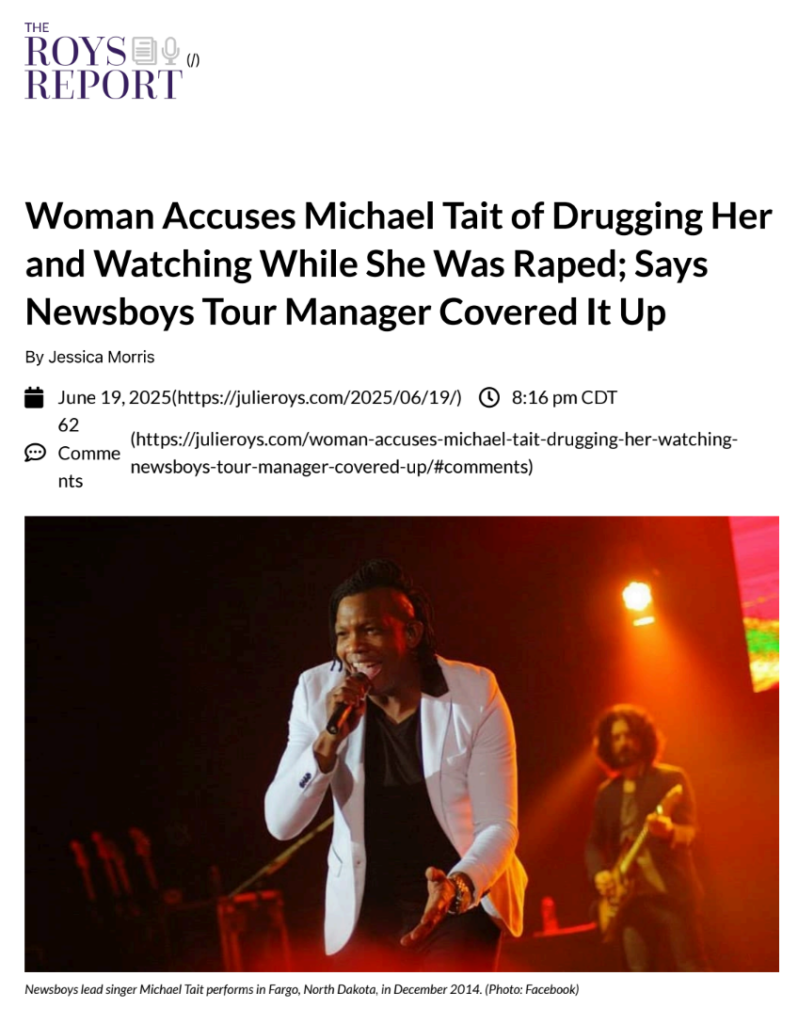
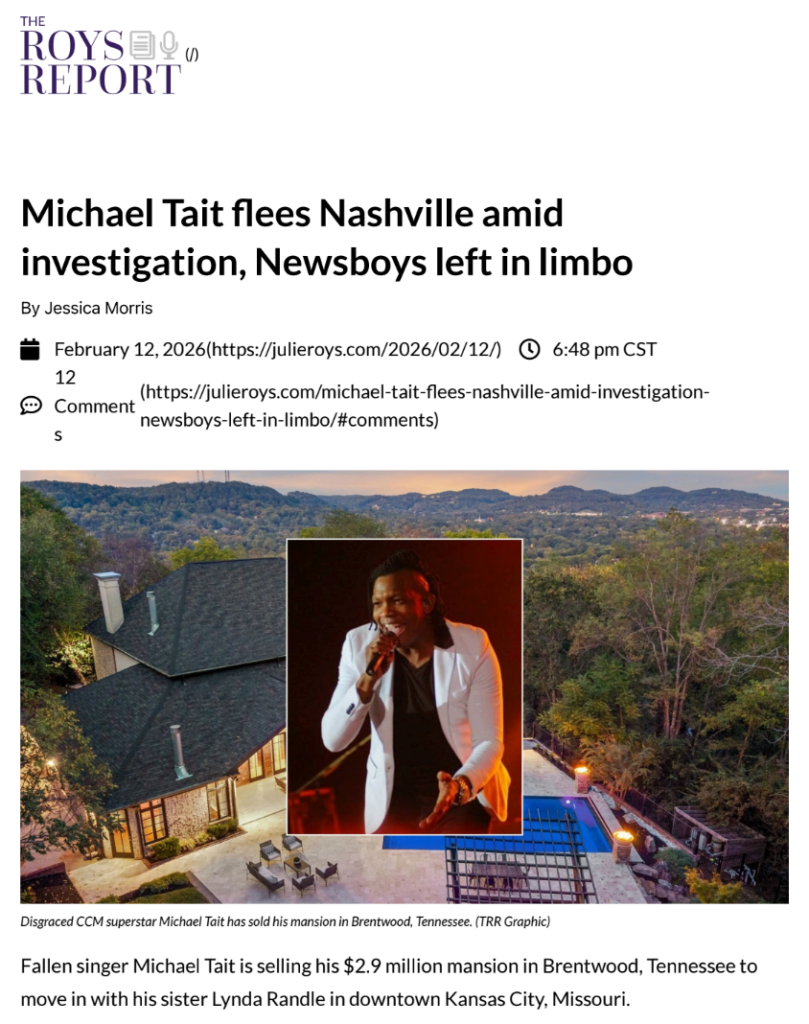
Although damage to the Newsboys’ commercial viability began in early 2025, in the wake of accusations against Tait from Jonathan Merritt-outing Azariah Southworth, and Tait’s abrupt departure from the Newsboys (Faith Live Canada canceled all post-Tait 2025 Canadian dates for the Newboys), the post-“Nicole” impact was immediate. The Newsboys were effectively sidelined across much of the Christian music ecosystem. Relationships deteriorated. Opportunities disappeared. The lawsuit argues that the reporting did not simply describe events but helped trigger a cascade of decisions that removed TCA and the Newsboys from the marketplace.
Roys Report Coverage and the Disputed Record
The Roys Report’s articles relied heavily on firsthand accounts and source attribution. The June 2025 article presented detailed allegations from a woman who claimed she had been drugged and sexually assaulted while on tour, with Tait allegedly present. Follow-up reporting expanded the scope, citing additional sources and describing what was framed as a broader pattern of misconduct.
This approach is common in investigative journalism, particularly in abuse cases where documentation can be limited and testimony forms the backbone of the reporting.
The lawsuit, however, directly challenges the completeness of that reporting. Plaintiffs allege that key contradictory information was omitted, including police findings that they claim characterized at least one of the central incidents as consensual rather than criminal. According to the complaint, those omissions materially altered the narrative presented to readers, creating the impression of confirmed wrongdoing rather than disputed allegations.
This dispute goes to the heart of the legal case. The plaintiffs are not simply arguing that the Roys Report got the story wrong. They are arguing that the reporting selectively presented evidence in a way that amplified the most damaging interpretation while excluding contrary facts.
With regard to the Roys’ usual “according to,” “sources say,” and “court documents reveal” attribution-based “journalism,” courts evaluating defamation claims do not focus solely on whether statements were attributed or qualified. They also consider the overall impression created. Even when allegations are presented as claims, liability can arise if the total narrative implies a false conclusion and known contradictory evidence was left out.
At the same time, the broader context complicates the picture. Allegations involving Tait were not limited to a single outlet, and similar claims have surfaced elsewhere. That reality means the case is not simply contesting isolated statements, but attempting to reframe a widely circulated narrative.
Why Some Outlets Held Back
The Roys Report’s coverage also highlights a divide in how Christian media outlets approached the Tait allegations.
Long before any article was published, claims about Tait were circulating quietly within segments of the Christian music world and among online journalists. And Tait had announced his departure from the Newsboys in January 2025. Protestia was among the outlets aware of the allegations against him. They were not unknown. They were discussed, shared, and evaluated. But they were not published.
The reason was straightforward. The claims, as they existed at the time, were not independently verifiable. There were no police filings establishing criminal conduct, no documented evidence that could be confirmed, and no on-the-record sourcing that would meet a responsible publication standard. There was not enough to justify the reputational damage that publication would cause.
That editorial restraint stands in contrast to the approach taken by The Roys Report, which moved forward by centering firsthand accounts and attributed allegations.
That difference in approach may also help explain why a (in this case potentially compromised) source would choose one outlet over another. Journalists willing to publish based on testimonial accounts, even when facts remain contested, are more likely to receive those accounts. Outlets that require a higher degree of corroboration may never become the destination for such claims, not because they are unaware of them, but because they are not positioned to publish them under their standards.
None of this establishes motive or coordination. It does, however, reflect the reality that editorial philosophy shapes both what gets published and who chooses to bring information forward.
Following the Money
Public filings add another layer of context.
As we discussed in prior coverage, the Roys Report’s nonprofit reported roughly $185,000 in revenue in the first half of 2024. In 2025, that number rose to over $690,000, with the overwhelming majority coming from unknown donors rather than program revenue like reader subscriptions. That increase coincides with the period in which Roys’ reporting on the Tait/Newsboys controversy gained widespread attention.
Such growth is not necessarily unusual for outlets that break high-profile investigative stories, as increased visibility can lead to increased support. But the fact that Roys’ financial surge coincides with her publishing accusations from a purported employee of the multibillion-dollar private equity firm that stands to benefit financially from reputational damage to the Newsboys cannot be overlooked.
Of course, none of this establishes wrongdoing. It does, however, highlight the broader reality that high-impact reporting carries both influence and incentive. The same stories that reshape reputations can also expand audiences and funding.
What Happens Next
The lawsuit’s claims are sweeping. They include antitrust violations, trade secret theft, breach of contract, tortious interference, and defamation. It seeks damages exceeding $50 billion.
Whether those claims hold up remains to be seen. Antitrust cases of this scale are notoriously difficult to prove, and defamation claims involving public figures face a high legal bar.
What is clear is that this case will test the boundaries between journalism and advocacy, competition and coordination, and reputation and reality in the Christian music industry.
For now, it stands as one of the most consequential legal battles the industry has seen in years, with implications far beyond a single band or a single article.





















7 responses to “Inside the $50 Billion Lawsuit Shaking Christian Music”
Fantastic reporting. Julie Roys is not a reporter. She is an advocate who regularly twists the truth.
Honestly hope Julie Roys gets her just desserts with this. She has enough truth in her reporting to make people believe everything she reports (reminds me of when she reported John MacArthur’s wealth). And that jump in revenue? Now that is something someone should investigage.
[…] Inside the $50 Billion Lawsuit Shaking Christian MusicApologist William Lane Craig Says Belief In A ‘Young Earth’ Is Akin to Belief In A ‘Flat Earth’Worship Artist Cory Asbury Says ‘Sin is Rampant’ In Christian Music Industry, But Again Won’t Name NamesReformed Seminary VP Given 15 Year Sentence For Distributing CSAM‘Christian’ Detransitioner Neeza Powers is ‘Re-transitioning’ to a ‘Woman’ […]
Look, whatever you think of The Roys Report… demonizing them in this instance is certainly a choice.
In most cases, I’d think that a Christian publication would appreciate when their peers hold other Christian organizations accountable.
Then again, we’re looking at a publication that continues to carry water for J.D. Hall, despite his myriad of moral and legal failings. So I guess it shouldn’t surprise us that Protestia is choosing to demonize accountability.
Julie is that you?
I read this who thing and still don’t understand what is really going on.
[…] because the article being analyzed not only is a direct exhibit in the Newsboys/Wes Campbell lawsuit against multiple parties, including Julie Roys herself, but Morris and her reporting on the case […]