


The current status of McRaney vs The North American Mission Board — particularly the courts’ willingness to categorize virtually every intra-Baptist dispute as an untouchable “church matter” — represents one of the most serious threats to historic Baptist principles in modern American jurisprudence.
Ironically, a legal doctrine intended to protect churches from government control may instead push Baptist institutions out of meaningful participation in civic life altogether.
And if that happens, Baptists will have helped create the very hierarchical, opaque religious system they have historically rejected.
What the Case Is Actually About
Will McRaney, former Executive Director of the Baptist Convention of Maryland/Delaware, sued the Southern Baptist Convention’s North American Mission Board (NAMB) in 2017 after alleging that NAMB improperly interfered in his employment and later damaged his ministry reputation.
According to court filings and documented evidence:
- NAMB allegedly threatened to withdraw roughly $1 million in cooperative funding unless McRaney was removed.
- After his termination, McRaney claims NAMB officials interfered with speaking opportunities and ministry relationships.
- Evidence includes testimony that speaking invitations were rescinded after communications tied to NAMB leadership.
- McRaney also alleges reputational harm, including a photograph displayed at NAMB headquarters indicating he was not to be trusted. Background of the McRaney v. NA…
NAMB disputes wrongdoing and argues the conflict is fundamentally ecclesiastical — an internal ministry dispute beyond the jurisdiction of civil courts.
Increasingly, courts have agreed. And that is precisely the problem.
The Expanding “Church Matter” Problem
Recent rulings have leaned heavily on the church autonomy doctrine, holding that civil courts must avoid disputes involving religious governance. In principle, Baptists should cheer this. Religious liberty matters. Churches must be free from state control. But what is happening now goes far beyond protecting doctrine or church discipline.
The courts are being asked — and are beginning — to treat any dispute between legally autonomous Baptist organizations as inherently religious and therefore legally untouchable.
If that standard holds, then:
- Tortious interference becomes immune if done by a ministry.
- Defamation becomes non-actionable if spoken inside denominational networks.
- Organizational coercion becomes legally invisible if framed as cooperation.
In effect, Baptist entities gain something approaching civil immunity — not because of theology, but because courts will refuse to examine facts at all. That outcome may feel like institutional protection. In reality, it is institutional exile from civil society.
The Misuse of 1 Corinthians 6: When Religious Liberty Becomes Biblical Revisionism
A central public defense of NAMB’s legal position has come from its lead appellate counsel, Matt Martens, who recently argued:
“The argument that people won’t partner in ministry unless they can sue each other in secular courts over ministry decisions and actions is a bad argument, especially biblically. 1 Cor. 6:1–6.”
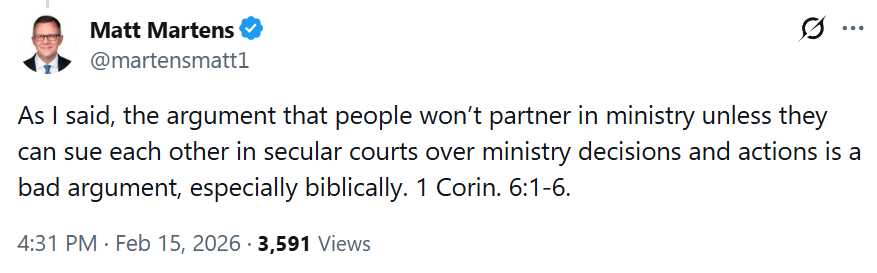
He reinforced the claim by appealing to Charles Spurgeon and John MacArthur, asserting that Scripture teaches Christians must not sue other Christians.
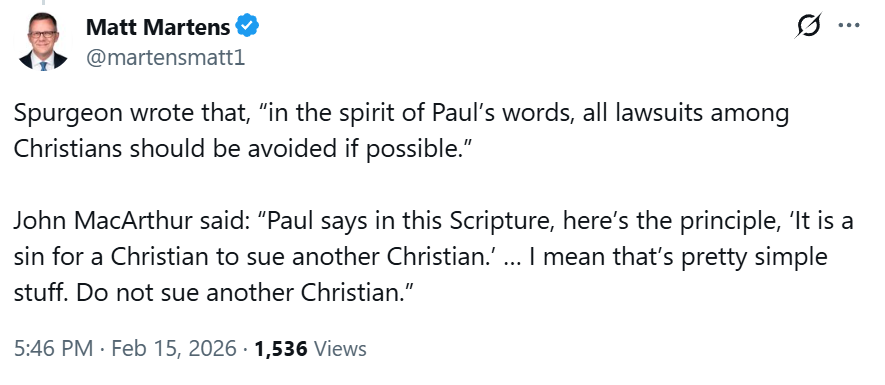
At first glance, this sounds pious. Yet upon closer inspection, it collapses both logically and biblically.
1 Corinthians 6 Is About Church Jurisdiction — Not Civil Immunity
Setting aside for the moment the fact that the very organization Martens is arguing should be biblically immune to suit from other believers has itself taken civil legal action against other believers on numerous occasions, Paul’s rebuke in 1 Corinthians 6 addresses a specific situation: members of the same local church dragging internal disputes before pagan courts rather than submitting to congregational adjudication.
The text itself makes this explicit:
“If any of you has a dispute with another, do you dare take it before the ungodly for judgment instead of before the Lord’s people?” (1 Cor. 6:1)
Paul assumes several conditions:
- The parties are known believers.
- They belong to a shared ecclesial body.
- That body possesses recognized authority to adjudicate disputes.
- The disputants are mutually accountable to that authority.
Remove those conditions and Paul’s instruction loses its operative framework. And that is precisely what Martens’ argument ignores.
The Basic Logical Problem
Martens’ interpretation implicitly claims:
Any dispute between professing Christians is biblically barred from civil court.
But this immediately raises an unavoidable question:
How do we determine who qualifies as “another believer”?
- Do we accept mere self-identification?
- Does conversion mid-lawsuit nullify legal claims?
- Does denominational disagreement invalidate jurisdiction?
- Must one church recognize another church’s discipline?
- Who decides when parties are no longer “brothers”?
Scripture provides an answer — and it is not individual assertion. The New Testament locates Christian identity judicially within the local church.
Church discipline determines who is treated as a brother (Matt. 18; 1 Cor. 5). Paul himself instructs believers to treat the unrepentant as outsiders subject to ordinary social judgment. Without shared ecclesial jurisdiction, the category “brother” becomes legally meaningless.
MacArthur and Spurgeon Don’t Say What Martens Needs Them to Say
Martens cites Spurgeon and John MacArthur as if they support an absolute prohibition. Of course, they do not.
Spurgeon carefully qualified his statement:
“All lawsuits among Christians should be avoided if possible.”
That is pastoral counsel, not a universal legal ban.
MacArthur is even clearer. His commentary explicitly frames Paul’s instruction as applying within the church — meaning disputes among members under shared spiritual authority. That distinction matters enormously.
Paul is not abolishing civil courts. He is rebuking Christians who bypass their own church’s adjudicatory authority. Where no such authority exists, Paul’s instruction cannot apply.
Baptist Polity Makes Martens’ Argument Impossible
Here is the irony: Martens’ reading only works in a hierarchical church. In episcopal or magisterial systems, disputes can be routed upward through binding ecclesiastical courts. Baptists explicitly rejected that model.
There is:
- no Baptist bishop,
- no denominational tribunal,
- no binding inter-church judiciary,
- no mechanism compelling one autonomous Baptist entity to submit to another.
This is not mere polity preference. This is a statement of witness from Baptists to the world around them: God’s law is good, and Baptists stand up for it both inside and outside our churches.
Which means this question becomes unavoidable:
If two autonomous Baptists or Baptist organizations are not part of the same church, where does 1 Corinthians 6 require them to adjudicate disputes?
No such venue exists.
Martens’ interpretation, therefore, produces an absurdity:
- Civil courts are forbidden.
- Ecclesial courts do not exist.
- Accountability disappears entirely.
That is not biblical peacemaking, it is self-serving institutional immunity that threatens the core distinctives of Baptist polity.
Paul’s Command Requires a Church — Not Merely a Brand Identity
The Apostle’s solution was not secrecy but church judgment:
“Is there no one among you wise enough to judge a dispute between believers?” (1 Cor. 6:5)
Paul assumes identifiable elders, recognized authority, and mutual submission. But NAMB and McRaney were not members of the same congregation. They were leaders in separate cooperative entities without shared jurisdiction. Applying 1 Corinthians 6 to that relationship is like applying marriage counseling instructions to two strangers because both wear wedding rings.
The category mistake is fundamental.
The Dangerous Theological Consequence
If Martens’ interpretation were adopted consistently, it would mean:
- Any ministry could avoid civil accountability simply by claiming Christian identity.
- Defamation between ministries becomes non-actionable.
- Economic coercion between religious organizations receives biblical cover.
- Courts must abstain even when no church authority exists to resolve disputes.
In other words, Christianity becomes a legal shield rather than a moral obligation. Paul’s warning against scandal before unbelievers would be turned on its head — creating precisely the public injustice he sought to prevent.
What Paul Was Actually Protecting
Paul’s concern in 1 Corinthians 6 was the witness of the church.
Believers publicly suing one another demonstrated spiritual immaturity because the church itself possessed the wisdom to judge rightly. But when no shared church authority exists, refusing civil adjudication does not protect Christian witness. It destroys it. It signals to the watching world that Christians demand legal privilege without legal accountability, and that we possess superior ability to adjudicate moral/ethical matters that are plainly obvious to believers and unbelievers alike (Romans 2:15). It locates enforcement of the second table of God’s law within the walls of the church, making it hypocritical to continue to insist it should be applied to all people.
The Real Baptist Reading of 1 Corinthians 6
A historically Baptist interpretation looks like this:
- Disputes within a local church belong to the church.
- Disputes between autonomous entities without shared jurisdiction may properly fall under civil law.
- Religious liberty protects doctrine and discipline — not alleged torts unrelated to theology.
Civil courts are not competitors to the church’s authority. They are the mechanism that allows voluntary cooperation to remain genuinely voluntary.
The Irony at the Center of the Case
Martens argues that allowing lawsuits undermines ministry cooperation. The opposite is true. Cooperation without accountability is not cooperation. It is coercion.
And when Scripture is invoked to eliminate accountability rather than encourage reconciliation, biblical authority is not being defended — it is being conscripted.
How Martens’ Theology Became the Court’s Legal Framework
Matt Martens has repeatedly summarized the case with a deceptively simple question:
“The issue is what body gets to resolve whether anyone lied.”
At first glance, this sounds procedural — merely a dispute about jurisdiction. But that framing does far more than describe the case. It defines it. And notably, the Fifth Circuit’s reasoning now mirrors that same conceptual move.
The court did not primarily rule that McRaney’s claims were false, weak, or unsupported. Instead, it concluded that civil courts lack authority even to examine the claims, because doing so would intrude into religious governance and internal ministry decisions.
In other words, the decisive question became not:
- Did interference occur?
- Was reputational harm inflicted?
- Were statements true or false?
But rather:
- Who is allowed to ask those questions at all?
That shift is critical.
As documented in the litigation record, NAMB’s defense — led at the appellate level by Martens — argued that church autonomy turns on the subject matter of the dispute, not the organizational relationship between the parties. Courts, therefore, must abstain whenever resolving a claim would require evaluating decisions connected to religious mission or cooperation, no matter how plainly non-doctrinal the facts are.
The Fifth Circuit adopted precisely this logic, holding that even facially secular tort claims become constitutionally untouchable if adjudication risks examining internal ministry decisions.
The result is a remarkable legal inversion:
Truth becomes irrelevant because jurisdiction disappears.
The court does not determine whether anyone lied — because it concludes no civil body may decide the question at all. This is exactly the outcome Martens’ public argument anticipates.
His theology supplies the interpretive lens through which the legal doctrine operates.
The Quiet Expansion of Church Autonomy
Historically, church autonomy protected churches from state interference in:
- doctrine,
- membership,
- worship,
- and pastoral selection.
But under the reasoning now emerging from McRaney v. NAMB, autonomy expands into something much broader: inter-organizational immunity.
If a dispute arises between religious entities and touches ministry cooperation, courts must abstain entirely — even where claims involve real harms like defamation or tortious interference.
This expansion depends on accepting Martens’ premise that jurisdiction itself is the constitutional injury. Once that premise is granted, every factual dispute becomes secondary. And that is where the argument collides head-on with Baptist history.
“Who Decides?” and the Baptist Confessional Tradition
Martens’ central claim — that the decisive question is who decides whether anyone lied — sounds intuitively Baptist. After all, Baptists fiercely defend church independence. But historic Baptist confessions answer that question very differently.
The Second London Baptist Confession (1689) grounds authority explicitly in the local gathered congregation, not in networks of cooperating ministries.
Likewise, the Baptist Faith and Message affirms:
Each congregation operates under the Lordship of Christ through democratic processes.
Authority is:
- local,
- covenantal,
- and mutually accountable.
It is not transferable through partnerships, funding relationships, or cooperative agreements. Baptists rejected centralized adjudication precisely to prevent institutions from exercising unreviewable authority over one another.
From their earliest associations, Baptists insisted that cooperation creates fellowship, not governance. Associations could advise. Conventions could recommend. Entities could partner.
But none could exercise binding judicial authority over another autonomous body. That distinction is foundational.
Yet Martens’ framework implicitly treats cooperative ministry as jurisdictional authority — meaning disputes arising from cooperation must remain inside a protected religious sphere.
Historically, Baptists denied exactly that claim. If cooperation created jurisdiction, Baptist associations would have functioned as courts. They never did, and they never should.
Why Civil Courts Were Never the Enemy
Contrary to modern assumptions, early Baptists did not reject civil adjudication.
They appealed constantly to civil courts — not to resolve doctrine, but to protect liberty, contracts, and reputation.
Their argument was simple:
- The church governs spiritual matters.
- The magistrate governs civil ones.
- Confusing the two corrupts both.
The emerging McRaney doctrine collapses that distinction by declaring civil harms unreviewable whenever religious actors are involved. That is not Baptist separation of church and state. It is a fusion of ecclesial identity with legal immunity.
The Confessional Problem Martens’ Framework Cannot Solve
Martens claims that he is defending a religious institution’s right to decide whether someone in its employ lied. What he is actually defending is a religious institution’s “right” to determine what a lie is.
Historic Baptist theology answers:
- The local church, when the dispute is ecclesial.
- Civil authority, when the dispute concerns civil injury.
What Baptist theology has never recognized is a third category:
autonomous religious institutions exercising authority without either church jurisdiction or civil accountability.
Yet that is precisely the category the current legal reasoning creates. It leaves disputes neither inside the church nor inside civil society — but suspended in an accountability vacuum.
The Irony Baptists Should Notice
The argument advanced in defense of Baptist autonomy now risks producing a system Baptists historically opposed:
- authority without hierarchy,
- discipline without jurisdiction,
- and immunity without confession.
In attempting to protect ministries from government intrusion, the courts may instead redefine Baptist cooperation as something Baptists themselves never believed it to be. And if that redefinition stands, the question “who decides?” will no longer have a Baptist answer at all. And ironically, many of the same voices who routinely decry the “unaccountability” of the court of public opinion (discernment blogs, YouTubers, etc.) are siding with a legal position that will leave them with no recourse at all, the moment a defamatory online voice claims a similar religious identity.
Baptists Never Believed in Secret Justice
The irony here is profound.
Historic Baptist theology rejects precisely the kind of closed, internal dispute system now being implicitly created.
Baptists were dissenters. They rejected ecclesiastical courts. They opposed state-church privilege. They insisted religious life should exist openly under the same civil law as everyone else.
The Baptist witness has always included:
- transparency,
- voluntary cooperation,
- and accountability under ordinary civil authority.
Unlike episcopal or hierarchical traditions, Baptists have no magisterium, no bishopric, and no ecclesial court of final appeal. When cooperation breaks down between Baptist bodies, there is no internal judicial mechanism capable of delivering binding justice.
Civil courts were never enemies of Baptist life — they were safeguards ensuring voluntary cooperation remained genuinely voluntary. If civil courts now refuse jurisdiction entirely, ministers and churches harmed by other ministries are left with no redress whatsoever.
The Dangerous Logic Emerging in Court
As highlighted in recent analysis by The Baptist Report (“Leaders Warn Foundational Principles at Stake”), the legal arguments advanced in defense of NAMB increasingly rely on portraying Baptist cooperation as functionally hierarchical (the ERLC under NAMB president Kevin Ezell’s ally Russell Moore originally lied to the 5th Circuit Court of Appeals that the SBC was hierarchical, only to later blame the obvious and egregious lie on being rushed).
That framing is historically foreign to Baptist polity. Yet it carries enormous legal consequences.
If courts accept that cooperation equals submission to religious governance, then any Baptist organization partnering with another implicitly forfeits access to civil remedies.
This effectively converts voluntary cooperation into a de facto hierarchy — the very structure Baptists rejected for four centuries. Even more troubling, it signals to courts that Baptist institutions prefer internal secrecy over public accountability.
When Religious Liberty Becomes Civic Withdrawal
Here is the deeper issue.
Religious liberty protections exist so churches may participate freely in public life — not withdraw from it.
But if Baptist disputes are categorically barred from civil adjudication, Baptist organizations become legally unique actors:
- able to affect reputations,
- influence employment,
- and exert financial pressure,
while insulated from ordinary legal scrutiny.
Courts will increasingly treat Baptist institutions as private religious enclaves, operating outside normal civic frameworks.
That undermines Baptist witness in two ways:
- Externally, it signals that Baptist ministries prefer immunity over transparency.
- Internally, it incentivizes power consolidation without accountability.
Neither reflects historic Baptist convictions about truth, conscience, or voluntary association.
The Opposite of Baptist Polity
The emerging legal logic produces an outcome Baptists should find alarming: Disputes must be resolved secretly within institutions that lack binding authority to resolve them.
That is not Baptist governance. That is closer to medieval ecclesiology than free-church tradition.
Baptists have historically insisted that religious organizations, precisely because they are voluntary associations, must remain accountable through ordinary civil mechanisms when disputes involve contracts, reputations, or economic harm.
The McRaney case risks replacing that model with one where:
- cooperation creates legal vulnerability,
- accountability disappears,
- and institutional power becomes effectively unchecked.
Why This Matters Beyond One Lawsuit
This is no longer about Will McRaney or Kevin Ezell. It is about whether Baptist life can exist openly within American civil society.
If every inter-ministry dispute is deemed a “church matter,” then Baptist institutions are functionally declaring:
“We do not wish to be governed by neutral principles of law.”
Courts may eventually take that claim seriously — and respond by treating Baptist entities as legally separate from ordinary civic participation. That outcome anabaptizes the Baptist cultural witness.
The Baptist Alternative
Historic Baptist principles point to a better path:
- Churches govern doctrine and membership.
- Civil courts adjudicate torts and contracts using neutral principles.
- Cooperation remains voluntary because accountability exists.
Religious liberty protects belief and ecclesiastical authority — not alleged misconduct unrelated to theology. Allowing courts to hear secular claims does not establish a state church. Rather, it preserves the credibility of religious institutions operating in public life.
The Real Danger Ahead
The greatest danger of the McRaney litigation is not that a ministry might lose a lawsuit. It is that a supposedly Baptist institution may win a legal theory that quietly destroys Baptist ecclesiology.
A system where ministries cannot be held accountable in civil court is not a triumph of religious freedom. It is an abandonment of Baptist convictions about transparency, autonomy, and truth lived openly before the world. And if Baptists continue down this road, they may discover too late that immunity is indistinguishable from irrelevance.
Note: Recently, over 50 Baptist leaders signed an amicus brief asking the Supreme Court to hear McRaney’s case. Much like the above article, it argues that the Fifth Circuit dangerously expanded the church-autonomy doctrine by treating voluntary Baptist cooperation as ecclesiastical authority. Because Baptists lack hierarchical courts, the ruling leaves ministers and Baptist institutions with no forum — religious or civil — to resolve disputes involving defamation or interference. The brief contends the ministerial exception protects only a church’s authority over its own ministers, not third-party religious entities, and urges the Supreme Court to intervene before church autonomy becomes a blanket immunity from ordinary law.
For further reading (including on the related matter of Garner vs the SBC), check out Jon Whitehead’s recent articles here:
https://centerforbaptistleadership.org/no-religious-liberty-doesnt-depend-on-protecting-defamation/


















6 responses to “The McRaney Case Is a Disaster for Baptists — And Many Still Don’t See It”
This is an issue that strikes fairly close to home for me, due to some fairly serious wrongs committed against my family and myself by a wealthy family member, and member of the same local church. We set out to borrow from him to buy a house. Then when the house was purchased, I went in and did a full renovation, with some remodeling including finishing out the basement. Then after this was done, we were moved, the previous home was sold, and he was paid a $60K down payment, he decided to keep the house for himself, and make it a lease, at which point he stole a large sum of existent equity, among other sins. For years I begged and pleaded to this man to repent and for things to be made right – to respect our God-given rights and quit sinning against us. In accordance with Matt. 18, and also, frankly, because we couldn’t afford to pay a lawyer enough to see a lawsuit through, even though our case is fairly ironclad, I finally ended up taking the matter to the church. But at that point, the local church showed partiality to the wealthy member, and encouraged him to continue his wrongdoing against us.
Then a few months ago, I made it known that if the pastor was not only refusing to do his job, but doing the opposite of his job by being complicit in the sin, that he needed to either repent or be fired. And this is, of course, in proper accordance with scripture. The man is not qualified according to scripture.
Well, that set off a firestorm. Like some sort of cult out to protect itself and it’s leader without any regard for God’s standards of what’s right and wrong, I was accused of all sorts of mess, including supposedly “attacking” the church – because I spoke the truth of what the scripture says concerning his qualifications. While I’d been pleading for years, giving opportunity upon opportunity for the wrongdoer to repent, the local “church” did not itself honor Matt. 18, but instead immediately and without warning reported me to federal law enforcement for supposed online harassment. To which I responded, please do. Right. “your terms are acceptable”. I’d like nothing more than for the FBI to read what I’ve said (because there are serious crimes involved).
At that point, then, I reported the “church” to the Executive Committee. And after a bit of persistence, Jeff Lorg responded to me saying that the SBC does not have the resources to investigate such matters, and that I needed to report it to law enforcement.
Well, I’d already tried to report it to law enforcement a week or so earlier (understand this is after years of showing extreme patience and mercy, nearly begging for repentance), ended up talking to a local magistrate who told me that there couldn’t be any criminal resource because the wrongs were done within the context of what should be a civil agreement. While the wrongs included coercion, dictating things to us against our will and without our agreement. Of course, there’s no question the magistrate is wrong. It is certainly possible for crimes to occur within the context of civil agreements, some of which are directly related to civil agreements, such as coercion for example.
That local “pastor” said, when he claimed to have reported me to federal authorities, that it didn’t involve the church because it was a family matter. I said, what part of scripture says sin is to be ignored and unaddressed as long as it occurs within family? Where does the Bible say it’s ok to sin against others, as long as they’re family? Mine doesn’t contain any such concept.
Very long story short, where things now stand is that everybody has basically told me it’s not their pay grade. The local church says it’s a family matter. The national convention says it’s a criminal matter. The local magistrate says it’s a civil matter. One lawyer says it’s a money matter – could cost tens of thousands to see the lawsuit through. Another lawyers says its a conflict of interest matter – in smaller towns few have the guts to take a stand for what’s right, if they think it might bring them harm (when there’s no rightful reason that it should – such hesitancy to do what’s right only points to the existence of very severe and deeper problems)
I could go on, but the reason I am making this known is to simply say that I can very well attest to the fact that these are very difficult issues to deal with. There are 1001 things to consider. And while it may ideally work for the local ecclesia to determine who is an is not a brother, in this day and age we must also consider what’s a church, and what’s a pastor. If the local assembly doesn’t meet scriptural qualifications, then it isn’t a church. If the local pastor doesn’t meet scriptural qualifications, then he isn’t an elder. Churches and elders who are complicit in sin, and continue in sin, encouraging others to sin, perverting the grace of God into a license to sin, do not meet the scriptural definition of churches and elders. On the contrary, they’re dens of thieves, broods of vipers, Pharisaical servants of Satan, more resembling cults than churches. A cult will protect its own regardless of what’s right or wrong, without respect for the commandments of God.
According to scripture, we are told to determine who is and is not a brother by testing the spirits, by the authority of none but the Lord. If they continue in sin, then they’re not born again (1 John 3, etc.). If they pervert the grace of God into license to sin, they’re not brothers (Jude, etc.)
At the end of the day, what matters is what truly matters. The ultimate question, what it all boils down is do we truly believe what we say we believe, do we truly know what we say we know, do we truly trust the Lord or do we not. In Matt. 18, Jesus went on to make this point, and Paul did so as well in 1 Cor. 6. Ultimately nobody is ever going to get away with anything. If matters aren’t dealt with now, then they will be dealt with on the day of judgment, in which case it will be far worse for the unrepentant wrongdoer. Far worse. And in this sense, it can be merciful to hold them accountable now, because as Jesus said, what we loose on earth will be loosed in Heaven, and what we bind on earth will be bound in Heaven. That is, if we deal with it now, then none will face their Maker with unrepented sin. While we ourselves must be careful not to justify wickedness, and to not ourselves pervert the grace and love of God into a license to sin. There are many times when we must, and absolutely should, demand repentance, not just for our sake but also for the sake of the wrongdoer’s lose soul.
These are not easy matters to deal with. It’s not easy to know what to do. But we must stay focused on what truly matters, and we must trust the Lord in all things at all times. That’s the ultimate point of Matt. 18 and 1 Cor. 6. Less about how it makes the church look, less about structure and organization, and a lot more about simply whether or not we believe what we say we believe. Whatever we do, however we deal with things, that must not be compromised. Indeed, if we do truly know what we say we know, then we will not compromise it. If we stay focused on this, we’ll be handling matters properly.
Scripture does not strictly forbid lawsuits in secular court, but it does say to handle matters ourselves if possible, and it also give’s the reason why. It’s the question, do we truly believe what we say we believe. That’s what it’s about, and that’s the measure by which we determine what to do, as He leads.
Just to show how severely cowardly they are, and the state of mankind these days. (Romans 1, 2 Tim. 3, 2 Thess. 2 – scripture perfectly describes it). We have a ton of proof. It was 28 months into the loan that he switched to a lease. And that after we had moved in and had no place else to go. (it’s fraud, coercion, theft, deceit, in my case it’s technically enslavement – several sins and illegal violations of rights) The down payment check with “house down payment” written on it. House payment checks with “house payment” written on them. Obvious proof the work was done. Nobody goes in and does that sort of work on a house, and pays a $60K down payment just for the privilege of renting.
It makes you appreciate Paul saying “I say this to your shame. Can it be that there is no one among you wise enough to settle a dispute … ??”
It is indeed shameful – to the point of being ridiculously stupid. A fourth-grader could rightly see and understand that the man did wrong. All I’d asked the church to do was to correct the man who’d done us wrong, by informing him that he’d done wrong. The Deacons all were told, and also remained silent. The head of the county association was told, and did nothing. I didn’t ask for a trial or verdict, or for them to come up with some sort of solution. All I asked was that they at least rebuke him for his sins, and tell him to quit sinning against us. Just to sternly inform him that he’s severely doing wrong because he and his wife don’t believe they’ve done anything wrong. And the matter cannot be rightly settled until they recognize the fact that they’ve severely done wrong. But the “church” couldn’t even do that much. In fact, it does no good to say anything to their shame, because they have no shame. And that is because they have no conscience informed by the Holy Spirit. There’s no evidence of the work of the Holy Spirit in them, and therefore no evidence that they are truly born again. There’s no good fruit. And that’s how we are told to evaluate whether or not others are brothers. They have a “form of Godliness, but deny the power thereof”.
Once it reaches the point where the wrongdoers are “as gentile or tax collector” (because the wrongdoer either refused to listen to the church, or because it turns out the church isn’t a church), then it’s fully public, and then appealing to secular law and courts is acceptable, as I understand the scripture. (with the test of that being – do we truly believe and know what we say we truly believe and know)
At this point in time, as bad as things have become these days, I don’t know if there are any churches that are truly churches, or elders that are truly elders. And brothers who are truly brothers are a rarity. As Jesus said, “few there be that find it” (Matt. 17:4). It’s a very cynical to say, and admittedly not true. I’m am sure there are some. Where they are, who knows. I certainly don’t see any around my particular neck of the woods. All I see are wicked-hearted gutless cowards.
[…] The McRaney Case Is a Disaster for Baptists — And Many Still Don’t See ItA Pastor Made 50 Sex Tapes With His Wife. Now He’s Bleeding Congregants As New Revelations EmergeMegachurch Pastor With 120K Members Secretly Divorces Wife, Doesn’t Tell ChurchRev. Jesse Jackson Dead at 84Pastor Faces 150 Years in Prison For Major Retail Theft […]
In my experience in churches there are few men worth following.
Way too redundant article. Likely AI writing. Slim it down broski.
[…] Note: to catch up on the particulars, read The McRaney Case is a Disaster for Baptists and Many Still Don’t See It. […]