

Here we go again.
Once more, we are watching the same pattern repeat itself in anti-Christian Nationalist evangelical discourse. This pattern has now emerged so predictably that it deserves to be named for what it is: crying wolf.
The pattern starts with the movement (Christian Nationalism) being tagged as dangerous. Some of the concerns are legitimate. The excesses are real, and taking biblical issue with them has brought plenty of digital, anonymous heat on Protestia. But instead of carefully separating error from truth, voices from squarely within our theological camp have fired wholesale volleys against the broad Christian Nationalism recipe that don’t separate the good (love of nation, public Christian witness and advocacy of God’s law) from the bad (magisterial enforcement of the 1st table, violence against speech). collapsing essential distinctions and ultimately accomplishing the exact opposite of what they intend.
This same pattern is repeating itself, with the alleged offense being the use of artificial intelligence.
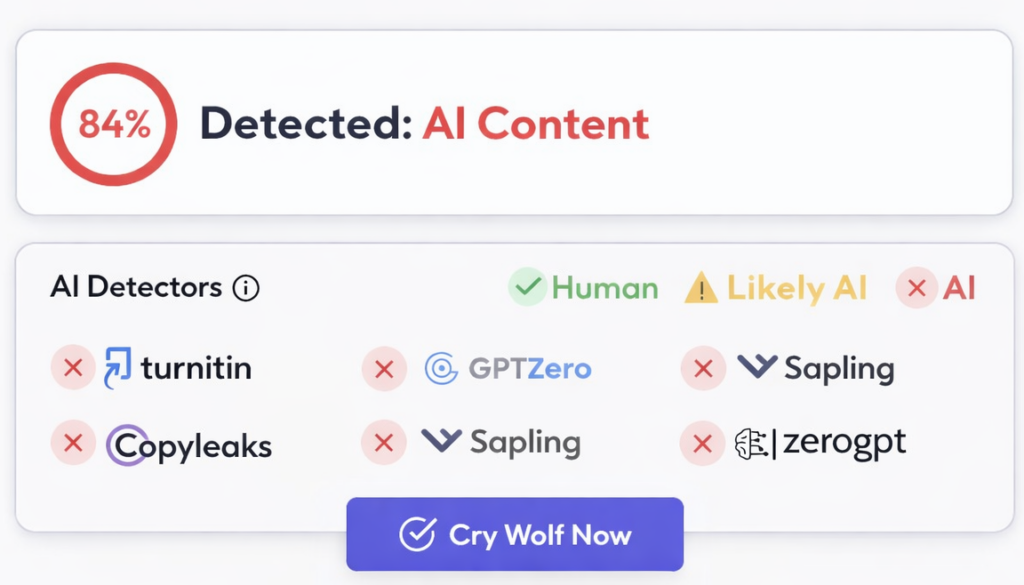
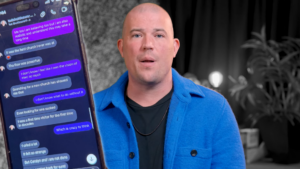
Screenshots of “AI detection” tools are now being circulated online as proof of moral failure among professing Christians. No biblical case is being made. No engagement with the substance of what they are opposing occurs. No argument is being answered. When pushback occurs, the best responses have been light (and ultimately incoherent) ethical appeals, illogically tying AI writing tools to plagiarism.
An algorithmic probability score is simply dropped into the conversation as if it were self-authenticating evidence of sin.
It isn’t.
And worse, this approach is actively sabotaging the very effort to confront the real theological problems within Christian Nationalism.
Sadly, these ham-handed attempts to use technical disqualification in place of argumentation against Christian Nationalism are not new.
In 2023, several voices in the G3 orbit attempted to confront the rise of Christian Nationalism. Many of their instincts were correct. There were real dangers emerging. There were theological overreaches gaining traction.
But the arguments deployed were not sufficiently surgical, and too often failed to engage with the epistemological and rhetorical devices at play.
In attempting to repudiate the excesses, many of Christian Nationalism’s critics undermined:
- Legitimate Christian engagement in civil life
- The biblical role of the magistrate
- The duty of Christian citizens in a representative republic
- The second-table jurisdiction of civil authority
By failing to distinguish what Christian Nationalism gets wrong from what it gets right, the critique collapsed into something that sounded more like pietistic withdrawal theology than biblical correction. The result was predictable. Rather than weakening Christian Nationalism, those arguments strengthened it.
Young men who were open to being convinced of Christian Nationalism’s errors concluded (often incorrectly), that not only did its critics lack a coherent political theology from which to explain and understand their grievances, but that the same critics would be conscientiously objecting behind their pulpits rather than standing beside them as fellow law-abiding citizens when the lawless of the world threatened physical harm against their families and communities.
They quit listening, called them fake and gay, and retrench with those who gave voice to their concerns, however misaimed their direction was.
The critique missed its target.
In 2024, the pattern repeated itself with the so-called Antioch Declaration.
Once again, some concerns were legitimate. There are sinful forms of ethnic partiality. There are real theological dangers in collectivist rhetoric. These matters deserve serious engagement.
But once again, the execution was blunt, accusatory, and imprecise (not to mention possibly politically motivated).
Instead of carefully demonstrating where Scripture was violated, the declaration trafficked in insinuation rather than exposition, generalities rather than argument, and moral collectivism rather than biblical specificity.
Anonymous actors were treated as representative. Disagreement was flattened into extremism. Guilt was inferred rather than demonstrated. And once again, the outcome was predictable.
Support for their opponents hardened, and proper critique was marginalized yet again. Opportunity for genuine correction was squandered.
Every time a Christian Nationalism critic responded to excessive rhetoric with “Christians are citizens of another kingdom, not America,” or some other pietistic (and often self-serving) silliness, young men heard, “Turn the other cheek when the enemies of God overrun your community.”
Now we’re seeing the same strategic failure (hopefully on a smaller scale) popping up in the form of (comically ironic) accusations of AI-produced content.
Instead of saying:
“This doctrine is wrong because Scripture teaches otherwise,”
We are now being told:
“This man is discredited because an algorithm says he used AI.”
This is not discernment.
It is an argument by technicality. Worse, it is an argument based on either misunderstanding the technology or deliberately misapplying it. AI detection tools do not prove authorship. They do not establish plagiarism. They merely analyze linguistic patterns and compare them to probabilistic models. That is all.
The same companies selling AI detection, revision, and “humanizing” services openly admit this. The same companies sell both the detection tools and the “humanizers” designed to evade them.
An algorithm accusing another algorithm of algorithmic resemblance is not proof, much less the basis on which to suggest others have sinned. This is particularly true when many public accusers apparently don’t know the difference between plagiarism detectors (which compare submitted work to libraries of other published work to find exact textual matches) and AI detectors (which look for patterns in structure, not exact content).
Tellingly, the brothers doing this (who should know better) are stopping short of calling it sin, conveniently excusing themselves from having to mount a fully formed biblical argument.
Saying AI use is “wrong,” or simply publishing an algorithmic claim of probable AI use and relying on others to assume the accusation is not just weak and cowardly. It is sinful.
Scripture is not silent on how accusations must be made.
Plagiarism (what many are labeling AI use as) is sinful because it involves:
- False witness
- Theft of another person’s labor
AI use does neither by necessity.
If a man publishes material under his own name, he bears responsibility for its truthfulness, regardless of the tools used in its preparation.
That standard already exists.
What Scripture does not permit is insinuation.
Probability is not proof. Suspicion is not evidence.
Disliking someone’s theology or associations does not justify lowering the standards of accusation, nor of simply not making a formal accusation, sitting back, and letting ignorant supporters fill in the accusatory gaps.
A prominent example demonstrates an inconsistency that is impossible to ignore.
John MacArthur (beloved by all of us) produced an extraordinary volume of published material while simultaneously serving as a senior pastor, seminary president, conference speaker, and radio broadcaster.
No reasonable person believes he personally drafted every page of every book. Nor has anyone accused him of sin for that fact.
Why? Because it was universally understood that his sermons supplied the theological substance, while editorial staff handled transcription and structure, researchers assisted with preparation, and MacArthur reviewed and approved the final product.
The arguments were his. The responsibility was his. That is what authorship means.
If that model was morally legitimate (and it was), then the distinction between human editorial assistance and software-assisted editing is not a biblical distinction at all. It is an emotional one.
Worse, rebuking small-scale theologians for using technology rather than large institutions to fully form and publish their content smacks of a kind of theological class warfare unbecoming of the church, as if one must enjoy a higher level of institutional power before their argumentation qualifies for an audience.
In terms of critiquing Christian Nationalism, here is the central issue:
Every time critics substitute bad arguments for biblical argumentation, they make proper critique harder.
When accusations are sloppy, personal, or overbroad, error becomes harder to expose, truth becomes easier to dismiss, legitimate concerns are delegitimized, and extremists gain credibility by contrast.
The God-loving young men we are trying to reach are watching these debates, and they are not blind. They see when screenshots replace Scripture. They see when insinuation replaces argument. And when we (ironically) use polemical shortcuts (“dismiss this guy because he might have used AI”), they don’t take our corrections seriously. Instead, they conclude that we don’t know what we’re doing. And they’re right.
If a man’s theology is wrong, explain why. If his doctrine violates Scripture, demonstrate it. If his claims exceed biblical jurisdiction, show where. But declaring someone disqualified because an algorithm said so is not discernment.
It is precisely the kind of behavior that has repeatedly undermined every serious attempt to address the magisterial excesses of Christian Nationalism over the last four years, and it’ll either stop, or the voices acting this way will continue to marginalize themselves and make the work more difficult for the rest of us. For Protestia’s part, we’ll keep doing the work to explain as we attack, fighting our friends because we love them.



















16 responses to “Crying Wolf with Algorithms: Why “AI Use” Is Not Evidence of Sin”
[…] Crying Wolf with Algorithms: Why “AI Use” Is Not Evidence of SinChristian Nurse Who Was Suspended For Misgendering Trans Pedophile Is ReinstatedApologia Church Sues Former Congregant for DefamationGiveSendGo To Help ‘Cities Church’ Beef Up Security Hits $35kProminent Vineyard Pastor, 74, Resigns After Snapping Booty Pics: Church Concealed for 5 Years […]
AI is just a tool like any other tool. It can be used righteously or wickedly. A hammer can drive a nail, or it can be used to commit murder. Same with guns. Same with fire. Same with about everything. As it pertains to AI, I’d say it would depend on how the AI is trained, and what information is being fed to it. If it’s just scraping text off somebody else’s website, then sure it would be plagiarism. But that would not inherently be a problem with the technology as much as it is a problem with how the technology is used.
Just stick to scripture and don’t sin. That’s the key. And I’m in 100% agreement with David on this. Argue, debate, duke it out, whatever. That’s not a problem. It’s good, in fact, because iron sharpens iron. But stick to God’s standards, stick to His word, and do not sin. Do this, and all will be heading in the right direction.
Stoop to sinning and stray from scripture, and all you’ll do is show everyone you’re not fit to run a lemonade stand, much less a country.
Our words are not supposed to be our own in the first place. Without the aid and leading of the Holy Spirit, we’re all idiots. So let him who boasts, boast in the Lord. (2 Cor. 10:17, etc.) If we happen to be intelligent and diligent enough to say something useful and worthwhile, it’s only by the breath and grace of God that we do so.
“13 This will be your opportunity to bear witness. 14 Settle it therefore in your minds not to meditate beforehand how to answer, 15 for I will give you a mouth and wisdom, which none of your adversaries will be able to withstand or contradict.” – Luke 21:13-15
“25 Therefore, having put away falsehood, let each one of you speak the truth with his neighbor, for we are members one of another. 26 Be angry and do not sin; do not let the sun go down on your anger, 27 and give no opportunity to the devil. 28 Let the thief no longer steal, but rather let him labor, doing honest work with his own hands, so that he may have something to share with anyone in need.” – Eph. 4:25-28
sorry but you are wrong. Is there a means where porn can be used the right or wrong way? Just curious. You can make that argument about driving cars, electricity etc. You can’t make that argument when you are supporting something that amounts to simply a convenience or entertainment. Then there is no innocent use if that same convenience and entertainment is used for evil purposes. You do a great job of posting unrelated scripture verses but this doesn’t have to go to scripture only to if people possess actual values at all.
Seems you might’ve misunderstood, Doug.
Porn would be the wicked use of technology that otherwise isn’t inherently wicked, such as cameras, and the internet you used to post that very response.
Outstanding addition, tek. I’m new here, but based on your comment, hope you comment here often. I found this article powerful, necessary, and important for the church – it was some good stuff and yours was a great comment about it. I do Christian videos and this piece was excellent advice for me, both in what I say and what I use in preparation for them.
Thank you Oscar, but I can’t claim it all as my own 🙂
I’ve had some training and experience dealing with such issues from my days working as a programmer. But ultimately, it’s all the result of the training that the Lord put me through, and what He has taught me for His purpose. Without Him, we’re all idiots, and I’m certainly no exception.
I understand where those skeptical of AI are coming from. Maybe it’s not inherently evil, but it’s unquestionably being used for evil purposes. Such tools, like the sword, will no doubt be used by the Man of Sin. So there is a hesitancy to feed into and promote something that is being used for wicked purposes, and undoubtedly will continue to be so. From this perspective, a good healthy public debate is a good thing. It directs attention back to the issue of absolute right and wrong, to the concrete commandments of God, to what is sinful and what isn’t. We end up holding one another accountable on those terms, according to God’s word and His standards, and that’s exactly how it’s supposed to be. It’s important that the world know that even though we may support and use a particular technology or tool, that doesn’t mean we condone every wicked thing done with that technology or tool. The same way Jesus did not support wickedness when He told the Disciples to buy and carry swords for their own self defense. So it’s a good debate to be having, for the most part, as long as there is no sin involved – no false accusing, no twisting of scripture, and so on, as well as no diversionary focus on the tools themselves as opposed to what we should be focusing on. Though we might see such a diversion as good, the world will use it as an excuse, every time, twist it and use it to justify wickedness and condemn righteousness. It is vitally important to stick with the commandments of God, and not the commandments of men.
You know there’s a lot that can be said. And I have a tendency to make too many posts at times, so I don’t want to get too carried away here. I’d like to see some of your videos one of these days. Based on what you have said, your heart is for the Lord, which leads me to believe they would be very beneficial, informative, encouraging and uplifting, serving His purpose.
A lot of us are going through difficult times these days, and the guys at Protestia are no exception. I can’t afford to donate, but I try to offer encouragement and add to the debate. Maybe even stir up some debate. Much of what I said was about the same thing David said, but from a different angle. But that’s mainly the reason I post. We’ve got to encourage one another in these difficult times.
Once more we see so called “Christians” trying to justify their involvement in evil. Sorry but you can’t have it both ways.
Just like the so called “Christians” who continue to watch the NFL. You know, the phony Christians who claim to support the Police but then put money in the pockets of an organization that not only devalues America in general but actually put money into the pockets of people who got police officers killed.
You can’t have it both ways hypocrites. No different with AI. It’s not essential for life and right now it is the single largest purveyor of propaganda and misinformation on the planet. I actually got gemini to admit it eclipses the propaganda and reach of the Nazi party.
Explain how there is innocent use of this?
Doug I don’t completely disagree with you. Your points are valid, and questions are worth considering. I used to love watching the NFL. Grew up playing football, and loved the game. Now I don’t watch it, for the very same reason you gave. I have a nephew who loves basketball. And I’ve asked myself the same questions. How much do I want to feed into that, and how much should he be looking up to the players in the NBA and the organization itself. It would be easy for me to demonize the game of basketball, and to advise him to stay away from it altogether.
But I believe we also need to be careful. We’ve got to criticize what the NFL is doing, but not get sidetracked with demonizing the game of football itself. Doing so would actually give the leadership of the NFL an excuse.
I’ve said the same thing about God’s beautiful rainbow. We can’t display it anymore. If we do it’s sending the wrong message. It’s been hijacked, and there’s no way we could take it back. Only the Lord could do it. You will not catch me displaying any depiction of a rainbow in any form at all, because of the wickedness it now is used to represent.
These are all very good questions, points and concerns, and it’s a debate worth having. What are the limits. What should we be doing. And I don’t have all the answers, my friend. I don’t know. We need to look to the scripture for the answers, look at the Lord’s example, at the Apostle’s example, to consider whether or not something is a matter of supporting or justifying wickedness and condemning righteousness, of calling evil good and good evil, perverting grace into a license to sin, or otherwise taking away from, or distracting from, the Gospel.
I’ve considered the same question about facebook and many other social media sites. We have churches and ministries, some of which the members nearly live their lives on those sites, churches conducting church on those sites, but you can’t sign up to them without having to sell your soul. For example, you cannot sign up to facebook without answering a gender question that is a direct assault, and rebellion against, our Creator. So why are churches trying to draw people there? Are new members expected to go through that signup, in order to be a part of the family?
My conclusion is that churches need to get off of facebook, and any other site that does such things. What sort of message does that send to any new believers who join the church? For the first thing you ask them to do to be to violate their conscience and to justify wickedness?
In principle, I agree with you Doug. Then question is whether or not it applies to AI. If we start doing away with anything and everything that has been used for wicked purposes, even inadvertently, we’re going to end up living in tents in the middle of the wilderness, if we could reasonably say that tents haven’t been used for wicked purposes. What tools haven’t been used for wickedness? If there aren’t any, they’re certainly few and far between. Even the Bible itself, our first and foremost greatest tool the Lord has given us, has been twisted, taken out of context, altered, taken from, added to, cherry picked, and abused to no end for the past two centuries, as an excuse to engage in wickedness.
What exactly is the limit. Where’s the line drawn. It’s certainly drawn between what is sinful and what isn’t. And I know we agree on that 100%. I don’t have all the answers, my friend.
past two millennia, should’ve been
It does remind me of 1 Cor. 5. They had previously been told it was ok to do business with the wicked, as little as necessary, so as to “not go out of this world”. But at some point, when it infiltrated the church, that limit was crossed. After which they were told to have nothing to do with the wicked at all. The answers are in the scripture. And we need to be looking for them. That much I do know, without a doubt.
But if we say the determining factor is just what’s needed for survival, then the end of that reasoning would be that we all need to live like a tribe of natives in the amazon rain forest. (But worse conditions even than that, because spears and bows and arrows are used to commit all sorts of wickedness.) Certainly Jesus and the Apostles didn’t live in such conditions. And scripture is clear that it is not sinful to make use of tools and technologies that have otherwise been used for evil purposes. It’s full of such examples.
I’m convinced, and know, that there is only one dividing line. We’ve just got to determine where that line is, based on the absolute and concrete standards of God, being careful not to divert off track to the relativist, baseless, commandments of men. And we need to debate that in a manner that isn’t itself sinful, crossing that same line that we’re trying to understand and uphold. If we don’t, then how much do we really respect it … and what sort of message would that send to the lost.
We agree that the most fundamental question is whether or not we’re justifying and supporting wickedness, feeding into and encouraging wickedness, and so on. I believe we agree on that. And I know there is a line that should not be crossed. I believe we agree on that also.
Wow. This has to be THE best essay on how to biblically critique others, how to keep our material our own (actually, God’s), and the dangers of not faithfully doing these two things. It’s advice is not just biblical, but logical and reasonable. It is so sound that it could be used – as written – by a secular professor at a public university, both to present his own research in writing, and to evaluate his students’ work. Thank you to the editors and to this site. On the strength of this one piece, your stock just soared in this reader’s opinion. Thank you!
You can tell AI to prove or disprove a point and it will provide a generic response. However, if the individual gives reasons and allow ai to verify a claim and if one layers their questions to establish an argument with ai verifying if it’s factual. Then asking and directing AI to compose an essay or blog would be the best way to use this tool. Let ai determine if a video is fake or not is something a human eye can’t catch.
No, not evidence of sin, just evidence that the compiler of such a piece is a thoughtless idiot. Comparing this to editors of MacArthur’s sermons? Haha…right.