
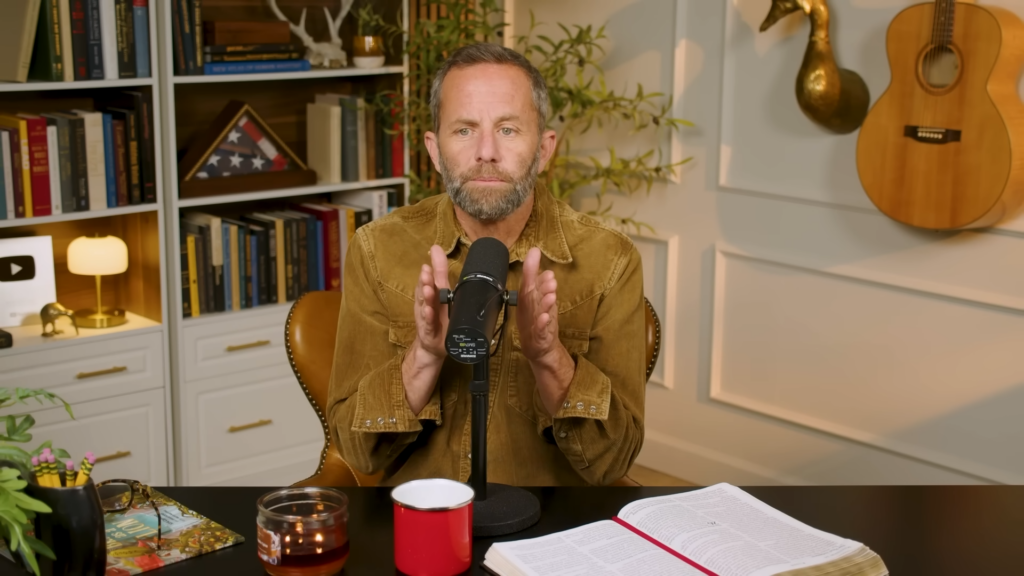

Former actor-turned-evangelist Kirk Cameron has revealed that he no longer believes in ‘eternal conscious torment’ for the wicked, which he suggests is “cruel and unusual punishment.” Instead, he revealed he leans strongly towards annihilationism, saying: “It fits the character of God.”
Appearing with his son on Episode 86 of the Kirk Cameron Show, he argues:
“The Bible, particularly in the Old Testament, never talks about the eternality, immortality of the wicked souls. The only ones who have immortal souls are those who are granted eternal life. And that’s only believers.
Jesus died so that we could have eternal life. But do the wicked have eternal life in hell? And if they do, why does the Old Testament describe the fate of the wicked in the opposite terms? For example, the Old Testament describes the fate of the wicked with three words, ‘death’, ‘perish’ and ‘destroy.’
The soul that sins. It shall die. It will perish. It will be destroyed, which is like the ending of life, not the ongoing life forever in punishment.”
He continues:
When you look at God’s judgment upon individuals or on nations, cities, empires, he says they’re gone. Like, the symbolism is scorched earth, destroyed, gone, and their name is remembered no more. You know, the jackals and the owls will come and inhabit their land.
And they’re not coming back. It’s like forever. Which really is a better description of dying, of perishing. Not being granted eternal life so that you can be tormented forever. That doesn’t seem to fit.
We give someone lethal injection, we do it humanely. “Humanely.” We can’t have cruel and unusual punishments for people, but an eternal conscious torment?
That would by definition in human terms be considered ‘cruel and unusual punishment.’ Does God not have a merciful and compassionate way to meet out his justice?
Cameron concludes:
So my position as it stands today…I used to hold the position of ‘conscious eternal torment’ because that’s just what I was taught by people that I love and trust. I’ve learned that there are other positions and a very robust argument can be made for conditionalism or annihilationism as Edward Fudge posits here.
And it fits the character of God, in my understanding, more than the conscious eternal torment position, because it brings in the mercy of God together with the justice of God. It doesn’t leave judgment out. It is just, but it also fits with the Old Testament picture of the fate of the wicked, which is to be destroyed. It is to die and it is to perish, not live forever in an eternal barbecue.
And the classic verses that used to get me into eternal torment, you know, the punishment, everlasting punishment, everlasting destruction, fits beautifully with a destruction, punishment, judgment that is irreversible and lasts forever. That is the eternalness of that punishment and that destruction. So that’s where I am today.
Here is a longer video, with more context, as Kirk and his son work through different bible verses and arguments. pic.twitter.com/su4XSPyOLq
— Protestia (@Protestia) December 6, 2025






















87 responses to “Kirk Cameron Denies ‘Eternal Conscious Torment,’ Is Now An Annihilationist?”
He’s getting his theology about hell from a guy named “Edward Fudge”? Where does he get the rest of his theology from? Kris Kringle?
Kirk is a calvinist! A follower of the man-made false doctrine of john calvin.
Kolasis Aionios – look it up – like you did on the word Hell. Original Greek <500AD shows church father views not post Augustinian mistranslation
Wow. Kriss Kringle! Love the humor! Witty.
Marshall
Matthew 25:46…”And these will go away into eternal punishment, but the righteous into eternal life.”
Jesus spoke those words. Eternal and eternal. Seems pretty cut and dried to me. It’s shameful that people just can’t read the text as it is and believe God’s Word as it is. This is basically saying, “Look, God, I know you said this, but I don’t like it, so I’m going to improve on what you said, because I’m smarter than you.”
Kirk Cameron is a calvinist! A follower of the man-made false doctrine of john calvin.
Kirk Cameron is a calvinist / reformist! A follower of the man-made false doctrine of john calvin.
Kirk Cameron is a calvinist / reformist! A follower of the man-made false doctrine of john calvin.
The Greek word aionian (eternal) can mean ‘an age’. Regardless, one scripture.. please consider these truly magnificent Almighty Omniscient Omnipresent FATHER GOD honoring scriptures at the website GreatestStoryTold
Eternal punnishment could also mean no eternity with God as not being with God or having God is punishment in and of itself. So there is that.
Kolasis Aionios – look it up – like you did on the word Hell. Original Greek <500AD shows church father views not post Augustinian mistranslation
After all these years of preaching you’ve just now discovered annihiliationism? Wishful thinking. I wish it were true. Jesus used the same words to describe the length of torment as he did for the glories of heaven. You don’t think it is in character with God? Then you don’t value, understand or give glory to an eternally holy God that we’ve offended. Eternal punishment, though violatingly garish, is full in keeping with the extent with which we’ve violated our Creator.
Assuming you are referring to Matthew 25:46. Annihalation is eternal punishment. It cannot be reversed. That’s pretty eternal to me.
Even diving into the Greek, there is no support for eternal punishing as arguments are on both sides regarding Greek grammar with this verse – specifically how aionios is used.
There is no verse in the Bible stating sinners will also receive eternal life, just in fire in hell so they can be tortured beyond anything we would do to our own enemies for billions, trillions of years and forever. But there are numerous verses speaking to their ultimate destruction
Kirk Cameron is a calvinist / reformist! A follower of the man-made false doctrine of john calvin.
Kolasis Aionios – look it up – like you did on the word Hell. Original Greek <500AD shows church father views not post Augustinian mistranslation
Assuming you are referring to Matthew 25:46. Annihalation is eternal punishment. It cannot be reversed. That’s pretty eternal to me.
Even diving into the Greek, there is no support for eternal punishing as arguments are on both sides regarding Greek grammar with this verse – specifically how aionios is used.
There is no verse in the Bible stating sinners will also receive eternal life, just in fire in hell so they can be tortured beyond anything we would do to our own enemies for billions, trillions of years and forever. But there are numerous verses speaking to their ultimate destruction
you wish it were true? how can that be when we are not as loving, kind and good as our Almighty Omniscient Omnipresent Heavenly Father? please consider the mind-blowing, FATHER G-D, Christ Jesus, Savior of THE WORLD, Redeemer, Lord and King honoring scriptures at the website GreatestStoryTold
Kolasis Aionios – look it up – like you did on the word Hell. Original Greek <500AD shows church father views not post Augustinian mistranslation
Length or nature?
I meant him and Ray comfort in my church. If he now believes this I would be very surprised he has come to this conclusion. The Bible is very specific on eternal punishment for lost people and for Satan and the demons. I would have to hear this from his own mouth to believe it. However, it is predicted that there will be a great falling away. Jesus said will I find any watching?
I’ve been watching ever since Summer of 1973!!! 🙂
Why do you think those who believe this view are not saved?
Kirk Cameron is a calvinist / reformist! A follower of the man-made false doctrine of john calvin.
and the Bible story is very specific concerning what the Son of God, Son of Man, Christ Jesus, has done to fulfill the Father’s eternal heavenly plan concerning the creatures He created in His image and likeness… that they would actually BE His image and likeness! it wasn’t just ‘hopeful wishing’ on the part of our Almightly Omniscient Omnipresent FATHER GOD! please consider this magnificent Story of stories in the scriptures on the website GreatestStoryTold
Kolasis Aionios – look it up – like you did on the word Hell. Original Greek <500AD shows church father views not post Augustinian mistranslation
I have been moving toward Mr. Cameron’s thoughts regarding eternal damnation. If you look at the Hebrew word for eternal, it doesn’t mean forever without end. it means the process or event will last until it is complete. if there is damnation, it doesn’t seem to be eternal as commonly taught.
Kirk Cameron is a calvinist / reformist! A follower of the man-made false doctrine of john calvin.
agreed. not to mention, one scripture vs the scores which confirm our Father God actually accomplished in and through Christ Jesus what He set out to do from ‘the beginning’? that the creatures He brought forth to ‘display’ His magnificent image and likeness actually would? what a glorious gospel!
Boom – you have got it correct – post Augustine translated it wrong – spread the GOOD NEWS not the fake news from mistranslation!!! Western Theology has messed this all up for everyone!
The big problem for this thesis are the words of Jesus…how can his teaching not fit “the character of God”?
“Where their worm does not die and the fire is not quenched.” Mark 9:48 (cf. Isaiah 66:24)
“Eternal fire” Matt. 25:41
“Hell, the unquenchable fire.” Mark 9:44
and what do you say about the many scriptures that speak of the triumphant work of our Lord Jesus Christ.. Savior of THE WORLD, Redeemer, Lord and King… in His victorious death and resurrection? for THE WORLD. please consider a few of these magnificent scriptures on the website GreatestStoryTold
Kolasis Aionios – look it up – like you did on the word Hell. Original Greek <500AD shows church father views not post Augustinian mistranslation
Yea Mark 9:48 is quoting from Isaiah 66:24, which is a picture of complete destruction. Worm not dying doesn’t mean a word living forever or soemthing. It’s an idiom for complete destruction, which is why Edom isn’t still burning now
Eternal fire – same fire that destroyed Sodom and Gomorrah. They are not still on fire. Just because the fire is eternal, doesn’t mean everything thrown in there is eternal also.
Unwuenchable fire – it cannot be stopped until it consumes everything. Has nothing to die with lasting forever.
Mike, it says dead “bodies”. As a condemnation to all “flesh”. The corrupted flesh. ALL flesh. Including the worm, because all flesh was corrupted at the fall, and death of all things entered the world. All of Creation was corrupted. Not just man. All of Creation. Back up to Isaiah 66:22, and you see the context. The eternal fire does not burn flesh. The flesh dies. It burns the spirit, the soul. We are made up of flesh and spirit.
For one sin God cursed the entire universe. When confronted with the terrors of what Scripture teaches concerning hell, better to admit our lack of understanding the depths of sin and the holiness and demands of God’s perfect justice than to deny what Scripture clearly teaches and exalt our limited understanding over the Word of our Creator. Kirk should know better. This affirms a principle by which all biblical truth can be denied.
do you mean ‘biblical truth’ as in this sample of scripures on the website GreatestStoryTold which speak of the glorious victory of the SAVIOR, REDEEMER, LORD and KING, Jesus the Christ, Son of God and Son of Man, for the sins of THE WORLD? rejoice! rejoice!
<- this
What exactly then is the Lake of Fire mentioned in the Bible? Cameron is just another one refusing to accept the Word of God as it is. Most modern day preachers got on the “feel good preaching” kick and just did not want to mention Hell…..but Cameron actually denies it’s existence. Whew, boy….another one bites the dust!!
how much time have you spent, Burke, combing the scriptures for what God has to say concerning the end result of eternal conscious torment for even one of the creatures he created to display His glory and splendor (ie, not the devil’s)? who ‘wins’ here? hands down.. no ifs, ands or buts.. it’s FATHER GOD. it’s CHRIST JESUS. (please see the scriptures on the website GreatestStoryTold and be free!)
Yup
“The Bible says X” is not the trump card that believers think it is. You don’t prove anything by making an assertion that is not backed up by observation and logic.
I do not believe in eternal punishment. I DO believe in eternal destruction. If you throw something in a fire, it does not burn continually, it is consumed. That is what will happen when the evil are thrown into the Lake of Fire. Also, we do not HAVE a soul. Genesis 2:7 says God “breathed into his nostrils the breath of life, and man BECAME a living soul.” The body plus the Breath of Life MAKES a soul.
David, your observation and logic here are both wrong. That scripture does not imply that the soul is produced from the flesh. Read it again, and read it carefully. Man became not just a soul, but a living soul. See, they’re not one and the same. In fact, to claim that the spirit and flesh are the same, is to deny the entire Gospel. It tells me you don’t know anything about what the true Gospel actually is. The soul may be created at the same time as the flesh, but that does not imply they are one and the same, or that the soul is dependent on the flesh. Don’t read into it anymore than what is actually there.
Also have to remember that Adam’s flesh prior to the fall was also eternal. Adams sin brought death into the world. Creation was changed. All flesh became corrupted. When God said, you will surely die, He wasn’t lying. Romans 5:12-14. And this has me thinking about that phrase “breath of life”. Life of the flesh and life of the spirit. And we will be given new bodies (Rom 8:23, 2 Cor. 5:4, etc.). Our current corrupt flesh and blood cannot enter (1 Cor. 15:50, etc.)
Hi Kirk, I watched this episode today and I have some information about forever that may help you. Exodus 21:6 and Deuteronomy 15:17 speak of a master freeing his servant. If the servant is content to stay with him, the master takes him to the door post and punches an awl through his ear to signify that he will serve him forever. Forever can’t mean eternity in these verses because that would dictate that both men must go to the same place at death. That’s not how salvation works. Main point: forever here means a period of time, not eternity. You may want to study this.
so true! and if more people would simply look up the definition for the hebrew word olam (‘eternal’), and the greek word aion (‘eternal’), and all the instances these words or their adjectives are found in the scriptures… as well as the many scriptures which speak of the absolute incomparable victory of the cross and resurrection of Jesus Christ.. we might be able to have a reasonable conversation concerning ETERNAL CONSCIOUS TORMENT (sorry but it’s so disturbing i have to use all caps), and what the truly GOOD news of Jesus Christ actually may be!
I looked it up. Kirk is wrong.
Kirk Cameron is a calvinist / reformist! A follower of the man-made false doctrine of john calvin.
have you looked up the scriptures on the website GreatestStoryTold too, Dana? rejoice, rejoice!!
Careful,Kirk…
That just gives the unsaved the idea that they can continue in their favorite sin without consequences…
That heresy also posits that demons don’t exist because they are the spirits of dead giants… The existence of demons blows annihiliationism’s boat straight out of the water…
Kirk Cameron is a calvinist / reformist! A follower of the man-made false doctrine of john calvin.
Stranger, do you actually believe people ENJOY sin? regardless, the consequence for THE SIN OF THE WORLD landed fully on our Precious Savior’s flesh. which he freely gave ‘for the joy set before him’. which is you, me, all of us! all those created in the image and likeness of Father God. for the express purpose of displaying that image and likeness! the devil don’t win nothing here, Stranger. not a blessed one. please consider the scriptures on the website GreatestStoryTold
Jesus describes hell as an actual place where the fire is never quenched and the worm never dies (Mark 9:44,46,48). That’s the end of the argument for me.
oh my, Bob, it seems the discussion goes much further than that. what is the Bible Story all about? what was the intention of Father God from ‘the beginning’? was that intention truly thwarted in ANY way by a deceiving imposter liar? when we behold the Lamb of God, who takes away THE SIN OF THE WORLD! that Father God’s express will and intention, of creatures created in His image and likeness, would actually display that image and likeness! rejoice, rejoice! and please consider the scriptures on the website GreatestStoryTold
Jesus describes hell as an actual place where the fire is never quenched and the worm never dies (Mark 9:44,46,48). That’s the end of the argument for me.
He needs to look more closely at the agony suffered by Christ at the cross as our substitute. He feared more than a regular earthly crucifixion in the garden, more than just death. When He asks the Father for this cup to pass and sweats blood, He’s fearing the cup of God’s wrath. As our propitiatory sacrifice, Jesus endured eternal Hell in finite time, and died.
how do you know Jesus was fearing the cup of FATHER GOD’s wrath? thing is, the cross and resurrection were The Plan from The Beginning, to SAVE AND REDEEM humankind! could the Savior of THE WORLD who gave His precious Life for THE SINS OF THE WORLD not accomplish that for which He was anointed to fulfill (fill full)? please see the scriptures on the website GreatestStoryTold.. and rejoice!
This may help. I use this site frequently and have found it to be legitimate and backed by scripture.
“Is annihilationism biblical?”
https://www.gotquestions.org/annihilationism.
html
(Also, research for yourself by rewording etc. the question.) Godspeed
Rev 20:10 sums it up for me on the torment and pain eternally…
Another thought, since Judas died before Jesus rose from the dead, Judas actually watched Jesus as He led the righteous captives out of HeII! I can’t imagine the degree of regret Judas experienced as he was left on the wrong side of the chasm as the righteous dead left… WOW!
All i can say.. as a person who was tormented for years with what i considered to be the absolute truth of there being a place of eternal misery for all who did not confess faith in Jesus Christ.. is that it finally hit me one fateful day in 1998, that despite all my faith and so-called effective ‘mother’s prayers’, that my own three sons could actually find themselves one day in that place!! FOR EVER!!
to which all i could do, as any sane mother would, is cry out from the very depths of my being to my All-Mighty All-Knowing FATHER, to PLEASE PLEASE PLEASE let me take their place if it ever came to that!!! knowing full well in my heart of hearts that if no one else, my Heavenly Father would fully understand!
to the point that even though it wasn’t in the ‘rule book’, i knew He could do it! esp as it also seemed one honest to goodness believer in place of three scrawny unbelievers would be quite the nice prize for any devil.. so there’d be no ‘issue’ there.
and so, yes, that was the beginning.. of quite a journey. of study. pondering. wrestling. glimpses. frustration. revelation. concerning Scriptures and the Hebrew and Greek words which comprised those Scriptures.
concerning what the Jews and early Christians believed regarding the ‘afterlife’. (Father God did not inform Adam/Eve they would be tormented forever in a place called Hell if they ate from the wrong tree. and if not them…)
years of growing in understanding concerning the Story. the GOOD News. who the Father and the Son were. what Jesus was anointed to actually full-fill.
understanding concerning who we are, as His image and likeness. and His undefeatable love and victorious eternal plan for us. for all.
and, just basically in general, what IS ‘It’ all about, Alfie??
what is IT all about, folks? what is the over-arching theme of the Story? a Story of such magnificent glory, we couldn’t even begin to imagine in the context of a human fleshly “eye for an eye; love you..oops, sorry..love you not” perspective!
our Father is SO GOOD, SO GLORIOUS! there is NOTHING He couldn’t and wouldn’t do to fulfill His Plan for us to be His Beloved Children! to His Only Begotten Son suffering and dying.. and raised from the dead! for everyone! for all! BECAUSE!! because LOVE!!
such a STORY!
(too lengthy to include here, but please consider the scriptures on the website GreatestStoryTold.. rejoice, rejoice!)
Romans 8:28 – And we know that in all things God works for the good of those who love him, who have been called according to his purpose. Which God referred to? That’s the question. The NT never once refers to the שם השם revealed in the 1st Sinai commandment; the greatest commandment of the entire Torah. Therefore Romans 8:28 profanes the 2nd Sinai commandment and calls upon foreign alien Gods.
The theological Creed known as Nicene which created out of the blue a mysterious 3 in 1 Gods – completely and totally alien to the Torah revelation at Sinai. The substitution of a false messiah JeZeus which the NT theology replace the faith to pursue judicial justice in the lands of Conquered Canaan defines the Faith revealed in the 1st Sinai commandment. Goyim living in foreign lands have no connection what so ever with being brought out of slavery oppression and being brought into Canaan through victorious series of Wars.
The Oral Torah interprets the mitzva of Moshiach based upon the Torah precedent of Moshe anointing the House of Aaron as Moshiach. The Talmud refers to Penchas the grandson of Aaron called – Moshiach Milchamah. Hence Shmuel anointed first Shaul of the Tribe of Binyamin and later David of the Tribe of Yechuda. Any and all Jews can pick up the mantle of Moshiach.
Just as the House of Aaron anointed as Moshiach, meaning dedicated to pursuit righteous judicial justice among the Jewish people. So too and how much more so all other anointed Moshiahim – this mitzva not limited to one man but to the entire House of Israel, in all generations!!!
Edward Fudge was a well-known and respected theologian, a major figure in high-level discussions about eternal conscious torment. His book, The Fire that Consumes, has been widely read and very influential in the debate. It is available now in its third edition. Another great source of information on the eternal torment issue is a great website, rethinkinghell.com.
An eternal fire requires inexhaustible fuel. Ecclesiastes 3:11 says that God has put eternity in man’s heart. The math and physics certainly does work.
I guess Cameron doesn’t read the Bible.
This is dangerously close to perversion of the grace and love of God into a license to sin. Those who do so, the Bible says, are condemned from long ago (2 Peter 2, Jude, etc.), which is itself a long term punishment. It’s prideful for us to tell our Creator that he’s wrong just because we don’t understand what He does. He’s almighty God. He tells us what’s cruel and unusual. We don’t tell Him.
“The Bible said it, I believe it, that settles it!” Some of y’all have only “studied” the Bible through listening to and reading from people who already share your bias. There’s so much more to it than what the words show at face value.
[…] In a recent episode of his show, Kirk Cameron publicly announced a change in his long-held views on Hell. Previously accepting the view of eternal conscious torment […]
[…] In a recent episode of his show, Kirk Cameron publicly announced a change in his long-held views on Hell. Previously accepting the view of eternal conscious torment […]
My prior post had a broken link, now fixed. I use the site below often and have found it to be legitimate and backed by scripture.
“Is annihilationism biblical?” https://www.gotquestions.org/ annihilationism.html
My prior post had a broken link, now fixed. I use the site below often and have found it to be legitimate and backed by scripture.
“Is annihilationism biblical?”
gotquestions.org/ annihilationism.html
It doesn’t matter what all think God told Adam if you eat from a specific tree he would die yet we see Adam continuing on! Because he died spiritually which is how dear he came upon in men. Thus why we need a savior to save us from DEATH AND HELL. There is spiritual death physical death and eternal death! To perish and die is to stop breathing and existing in the mortal body.
Rev 20:10 And the devil that deceived them was cast into the lake of fire and brimstone, where the beast and the false prophet are, and shall be tormented day and night for ever and ever.
Rev 20:11 And I saw a great white throne, and him that sat on it, from whose face the earth and the heaven fled away; and there was found no place for them.
Rev 20:12 And I saw the dead, small and great, stand before God; and the books were opened: and another book was opened, which is the book of life: and the dead were judged out of those things which were written in the books, according to their works.
Rev 20:13 And the sea gave up the dead which were in it; and death and hell delivered up the dead which were in them: and they were judged every man according to their works.
Rev 20:14 And death and hell were cast into the lake of fire. This is the second death.
Rev 20:15 And whosoever was not found written in the book of life was cast into the lake of fire.
If there’s no eternal death how do they die go to hell be brought back before God judged and thrown back into Hell and then into the lake of fire? That is the eternal hell forever and ever !
Good post NMK. But one correction/clarification, there was no physical death prior to the fall. See Romans 5:12-14, 1 Corinthians 15:21-22, Genesis 3:19 (the consequences of Adam’s sin included the return to dust)
If my 2 prior links do not work, just go to this site.
gotquestions.org
Search for:
Is annihilationism biblical?
Folks, the Bible itself defines the words.
aiónios (Strongs 166) is used 71 times, most often referring to eternal life.
If it doesn’t refer to punishment eternal, then those other scriptures do not refer to life eternal. In the case of Matt. 25:46, it is in the very same verse. You are being led astray by false doctrines of demons. (1 Tim. 4:1)
The following is from gotquestions, and it explains this position perfectly:
Annihilationism is the belief that unbelievers will not experience an eternity of suffering in hell but will instead be “extinguished” or annihilated after death. Annihilationism is an attractive belief to many because of the awfulness of the idea of people spending eternity in hell. While there are some passages that seem to support annihilationism, a comprehensive look at what the Bible says about the destiny of the wicked reveals that punishment in hell is eternal. A belief in annihilationism results from a misunderstanding of the consequences of sin, the justice of God, and/or the nature of hell.
In relation to the nature of hell, annihilationists misunderstand the meaning of the lake of fire. Obviously, if a human being were cast into a lake of burning lava, he or she would be almost instantly consumed; however, the lake of fire is both a physical and spiritual realm. The punishment is not simply of a human body; it is of a human’s body, soul, and spirit. A spiritual nature cannot be consumed by physical fire. It seems that the unsaved are resurrected with a body fit for eternity just as the saved are (Revelation 20:13; Acts 24:15). These bodies are prepared for an eternal fate.
Eternity is another point of contention. Annihilationists are correct that the Greek word aionion, which is usually translated “eternal,” does not by definition mean “eternal.” It refers to an “age” or “eon,” a specific period of time. In some passages, however, aionion is without question used to refer to an eternity. Revelation 20:10 speaks of Satan, the beast, and the false prophet being cast into the lake of fire and being “tormented day and night forever and ever.” These three are not “extinguished” by being cast into the lake of fire, but their torment goes on forever. Why would the fate of the unsaved, who are also thrown into the lake of fire, be any different (Revelation 20:14–15)?
One evidence for the eternality of hell is Matthew 25:46: “Then they [the unsaved] will go away to eternal punishment, but the righteous to eternal life.” In this verse, the same Greek word is used to refer to the destiny of the wicked and the righteous. If the wicked are only tormented for an “age,” then the righteous will only experience life in heaven for an “age.” If believers will be in heaven forever, unbelievers will be in hell forever.
Another frequent objection raised by annihilationists to the eternality of hell is that it would be unjust for God to punish people eternally for a finite amount of sin. How could it be fair for God to take a person who lived 70 years in sin, and punish him or her for all eternity? The answer is that our sin bears an infinite consequence because it is committed against an infinitely holy God. When King David committed the sins of adultery and murder, he prayed, “Against you, you only, have I sinned and done what is evil in your sight” (Psalm 51:4). God is an eternal and infinitely glorious being. Our sin, an affront to infinite worth and eternal glory, warrants an infinite and eternal punishment. The consequence is proportional to the value of the thing targeted. What matters is not the length of time we sinned, but the value of the character of the God we sinned against.
More personally, annihilationism puts forward the idea that we could not possibly be happy in heaven if we knew that some of our loved ones were suffering an eternity of torment in hell. Scripture says, however, that we will not have anything to complain about or be saddened by in the eternal state. God will “‘will wipe every tear from their eyes. There will be no more death’ or mourning or crying or pain, for the old order of things has passed away” (Revelation 21:4). If some of our loved ones are not in heaven, we will be in complete agreement that they do not belong there and that they are condemned by their own refusal to accept Jesus Christ as their Savior (see John 3:18; 14:6). It is hard to understand this, but we will not be saddened by the lack of their presence. Our focus now should not be on how we can enjoy heaven without our loved ones but on how we can point our loved ones to faith in Christ so they will be with us.
Hell is perhaps a primary reason why God sent Jesus Christ to pay the penalty for our sins. Being “extinguished” after death is no fate to dread, but an eternity in hell is. Jesus’ death paid our infinite sin debt so we would not have to pay it in hell for eternity (2 Corinthians 5:21). When we place our faith in Him, we are saved, forgiven, cleansed, and promised an eternal home in heaven. But if we reject God’s gift of eternal life, we will face the eternal consequences of that decision.
On the second to last paragraph, I’d consider including what Jesus said concerning marriage in heaven. Matt. 22:29-33, etc. It is indeed hard to understand, but “He is not God of the dead, but of the living”.
In the OT, it is also in the same verse Daniel 12:2. There the Hebrew word “olam” (Strongs 5769)
Just noticed Erin mentioned Daniel 12:2 in an earlier and excellent post below.
[…] December 8, 2025 […]
[…] https://protestia.com/2025/12/06/kirk-cameron-denies-eternal-conscious-torment-is-now-an-annihilatio… […]
What is the payment due for offending and disobeying and hating an eternal King? How many eons of punishment and suffering would be enough?
Jesus says this in multiple ways…
Matthew 5:25
Agree with thine adversary quickly, whiles thou art in the way with him; lest at any time the adversary deliver thee to the judge, and the judge deliver thee to the officer, and thou be cast into prison.
26 Verily I say unto thee, Thou shalt by no means come out thence, till thou hast paid the uttermost farthing.
Jesus also says in John 5:
26For as the Father hath life in himself; so hath he given to the Son to have life in himself; 27And hath given him authority to execute judgment also, because he is the Son of man. 28Marvel not at this: for the hour is coming, in the which all that are in the graves shall hear his voice, 29And shall come forth; they that have done good, unto the resurrection of life; and they that have done evil, unto the resurrection of damnation.
Jesus quoted that from old testament… Daniel 12:2–
2And many of them that sleep in the dust of the earth shall awake, some to everlasting life, and some to shame and everlasting contempt.
It’s important to note the emphasis of the blessing is the equal measure of the curse. I think of it as +1 vs-1. +50 vs -50 +infinity vs -infinity.
If Judas was just going to not exist.. Jesus would not have spoken, it would have been better for him to not have been born. Once a soul is created it continues forever… Marching forward on the positive number line or forever on the negative number line. Our puny brains can’t comprehend that. But the Lord God has revealed enough to know, we don’t want to close our eyes here without being found hidden/abiding in the ark. Which is Christ.
Indeed, it is a debt we cannot possibly repay. Very well said, Erin. Wow. It is clearly obvious, He has given you these words.
Blames those he loves for misleading him? Blame shifting along with a Hollywood Jezebel spirit and Biblical illiteracy. Wonder if his emails will be returned by Ray Comfort? 😊
Would it be just for the one who sold our Lord and Savior for 30 pieces of silver to cease to exist, or to suffer eternal torment ?
Kirk is wrong, and I’m flabbergasted that Ray Comfort hasn’t addressed this publicly.
First of all, Kirk is not even arguing from the Bible.
He is arguing using manmade logic.
Cruel and unusual punishment?
That comes from the US Constitution, specifically the 8th Amendment.
But not the Bible.
The Bible, in fact, over and over again, emphasizes using STONING as a form of execution, NOT lethal injection, hanging, or some other painless methods (Deuteronomy 13:1-11 requires stoning for idolaters in Israel under the Law of Moses).
Cruel and unusual punishment is also subjective.
How do you define it?
There is no clear-cut definition.
The Bible is clear that HELL is real and eternal.
Luke 16:19-31 There was a certain rich man, which was clothed in purple and fine linen, and fared sumptuously every day: and there was a certain beggar named Lazarus, which was laid at his gate, full of sores, and desiring to be fed with the crumbs which fell from the rich man’s table: moreover the dogs came and licked his sores. And it came to pass, that the beggar died, and was carried by the angels into Abraham’s bosom: the rich man also died, and was buried; and in hell he lift up his eyes, being in torments, and seeth Abraham afar off, and Lazarus in his bosom. And he cried and said, Father Abraham, have mercy on me, and send Lazarus, that he may dip the tip of his finger in water, and cool my tongue; for I am tormented in this flame. But Abraham said, Son, remember that thou in thy lifetime receivedst thy good things, and likewise Lazarus evil things: but now he is comforted, and thou art tormented. And beside all this, between us and you there is a great gulf fixed: so that they which would pass from hence to you cannot; neither can they pass to us, that would come from thence. Then he said, I pray thee therefore, father, that thou wouldest send him to my father’s house: for I have five brethren; that he may testify unto them, lest they also come into this place of torment. Abraham saith unto him, They have Moses and the prophets; let them hear them. And he said, Nay, father Abraham: but if one went unto them from the dead, they will repent. And he said unto him, If they hear not Moses and the prophets, neither will they be persuaded, though one rose from the dead.
Christ preached about Hell more than anyone else in the Bible, and Luke 16 is NO PARABLE but rather, a literally true story since Abraham is featured.
God is clear that Hell is real.
Otherwise, why the Gospel?
Consult a Bible lexicon Hell/English, Hades/Greek,Sheol/Hebrew they all have a meaning as the Grave.You will not find a definition of eternal conscious torment in fire for any of those words. Even Hell-fire/Gehenna in the Greek was a place where dead bodies were burnt up by fire.
(Rom 6:23) “The wages of sin is death” It doesn’t say an eternal conscious torment in fire for the wicked/unsaved. Death and hell along with the unsaved will be destroyed in the lake of fire (Rev 20:14-15) never to exist anymore.
God is not some sadistic monster who created a place somewhere in eternity where all who rejected Christ are tormented in a torture type chamber.
Rod, in Romans 6:23, Paul is talking about physical death. Romans is a book that you have to read in sequence in order to understand the arguments Paul is making, each building on the previous. Back up to Romans 5:12, and then read through. It is because of sin, Adam’s sin, that death entered the world. And that is the context of Romans 6:23.
As they say, you’ve got to consider what the “therefore” is there for. Romans has a lot of “therefors”. It has to be read and understood in sequence, to see the line of reasoning (and it is rock-solid, irrefutable reasoning)